The Point of Failure
A split seam. A sole peeling away from the upper. A collapsed arch support. For anyone who relies on their footwear in a demanding environment, these aren't just annoyances; they are points of failure that compromise safety, cost money, and erode trust in the equipment.
We often judge a boot by its most obvious quality: the thickness of its leather. It's a natural cognitive shortcut. We see a robust-looking material and assume the entire product is equally tough.
But this thinking misses the crucial point. The true durability of safety footwear is an invisible system. It’s an engineered outcome born from the interplay between materials, the method of their assembly, and a design philosophy that prioritizes longevity over initial impressions.
The Anatomy of a Long-Term Investment
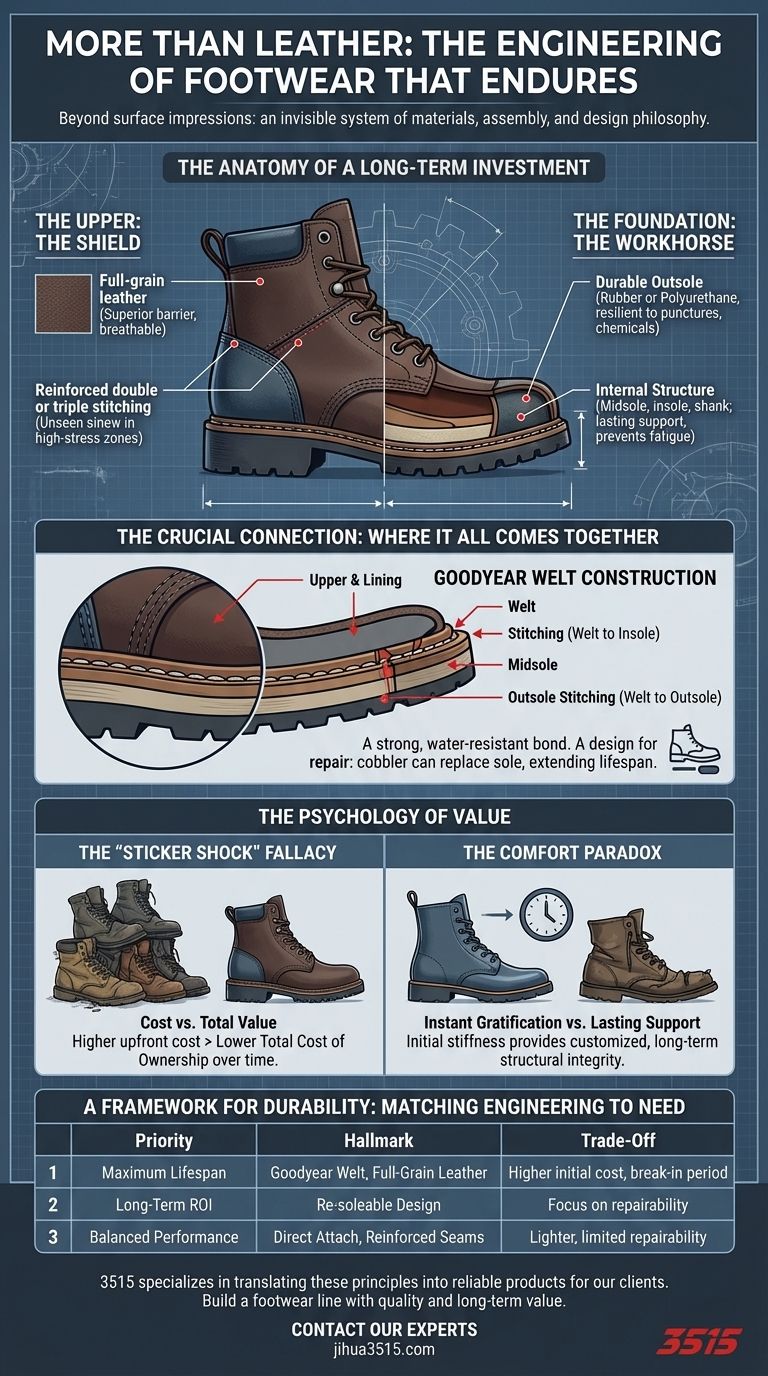
To understand what makes a boot last, we must look beyond the surface and appreciate its architecture. A boot is fundamentally two systems: the upper that shields the foot, and the sole that connects it to the world.
The Upper: More Than Just a Shell
The upper is your first line of defense, but its resilience isn't guaranteed by material alone.
Full-grain leather is the benchmark for a reason. As the strongest part of the hide, it provides a superior barrier against abrasion and water while allowing the foot to breathe. It’s a choice that signals a commitment to quality from the start.
But that leather is only as strong as its seams. Reinforced double or triple stitching, especially in high-stress zones, is the unseen sinew that prevents the boot from coming apart under load. It’s a small detail that makes a world of difference.
The Foundation: Built for a Million Steps
The sole system is the boot’s workhorse. Its longevity depends on both the material it's made from and the structure within.
A durable outsole is typically made of resilient rubber or polyurethane, compounds engineered to resist punctures, chemicals, and slips. The internal structure—the midsole, insole, and shank—provides the critical support that prevents fatigue. In a well-made boot, this structure is designed to retain its shape for years, not compress into a useless wafer after a few months.
The Crucial Connection: Where It All Comes Together
The single most important factor in a boot's lifespan is how the upper is attached to the sole. This is where true craftsmanship reveals itself.
The gold standard is the Goodyear welt construction. This method involves stitching a strip of leather (the welt) to both the upper and the sole, creating an exceptionally strong and water-resistant bond.
More importantly, it’s a design for repair. A Goodyear welt allows a cobbler to detach and replace the entire sole without destroying the upper. It transforms the boot from a disposable item into a long-term, serviceable piece of equipment. It is, in its own way, an act of engineering romance—building something not just to last, but to be renewed.
The Psychology of a Smart Decision
Choosing the most durable footwear requires overcoming common psychological biases about cost and comfort.
The "Sticker Shock" Fallacy: Cost vs. Total Value
Durable boots with superior construction have a higher upfront cost. This initial price can trigger a bias toward cheaper, seemingly "good enough" alternatives.
However, this is a fallacy of short-term thinking. A single, re-soleable $200 boot that lasts five years is far more economical than buying a new $70 cemented boot every year. The true measure is the total cost of ownership, and in that metric, quality always wins.
The Comfort Paradox: Instant Gratification vs. Lasting Support
The toughest boots often require a "break-in" period. They can feel stiff at first. Lighter, cemented boots feel flexible and comfortable right out of the box.
This presents a paradox. The initial stiffness of a full-grain leather boot is the very quality that allows it to mold perfectly to your foot over time, providing customized support. The instant comfort of a lesser boot often comes from materials that lack structural integrity and will quickly break down, offering neither comfort nor protection in the long run.
A Framework for Durability
Making the right choice is about aligning the boot's engineering with your primary needs.
| Your Priority | Engineering Hallmark to Look For | The Trade-Off You're Accepting |
|---|---|---|
| Maximum Lifespan | Goodyear Welt Construction, Full-Grain Leather Upper | Higher initial cost, requires a break-in period. |
| Long-Term ROI | A Re-soleable Design (Goodyear Welt is the standard) | Focus shifts from initial price to repairability. |
| Balanced Performance | High-Quality Direct Attach, Reinforced Seams, Premium Sole | Often lighter weight, but with limited repairability. |
This philosophy of engineered durability is the core principle behind intelligent footwear manufacturing. For distributors, brand owners, and bulk clients, providing products built on these foundations isn't just about selling a boot; it's about delivering predictable, long-term value and safety.
As a large-scale manufacturer of a comprehensive range of footwear, 3515 specializes in translating these principles of robust construction into reliable products for our clients. To build a footwear line that embodies this level of quality and long-term value, Contact Our Experts.
Visual Guide
Related Products
- Premium Wholesale Tactical Style Safety Shoes Boots with Quick Lacing
- High Performance Fire-Retardant Waterproof Safety Boots
- Premium Waterproof High-Cut Industrial Safety Boots for Wholesale and Bulk Orders
- Durable Leather Work Boots for Wholesale & Custom Manufacturing
- Durable Leather Work Boots for Wholesale & Custom OEM Manufacturing
Related Articles
- How Industrial Professionals Can Balance Safety Boot Requirements with Professional Appearance
- How to Choose Safety Boots That Reduce Fatigue Without Sacrificing Protection
- The Lacing Paradox: Why the Safest Boots Contain Their Own Greatest Risk
- The Anatomy of Trust: A Systems Approach to Workplace Foot Protection
- Why Your Certified Safety Boots Are Failing Your Team—And How to Fix It



















