The Illusion of Safety
A logistics manager watches a warehouse operator quickly pivot to grab a falling box. The operator is successful, but their ankle rolls slightly on the smooth concrete floor. They're wearing safety trainers—lightweight, comfortable, and equipped with a certified steel toecap.
The box is saved, no one is hurt. But the manager sees the hidden risk: the shoe protected the operator's toes from a potential impact, but it did nothing to prevent the joint injury that was narrowly avoided.
This small, everyday event reveals a deep truth about workplace safety. The choice between a safety trainer and a safety boot isn't just about comfort; it's a profound decision about the type of risk you are engineering your safety system to prevent.
A Tale of Two Philosophies: Agility vs. Fortification
Every piece of equipment is the physical manifestation of a philosophy. Safety footwear is no different. It solves a specific problem. The critical mistake is applying the wrong solution to the wrong problem.
The Psychology of a Safety Trainer
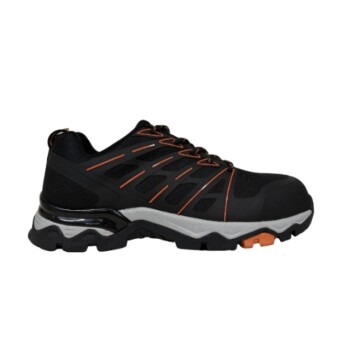
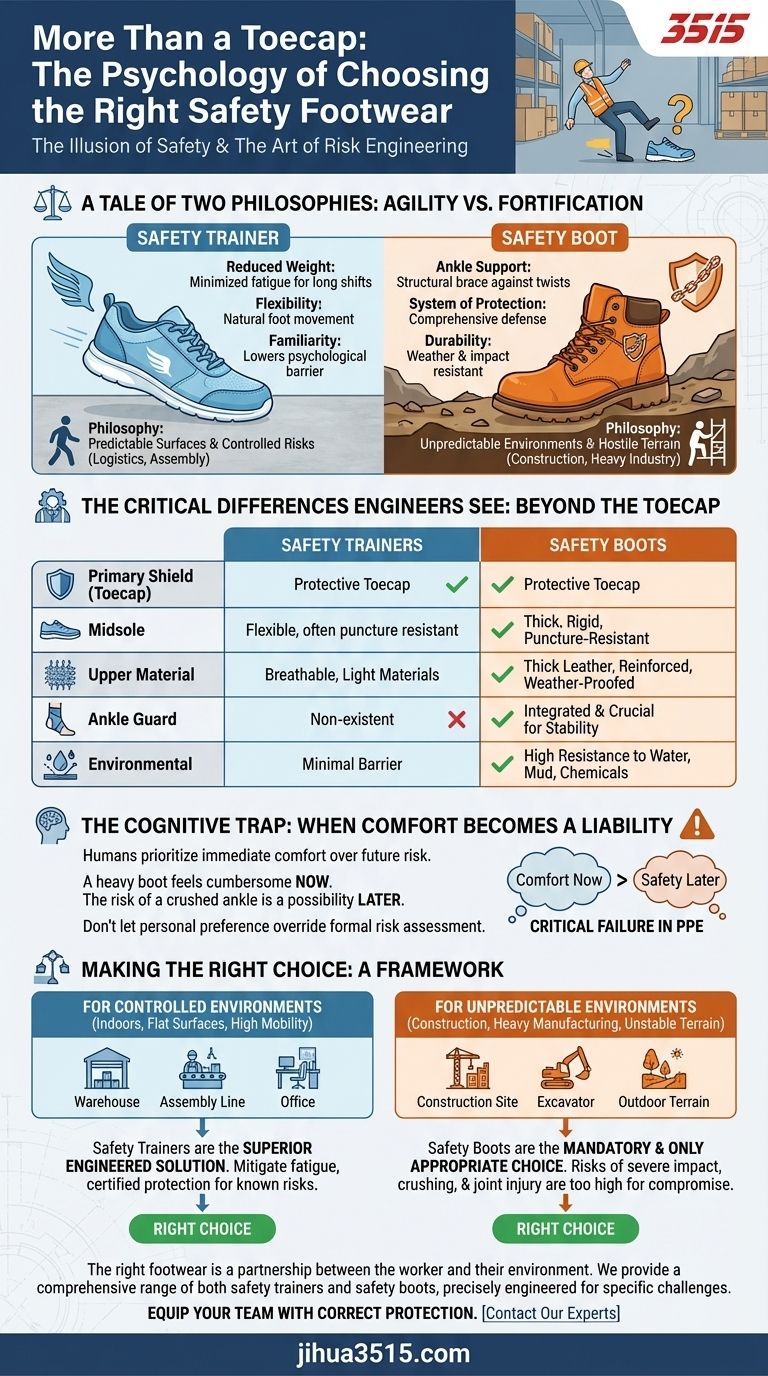
Safety trainers are designed for a world of predictable surfaces and controlled risks. They are built on the premise that fatigue is a primary hazard.
Their engineering prioritizes:
- Reduced Weight: Minimizing the energy expended with every step over a ten-hour shift.
- Flexibility: Allowing the foot to move naturally, reducing strain.
- Familiarity: They look and feel like a normal shoe, which lowers the psychological barrier to wearing them consistently.
They are the perfect solution for environments like logistics centers, light assembly lines, and automotive workshops, where the primary dangers are well-defined: impacts to the toe and slips on a level surface.
The Mindset of a Safety Boot
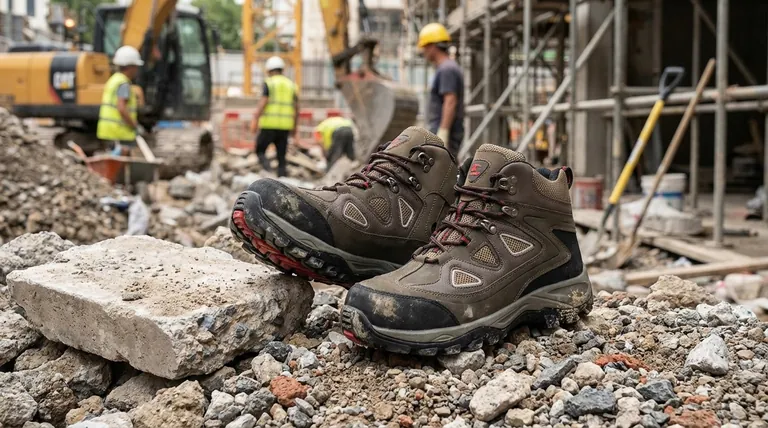
Safety boots are built for the unknown. They operate on the assumption that the environment is unpredictable and potentially hostile.
Their design is a conscious trade-off, sacrificing some flexibility and lightness for a comprehensive defense system. They are for construction sites, heavy industry, and outdoor terrain where hazards are varied and severe. A boot is a statement that you are prepared for what you can't see coming.
The Critical Differences Engineers See
While both might share a safety rating on paper, their construction tells a different story. The difference is not in degree, but in kind.
Ankle Support: The Forgotten Stabilizer
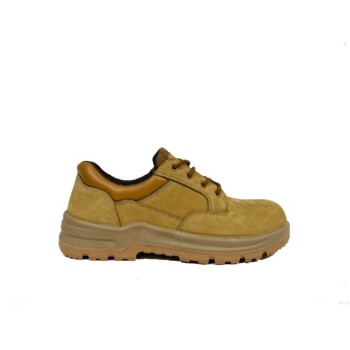
This is the most glaring structural difference. A safety trainer, by design, offers almost no ankle support. This is an intentional choice for maximizing freedom of movement on flat, stable floors.
A safety boot's high-cut design is a structural brace. It's engineered to resist the torsional forces that cause sprains and fractures on uneven ground, scaffolding, or during a slip or fall. It's a critical stabilizer in a dynamic environment.
The System of Protection: Beyond the Toecap
A protective toecap is a single component. A safety boot is a system.
| Feature | Safety Trainers | Safety Boots |
|---|---|---|
| Primary Shield | Protective Toecap | An entire protective system |
| Midsole | Often flexible, may have puncture resistance | Thick, rigid, and puncture-resistant |
| Upper Material | Breathable fabrics, light synthetic materials | Thick leather, reinforced, weather-proofed |
| Ankle Guard | Non-existent | Integrated and crucial for stability |
| Environmental | Minimal barrier to liquids or debris | High resistance to water, mud, and chemicals |
The danger lies in assuming the presence of one feature (the toecap) implies the existence of the entire system.
The Cognitive Trap: When Comfort Becomes a Liability
Humans are wired to prioritize immediate, tangible comfort over abstract, future risk. A heavy boot feels cumbersome now. The risk of a crushed ankle is a statistical possibility later.
This is the cognitive trap. Choosing footwear based on the comfort of walking across a flat office floor, rather than the reality of the work site, creates a critical failure in personal protective equipment (PPE).
The most dangerous belief is a false sense of security. A safety trainer is not a "more comfortable safety boot." It is a different tool for a different job. Deferring to a formal risk assessment, not personal preference, is the only rational approach.
Making the Right Choice: A Framework
Your decision must be dictated by the non-negotiable hazards of the job.
For Controlled Environments
If your team works indoors, on flat surfaces, and requires high mobility—think logistics, assembly, or client-facing technical roles—safety trainers are the superior engineered solution. They mitigate fatigue while providing the necessary, certified protection for the known risks of that environment.
For Unpredictable Environments
If your team works on construction sites, in heavy manufacturing, or on any unstable terrain, safety boots are the mandatory and only appropriate choice. The risks of severe impact, crushing forces, and joint injury are too high to justify any compromise.
The right footwear is a partnership between the worker and their environment, engineered to keep them safe and productive.
As a large-scale manufacturer, we produce a comprehensive range of both safety trainers and safety boots, understanding that each is a precise solution for a specific set of challenges. We help distributors, brand owners, and bulk clients equip their teams with footwear that is not just compliant, but correctly engineered for the task at hand. To ensure your team has the right protection for their specific risk profile, Contact Our Experts.
Visual Guide
Related Products
- Premium Suede Sport Safety Shoes for Wholesale & Bulk Orders
- Premium Lightweight Safety Shoes for Wholesale & Bulk Orders
- Wholesale Anti-Smash & Puncture-Proof Safety Shoes Custom Manufacturing for Brands
- Premium KPU Injection Athletic Style Safety Shoes
- Premium Safety Shoes with Rotating Buckle Safety Sneakers
Related Articles
- The Ghost in the Machine: Why an Obsolete Footwear Standard Creates Modern Risk
- Beyond the Steel Toe: The Hidden Ergonomics of Workplace Safety
- Why Traditional Laces Are a Hidden Safety Risk—And What to Do About It
- The True Cost of Skipping Safety Shoes: Long-Term Risks and Smart Protection
- How Safety Shoe Engineering Prevents Workplace Injuries Across Industries