You’ve made a significant investment to equip your personnel with new, high-quality tactical boots. You expect them to enhance performance and safety. Yet, within a week, you're dealing with an entirely different reality: team members are on light duty, morale is down, and the mission is compromised. The culprit isn't a lack of training or a difficult assignment. It's blisters, hot spots, and crippling foot pain caused by the boots themselves.
The Common Struggle: A Cycle of Wasted Time and Unnecessary Risk
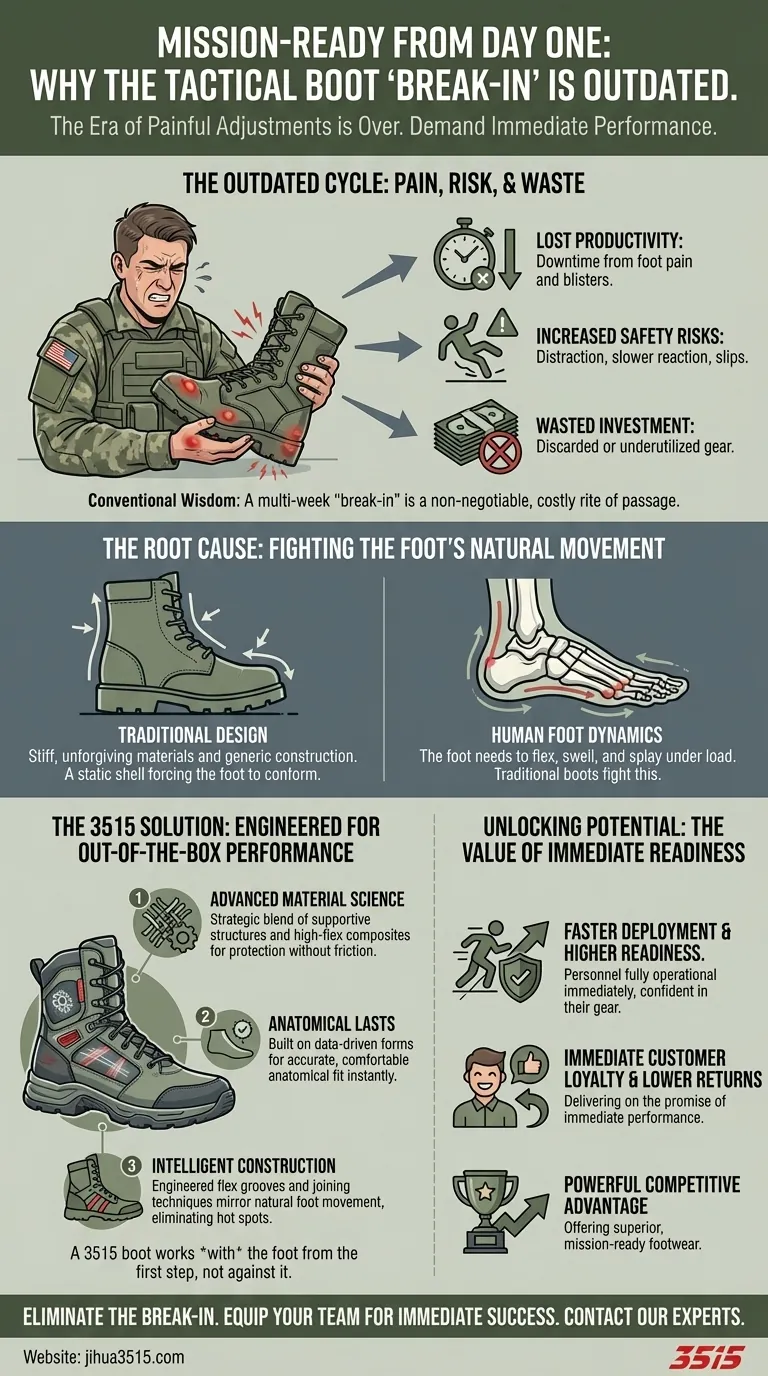
This scenario is frustratingly common. The conventional wisdom is that a painful, multi-week "break-in" period is a non-negotiable rite of passage. So we tell our teams to follow the script: wear the boots around the house, take them on short walks, and patiently endure the discomfort, hoping the stiff materials will eventually yield.
Organizations accept this process as a necessary evil, but the hidden costs are substantial:
- Lost Productivity: Every hour a team member spends dealing with foot pain or nursing blisters is an hour they aren't fully operational. This translates directly to project delays and reduced efficiency.
- Increased Safety Risks: An operator distracted by foot pain is less focused, has slower reaction times, and is more susceptible to slips, trips, and falls. In critical situations, this is an unacceptable liability.
- Wasted Investment: If a boot never properly molds to the user's foot, it will be discarded or underutilized. For bulk purchasers, even a small percentage of these failures represents a significant financial loss and a logistical headache.
We've been taught to manage the symptoms—with special socks, moleskin, and lacing tricks—without ever asking the fundamental question: why should a critical piece of equipment require such a painful adjustment period in the first place?
The Root of the Problem: It’s Not the Feet, It’s the Footwear's Philosophy
The need for a brutal break-in period isn't a feature; it's a flaw. It stems from an outdated approach to footwear manufacturing that relies on rigid, unforgiving materials and generic construction methods.
The core of the issue is a fundamental conflict: the boot is built as a static, stiff shell, and the "break-in" is the slow, painful process of your foot forcing that shell to conform. Traditional heavy leather and inflexible synthetic materials fight against the natural mechanics of the foot—flexing, swelling, and splaying under load.
This is why the common "solutions" are merely coping mechanisms. They don't address the underlying problem that the boot was not designed for the human foot's dynamic reality from the start. You're not breaking in the boot; you're simply enduring a design flaw.
The Solution Embodied: Engineering for Out-of-the-Box Performance
To truly solve this problem, you don't need better break-in techniques. You need a better boot, built from a modern manufacturing philosophy. The goal should be to create footwear that works with the foot from the very first step, not against it.
This is the principle that guides our production at 3515. As a large-scale manufacturer, we have moved beyond the "one-size-fits-all" mentality and leverage advanced engineering to minimize or eliminate the break-in period. This is achieved by directly addressing the root causes of discomfort:
- Advanced Material Science: We utilize a strategic combination of materials. Supportive structures are placed where stability is critical, while high-flexibility composites and modern treated leathers are used in key areas like the ankle and forefoot. This provides protection without creating painful friction points.
- Anatomical Lasts: Our boots are built on lasts (the molds that give shoes their shape) developed from extensive biomechanical data. This ensures a more accurate and comfortable anatomical fit from the moment the boot comes out of the box.
- Intelligent Construction: We engineer flex grooves and use joining techniques that mirror the natural movement of the foot. This prevents the bunching and pinching that cause hot spots, ensuring the boot feels less like a rigid case and more like a natural extension of the foot.
A 3515-manufactured boot isn't just an accessory; it's a piece of performance equipment, engineered to be ready when your team is.
Beyond the Fix: What Immediate Readiness Unlocks
When you eliminate the break-in period as an operational hurdle, you unlock significant new potential for your organization.
This isn't just about comfort; it's about capability. It means your teams can be deployed faster and more confidently after receiving new gear. It means higher operational readiness, with fewer personnel sidelined by preventable equipment issues. For brand owners and distributors, it means delivering a product that earns immediate customer loyalty and boasts a dramatically lower rate of return. You gain a powerful competitive advantage by offering a boot that delivers on its promise of performance from day one.
The era of choosing between durability and out-of-the-box comfort is over. Your organization deserves equipment that enhances performance, rather than hindering it. Stop accepting the break-in period as a necessary cost of doing business and start demanding footwear that is ready to perform when you are. If you are a distributor, brand owner, or bulk client looking to equip your users with superior, mission-ready footwear, let's discuss how our manufacturing expertise can solve your challenges. Contact Our Experts.
Visual Guide
Related Products
- Durable Leather Tactical Boots Wholesale & Custom Manufacturing for Brands
- High-Traction Suede Tactical Boots Wholesale & Custom Manufacturing
- Durable Leather High-Ankle Tactical Boots for Wholesale & Custom Manufacturing
- Durable Mid-Cut Tactical Boots for Wholesale & Private Label
- Wholesale Waterproof Tactical Boots Custom Suede & High-Traction Soles
Related Articles
- Why Your Tactical Boots Wear Out So Fast—And the Procurement Mistake Behind It
- The Agility-Protection Paradox: Deconstructing Safety in Modern Tactical Footwear
- Why Your Tactical Boots Keep Failing—And Why 'Tougher' Isn't the Answer
- How Tactical Boots Deliver Long-Term Value: A Cost & Performance Breakdown
- The Procurement Officer's Gamble: Why 'Tough Enough' Isn't Good Enough for Tactical Boots













