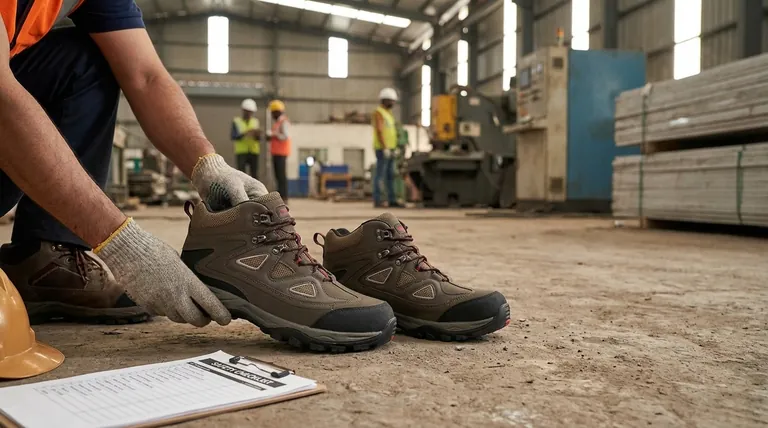
The Illusion of the Checkbox
There is a powerful and dangerous cognitive bias in workplace safety: the checkbox mentality. A manager sources and distributes ASTM-certified safety boots to the team. A box is ticked. The legal obligation, it seems, has been met.
But the boot itself is not the solution. It is merely the tangible output of a complex, living system. When that system fails, a steel-toed boot is just a piece of leather and metal that offers a false sense of security. The real work is not in the purchase, but in the architecture and maintenance of the program that surrounds it.
This transforms the task from a simple transaction into an ongoing commitment to systemic integrity.
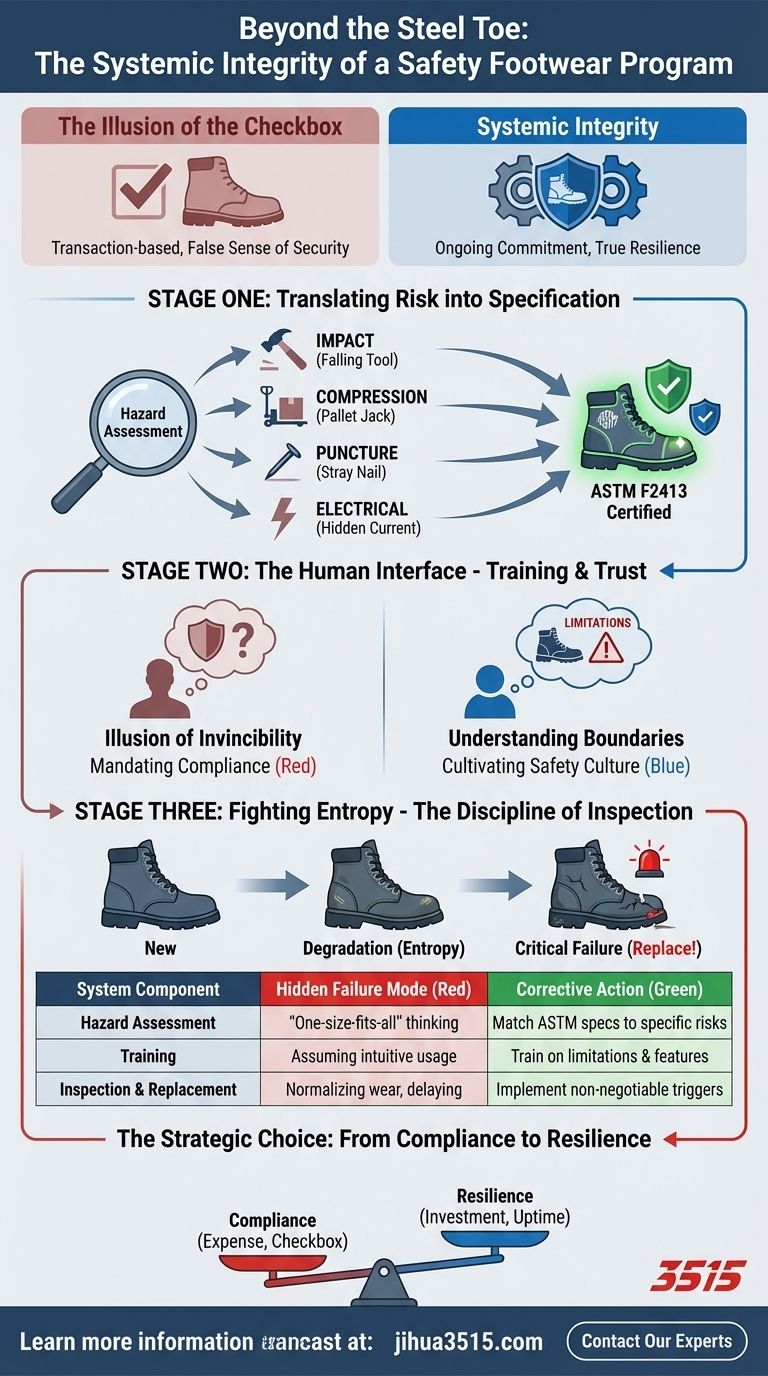
Stage One: Translating Risk into Specification
The foundation of any safety program is built on a single, critical act: translating the abstract dangers of a workplace into concrete engineering specifications. It's an act of profound diligence.
A thorough hazard assessment isn't just a walk-through. It’s a systematic process of identifying the specific kinetic and environmental forces your employees face.
- Impact: A falling tool from scaffolding.
- Compression: A slow-moving pallet jack.
- Puncture: A stray nail on a construction site.
- Electrical Hazard: A hidden current in a flooded basement.
Providing a puncture-resistant boot to an electrician worried about shock is as negligent as providing no boot at all. The assessment directly dictates the required ASTM F2413 certification markings. This isn't about buying "safety shoes"; it's about procuring a precisely specified tool for a well-defined problem.
Stage Two: The Human Interface - Training and Trust
Once the correct equipment is selected, the responsibility shifts from the technical to the human. Handing an employee a boot is not the same as protecting them.
Effective training is about managing expectations and dismantling the illusion of invincibility. It must explain what the footwear protects against and, just as importantly, what it does not. An employee who understands their boot’s limitations is far safer than one who believes it makes them indestructible.
This is about building trust in the equipment by being honest about its boundaries. It’s the difference between mandating compliance and cultivating a genuine safety culture.
Stage Three: Fighting Entropy - The Discipline of Inspection
In any engineered system, entropy is a constant adversary. Protective footwear degrades. It is exposed to abrasion, moisture, chemicals, and acute impacts. A program is only as strong as its protocol for managing this decay.
This is where most programs reveal their weakness. A small crack in a sole or an exposed steel toe is not a minor defect; it is a critical system failure. Yet, the psychological pull to "get a little more use out of it" is strong. The immediate, tangible cost of a new pair of boots often outweighs the abstract, probabilistic risk of an accident.
A resilient program creates a disciplined, non-negotiable system to counter this bias.
| System Component | The Hidden Failure Mode | The Corrective Action |
|---|---|---|
| Hazard Assessment | "One-size-fits-all" thinking; ignoring secondary hazards. | Match ASTM specs to specific, documented risks. |
| Training | Assuming usage is intuitive; creating a false sense of security. | Train on limitations as much as on features. |
| Inspection & Replacement | Normalizing wear and tear; delaying replacement to save cost. | Implement non-negotiable replacement triggers. |
Footwear that has sustained a significant impact must be replaced, even if there is no visible damage. Its structural integrity is compromised. Allowing an employee to continue using it is a catastrophic failure of the system.
The Strategic Choice: From Compliance to Resilience
Ultimately, an organization must decide what its safety footwear program is for. Is it to simply satisfy a legal requirement, or is it to build genuine operational resilience?
Viewing safety footwear as a recurring expense leads to checkbox thinking and cost-cutting that elevates risk. Viewing it as an investment in your people and your uptime changes the entire equation. A single serious injury can cost orders of magnitude more than a decade’s worth of properly managed footwear replacements.
This strategic choice extends to your supply chain. A truly resilient program requires a manufacturing partner who can reliably deliver durable, certified footwear tailored to the specific risks you've identified. It requires a partner who understands that they aren't just shipping products; they are providing a critical component for a larger safety system. As a large-scale producer of a comprehensive range of footwear, we at 3515 specialize in providing the dependable, certified equipment that forms the backbone of a world-class safety program.
Building a robust safety culture is a commitment to seeing beyond the obvious. If you are ready to move from simple compliance to true resilience, Contact Our Experts.
Visual Guide
Related Products
- Premium Suede Sport Safety Shoes for Wholesale & Bulk Orders
- Premium Lightweight Safety Shoes for Wholesale & Bulk Orders
- Wholesale Anti-Smash & Puncture-Proof Safety Shoes Custom Manufacturing for Brands
- Premium KPU Injection Athletic Style Safety Shoes
- Premium Safety Shoes with Rotating Buckle Safety Sneakers
Related Articles
- The Ghost in the Machine: Why an Obsolete Footwear Standard Creates Modern Risk
- Beyond the Steel Toe: The Hidden Ergonomics of Workplace Safety
- Why Traditional Laces Are a Hidden Safety Risk—And What to Do About It
- The True Cost of Skipping Safety Shoes: Long-Term Risks and Smart Protection
- How Safety Shoe Engineering Prevents Workplace Injuries Across Industries