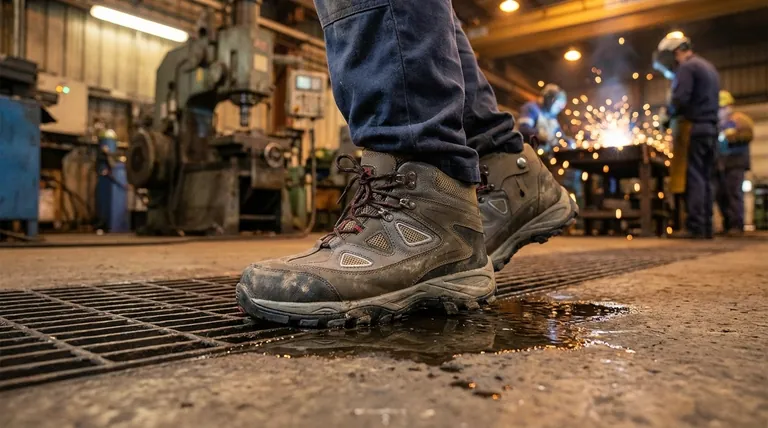
The Last Three Feet of Your Safety System
In a bustling manufacturing facility, the safety program is a complex network of systems: machine guards, emergency stops, ventilation, and operational protocols. Yet, all these large-scale protections converge at a single point: the interface between the worker and their environment.
Often, that final interface is the sole of their shoe.
We tend to think of safety shoes in simple terms—a steel cap that stops a falling hammer. But this view misses the point. A safety shoe is not a single feature; it is an engineered system designed to solve a multi-faceted problem. The real challenge isn’t just preventing an accident, but doing so in a way that acknowledges human psychology and behavior.
Deconstructing the Environment, Not Just the Shoe
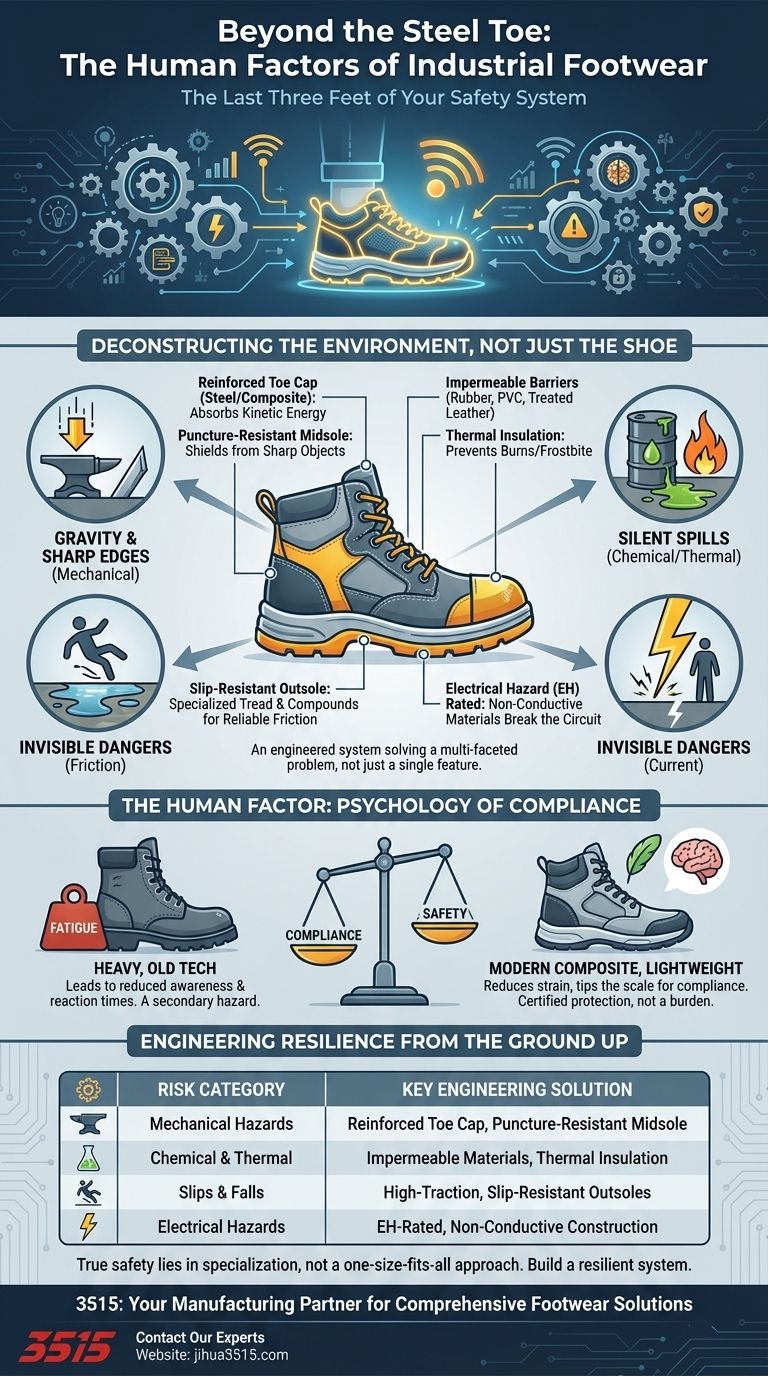
To understand protective footwear, we must first understand the ecosystem of hazards on the factory floor. Each risk demands a specific engineering solution.
The Obvious Threat: Gravity and Sharp Edges
The classic image of industrial danger is a heavy object falling or a sharp piece of scrap metal on the ground. This is the domain of mechanical protection.
-
Impact Resistance: The reinforced toe cap (steel or composite) is the primary defense. It’s designed to absorb and distribute the kinetic energy of a falling object, preventing a crushing injury that could be life-altering.
-
Puncture Resistance: A puncture-resistant midsole acts as a shield for the bottom of the foot. It’s the unsung hero that stops a nail or metal shard from turning a simple misstep into a serious wound and a potential site for infection.
The Silent Spills: Chemical and Thermal Risks
Not all dangers make a loud noise. A slow leak from a chemical drum or the ambient temperature of a foundry presents a constant, passive threat.
Here, the shoe’s material science is critical. Boots made from rubber, PVC, or specially treated leathers create an impermeable barrier against corrosive acids and solvents. In environments of extreme heat or cold, thermal insulation isn't a luxury; it's a necessity that prevents severe burns or frostbite.
The Invisible Dangers: Friction and Current
Some of the most frequent and debilitating industrial accidents are the most mundane: slips, trips, and falls.
Our brains are surprisingly poor at risk assessment. We often underestimate the danger of a slightly damp or oily floor because we navigate similar surfaces daily. A slip-resistant outsole, with its specialized tread patterns and material compounds, is an engineering solution to a cognitive bias. It provides the reliable friction our minds falsely assume is already there.
For electricians and maintenance crews, the floor itself can become part of a live circuit. Electrical Hazard (EH) rated footwear uses non-conductive materials to insulate the worker, effectively breaking the circuit and mitigating the risk of electrocution.
The Human Factor: The Psychology of Compliance
The most technically advanced safety shoe is useless if it stays in the locker. The decision to wear—or not wear—protective gear is a daily psychological calculation.
The Comfort vs. Protection Paradox
A heavy steel-toed boot offers incredible protection, but over a ten-hour shift, its weight contributes to fatigue. Fatigue reduces awareness, slows reaction times, and can lead to musculoskeletal strain. It becomes a secondary hazard.
This is why modern composite materials are so significant. They offer certified protection at a fraction of the weight, tipping the psychological scale in favor of compliance. The most effective safety feature is the one that isn't a burden to use.
The Fallacy of a "One-Size-Fits-All" Solution
Selecting footwear requires identifying the primary hazard. A boot designed for maximum chemical resistance may be stiff and lack breathability, making it a poor choice for a worker who spends their day walking miles on a concrete assembly floor.
Attempting to find one shoe for all jobs leads to compromises that satisfy no one. True safety lies in specialization.
Engineering Resilience from the Ground Up
Choosing the right safety footwear is a strategic decision about risk mitigation. It requires a clear understanding of the specific hazards your team faces daily. The goal is to create a seamless link between the identified risk and the engineered solution.
| Risk Category | Key Engineering Solution |
|---|---|
| Mechanical Hazards | Reinforced Toe Cap (Steel/Composite), Puncture-Resistant Midsole |
| Chemical & Thermal | Impermeable Materials (Rubber, PVC), Thermal Insulation |
| Slips & Falls | High-Traction, Slip-Resistant Outsoles |
| Electrical Hazards | EH-Rated, Non-Conductive Construction |
This level of specialization demands a manufacturing partner with deep expertise across the full spectrum of protective footwear. As a large-scale manufacturer, 3515 builds comprehensive footwear solutions for distributors and brand owners, engineered to meet the precise safety standards required for any industrial environment. Our capabilities cover every category of risk, ensuring your team has the exact tool for the job.
Protecting your workforce is about building a resilient safety system, starting from the ground up. Contact Our Experts
Visual Guide
Related Products
- Premium Wholesale Waterproof Safety Boots High Performance Protection for Industrial Markets
- Premium Waterproof High-Cut Industrial Safety Boots for Wholesale and Bulk Orders
- Puncture-Resistant Velcro Safety Boots for Wholesale & Custom Manufacturing
- Wholesale Mesh Steel Toe Safety Shoes with Dial Closure Factory Production
- Premium Wholesale Tactical Style Safety Shoes Boots with Quick Lacing
Related Articles
- The Anatomy of Trust: A Systems Approach to Workplace Foot Protection
- How Waterproof Boots Shield Police Officers from Chronic Foot Damage and Boost Tactical Efficiency
- How to Choose Waterproof Boots That Actually Work for Your Needs
- The Lacing Paradox: Why the Safest Boots Contain Their Own Greatest Risk
- How to Choose Safety Boots That Reduce Fatigue Without Sacrificing Protection