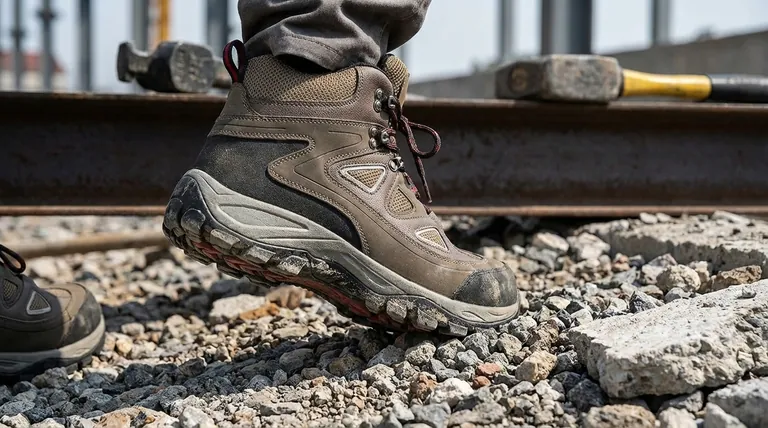
The Critical Interface
Your feet are not just what you stand on; they are the critical interface between you and your work environment. For a logistics operator, they are the source of stability across ten miles of polished concrete. For a lineman, the anchor on a wooden pole. For a construction worker, the first line of defense against the chaos of a job site.
We often think of safety footwear in terms of single, dramatic events—a dropped beam, a live wire, a stray nail. But the most significant risks are often silent and cumulative. The slow wear of fatigue from poor shock absorption. The distraction of a painful blister from an improper fit. The long-term joint damage from inadequate support.
The best safety footwear is not just a shield. It is a high-performance system designed to mitigate both the sudden and the slow-acting hazards of a workday.
The Non-Negotiable Foundation: Wearability
Before any protective feature matters, a boot must be wearable. If it's painful, ill-fitting, or exhausting to wear, its protective qualities become theoretical. The most common reason workers abandon their safety footwear isn't a lack of protection, but a lack of comfort.
A Poor Fit is an Active Hazard
An improper fit isn't a matter of preference; it's a safety failure.
- Too Loose: A boot that is too loose allows the foot to shift, creating friction that leads to blisters. More dangerously, it creates instability, turning a simple misstep into a sprain or fall.
- Too Tight: A boot that is too tight restricts blood flow and can cause nerve compression, leading to numbness and long-term foot ailments. The constant, distracting pain also diminishes focus on the task at hand.
Proper fit is the prerequisite for all other safety features to function.
The War Against Gravity and Fatigue
Every step on a hard surface sends a shockwave up your kinetic chain—through your ankles, knees, hips, and lower back. Over the course of a shift, this adds up to significant physical stress.
Quality footwear acts as a suspension system. Good arch and ankle support maintain proper body alignment, while cushioned insoles and midsoles absorb impact. This isn't about luxury; it's about conserving energy. Less fatigue means greater situational awareness and a lower probability of human error in the final hours of a long day.
The Anatomy of Direct Protection
Once the foundation of wearability is established, the focus shifts to shielding the wearer from specific, identifiable workplace hazards.
Shielding Against Impact
The protective toe cap is the most iconic feature of safety footwear. It creates a zone of confidence around the most vulnerable part of the foot, guarding against crushing and impact forces. The choice of material is a critical engineering decision:
- Steel: The traditional standard, offering maximum protection.
- Aluminum Alloy: Lighter than steel, reducing fatigue.
- Composite: Non-metallic and lightweight, ideal for environments where conductivity is a concern.
Mastering the Surface
Slips, trips, and falls are a leading cause of workplace injury. A slip-resistant outsole is engineered to maintain grip on unpredictable surfaces. Much like a car tire, its tread pattern is designed to channel water, oil, and other contaminants away from the point of contact, maximizing the surface area available for traction.
Defending from Below
For environments littered with sharp objects—construction sites, scrap yards, demolition zones—the threat comes from below. A puncture-resistant plate, made of steel or flexible composite fabrics, is integrated into the midsole. It turns the sole of the boot into a barrier against unseen threats.
Adapting to Specialized Environments
Beyond the common hazards, many jobs require protection against invisible or environmental forces.
Navigating Invisible Forces
Electricity presents a dual threat, and footwear is engineered to handle both sides of the equation.
- Electrical Hazard (EH): EH-rated footwear features non-conductive soles, insulating the wearer from the ground to protect against accidental contact with live circuits.
- Antistatic/ESD: In environments with sensitive electronics or explosive atmospheres, Electro-Static Dissipative (ESD) footwear does the opposite. It safely discharges the body's static electricity to the ground, protecting the environment from the wearer.
The Battle with the Elements
For outdoor and wet-condition work, a boot must manage moisture from both the outside and the inside. A waterproof membrane keeps water out, but it must also be breathable. Without breathability, sweat vapor becomes trapped, creating a damp internal microclimate that can lead to blisters and discomfort.
The Inescapable Economics of Choice
Selecting the right footwear is an exercise in balancing engineering trade-offs. Understanding these helps organizations make smarter investments in their team's safety and performance.
| Priority | The Trade-Off | The Insight |
|---|---|---|
| Protection vs. Energy | Heavier materials like steel offer more protection but increase the energy required for every step. | Match the protection level to the actual risk. Over-protection can be counterproductive if it leads to premature fatigue. |
| Waterproofing vs. Breathability | The most robust waterproof barriers can limit airflow, making boots hot in dry conditions. | Assess the environment honestly. A water-resistant, highly breathable boot is often better for occasional exposure than a fully waterproof one. |
| Initial Cost vs. Long-Term Value | High-quality materials and construction methods cost more upfront. | A durable, well-made boot lasts longer and provides more consistent protection. It often has a lower total cost of ownership by reducing replacement frequency and, more importantly, the risk of injury. |
A Systems Approach to Selection
The right safety footwear is not determined by a job title but by a thorough hazard assessment. A large workforce rarely faces a single, uniform set of risks. An electrician, a forklift operator, and a loading dock supervisor working for the same company need fundamentally different solutions.
This requires a portfolio approach. The goal is to equip every team member with footwear optimized for their specific daily reality. Managing this complexity is a significant challenge for distributors and large organizations. The solution lies in partnering with a manufacturer capable of producing the entire spectrum of safety footwear—from heavy-duty, puncture-resistant boots to lightweight, static-dissipative shoes.
As a large-scale manufacturer, 3515 produces a comprehensive range of footwear for distributors, brand owners, and bulk clients. Our capabilities cover every type of shoe and boot, ensuring we can engineer the precise solution for any given hazard. We build footwear that is not just a shield, but a tool for a safer, more productive workday.
To equip your team with the right protection, built on a foundation of performance and wearability, Contact Our Experts.
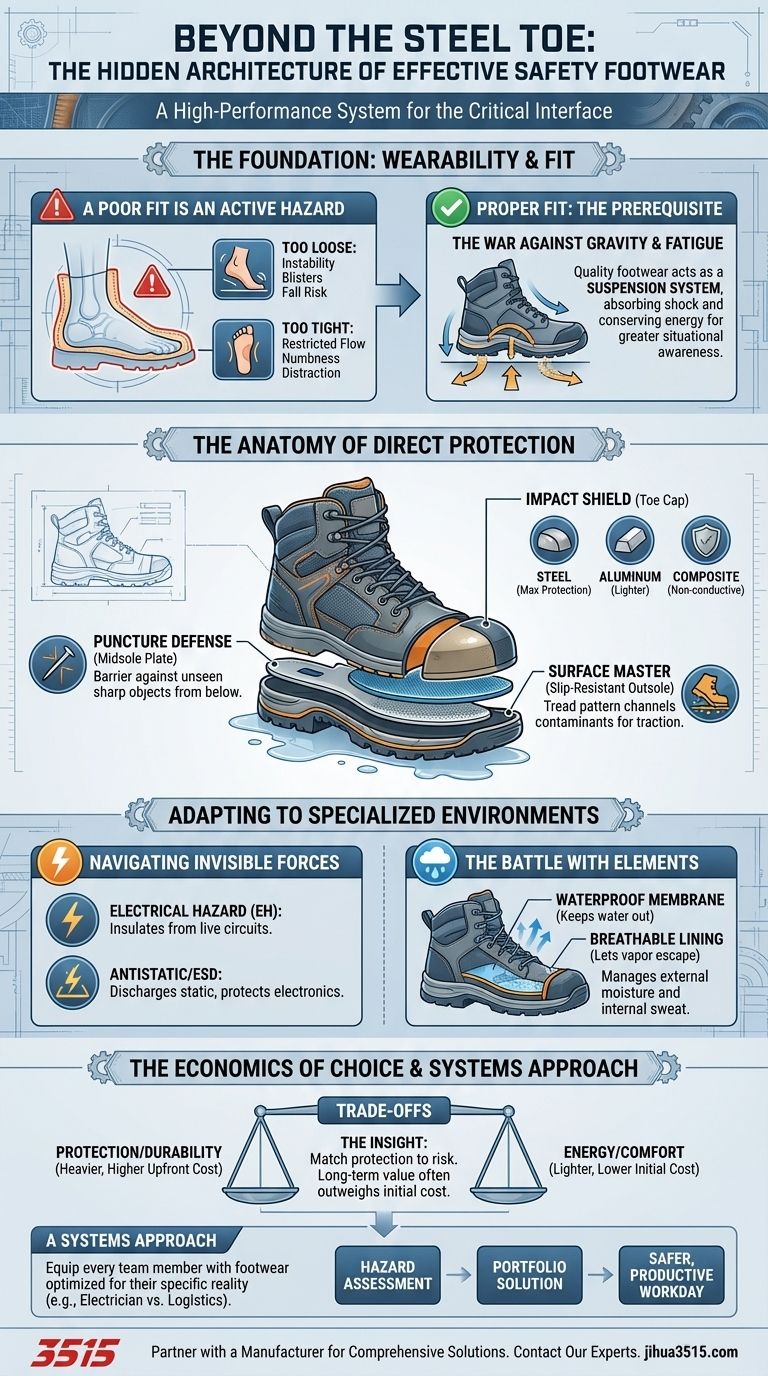
Visual Guide
Related Products
- Premium Suede Sport Safety Shoes for Wholesale & Bulk Orders
- Premium Lightweight Safety Shoes for Wholesale & Bulk Orders
- Wholesale Anti-Smash & Puncture-Proof Safety Shoes Custom Manufacturing for Brands
- Premium KPU Injection Athletic Style Safety Shoes
- Premium Safety Shoes with Rotating Buckle Safety Sneakers
Related Articles
- The Ghost in the Machine: Why an Obsolete Footwear Standard Creates Modern Risk
- Beyond the Steel Toe: The Hidden Ergonomics of Workplace Safety
- Why Traditional Laces Are a Hidden Safety Risk—And What to Do About It
- The True Cost of Skipping Safety Shoes: Long-Term Risks and Smart Protection
- How Safety Shoe Engineering Prevents Workplace Injuries Across Industries



















