The Specification Fallacy
A manager at a busy logistics hub once decided to upgrade the safety footwear for his entire team. His logic was simple: buy the boots with the highest possible ratings for impact and puncture resistance. On paper, his team was now equipped with the safest footwear money could buy.
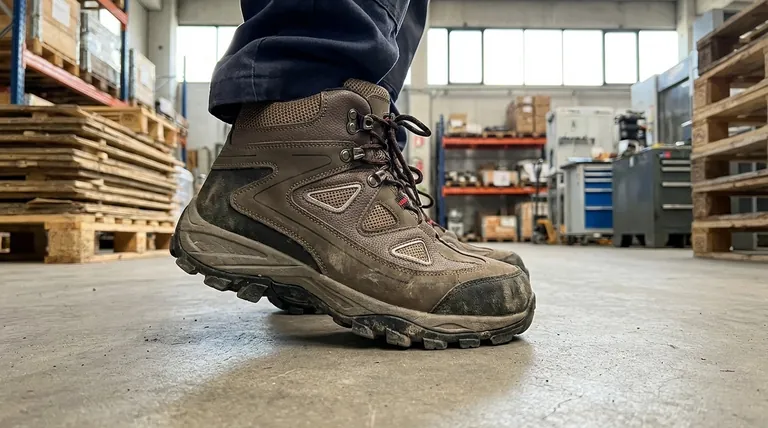
Within a month, compliance had plummeted. Workers complained of fatigue from the heavy boots. The stiff, rugged soles were overkill for the smooth concrete floors and made the 10+ miles of walking per day grueling. Some secretly switched back to their old, worn-out boots. The manager had fallen for a common cognitive trap: he focused on maximizing visible features rather than matching the tool to the specific problem.
Choosing safety footwear is a diagnostic process, not a shopping trip. The best boot isn't the one with the most features; it's the one that disappears, allowing the worker to focus on their task safely and without distraction.
Start With the Problem, Not the Product
The human brain is drawn to tangible solutions. A reinforced steel toe feels more concrete and "safe" than an abstract analysis of worksite conditions. But effective protection begins with that abstraction—a thorough hazard assessment.
Map Your Environment
Before you even think about a boot, analyze the system in which it will operate.
- Surfaces: Are you on slick concrete, uneven gravel, or metal grating? This dictates the required slip resistance and outsole design.
- Physical Threats: What are the primary dangers? The risk of a dropped engine block in a mechanic's shop is different from the risk of a stray nail on a construction site. This distinguishes the need for impact protection versus puncture resistance.
- Invisible Dangers: Is there a risk of contact with live electrical circuits? Electrical Hazard (EH) rated footwear isn't an optional add-on; it's a fundamental requirement built from non-conductive materials.
- Climate: Will the boots be subjected to extreme cold, constant water exposure, or corrosive chemicals? Material selection and construction (e.g., waterproofing, insulation) depend entirely on this context.
Deconstructing the Solution
Once the hazards are clearly defined, you can decode the engineering of the boot itself. Every component is a solution to a specific problem you've identified.
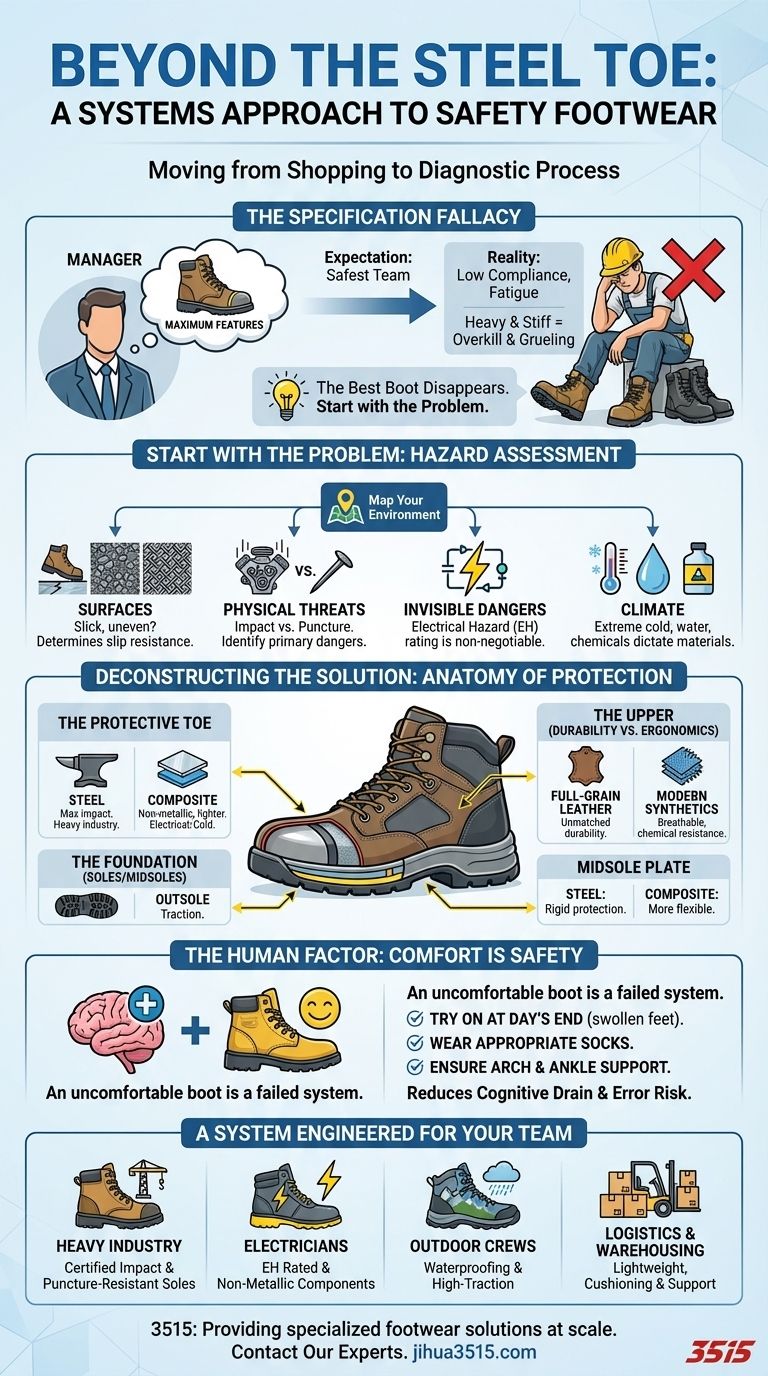
The Protective Toe: Steel vs. Composite
This is the most recognized feature, but the choice is nuanced.
| Toe Type | Key Characteristics | Best Use Case |
|---|---|---|
| Steel | Maximum impact and compression resistance. | Heavy industry, construction, environments with extreme falling object risk. |
| Composite | Non-metallic, lighter, doesn't conduct electricity or heat/cold. | Electrical work, high-security facilities, extreme temperature environments. |
The Foundation: Soles and Midsoles
The part of the boot that interfaces with the world is critical. The outsole provides traction, while a puncture-resistant midsole plate protects from threats below. A steel plate offers rigid protection, while a composite plate provides more flexibility. The right choice depends on the balance between puncture risk and the need for foot flexibility during a workday.
The Upper: Durability vs. Ergonomics
The upper material is a trade-off. Full-grain leather offers unmatched durability against abrasion, but can be heavy and less breathable. Modern synthetic materials can provide targeted chemical resistance, better breathability, and lighter weight, but may not have the same longevity in harsh physical environments.
The Human Factor: Comfort Is a Safety Feature
The most advanced safety boot is useless if it's too uncomfortable to wear correctly. An ill-fitting boot doesn't just cause blisters; it creates a constant, low-level cognitive drain.
This distraction increases the risk of error and accidents. It tempts workers to modify their PPE or abandon it altogether, negating the entire investment in their safety.
Proper fit is a non-negotiable specification. This means:
- Trying footwear on at the end of the day when feet are naturally swollen.
- Wearing work-appropriate socks to ensure an accurate fit.
- Ensuring adequate arch and ankle support to reduce fatigue over long shifts.
An uncomfortable boot is a failed system. A comfortable one integrates seamlessly with the user, becoming an extension of their ability to work safely.
A System Engineered for Your Team
There is no universal "best" safety boot. The right choice is a precisely tailored solution based on a specific diagnosis of risk and human factors.
- For heavy industry: Prioritize certified impact protection (steel toe) and puncture-resistant soles.
- For electricians: Demand Electrical Hazard (EH) ratings and non-metallic components.
- For outdoor crews: Waterproofing and high-traction, slip-resistant outsoles are paramount.
- For logistics and warehousing: Emphasize lightweight construction, cushioning, and support to combat fatigue.
Providing the correct footwear for each role across a diverse workforce is a complex logistical challenge. It requires a manufacturing partner who understands this systems-level approach—one who sees footwear not as a commodity, but as a critical piece of engineered equipment.
As a large-scale producer, 3515 has the capability to manufacture a comprehensive range of footwear designed for specific hazard profiles. We work with distributors and brand owners to build catalogs that answer the real-world needs of diverse industrial environments, ensuring every worker gets the right tool for the job.
To build a safety footwear program that is truly effective, you need a partner who can deliver specialized solutions at scale. Contact Our Experts
Visual Guide
Related Products
- Premium Suede Sport Safety Shoes for Wholesale & Bulk Orders
- Premium Lightweight Safety Shoes for Wholesale & Bulk Orders
- Wholesale Anti-Smash & Puncture-Proof Safety Shoes Custom Manufacturing for Brands
- Premium KPU Injection Athletic Style Safety Shoes
- Premium Safety Shoes with Rotating Buckle Safety Sneakers
Related Articles
- The Ghost in the Machine: Why an Obsolete Footwear Standard Creates Modern Risk
- Beyond the Steel Toe: The Hidden Ergonomics of Workplace Safety
- Why Traditional Laces Are a Hidden Safety Risk—And What to Do About It
- The True Cost of Skipping Safety Shoes: Long-Term Risks and Smart Protection
- How Safety Shoe Engineering Prevents Workplace Injuries Across Industries