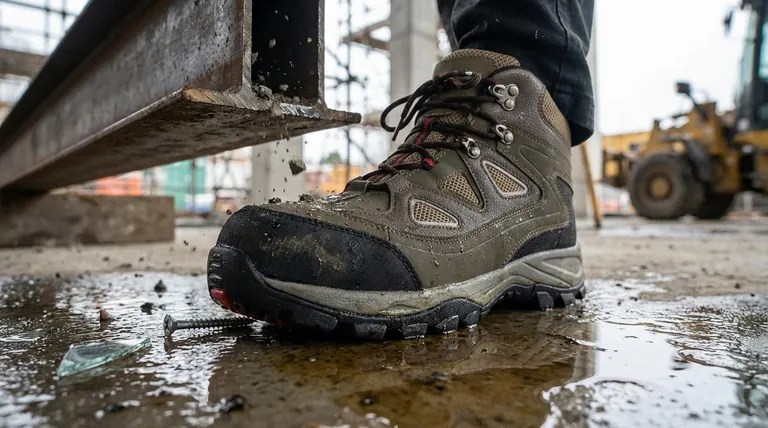
The Mental Shortcut That Puts Us at Risk
Humans are wired for efficiency. We use labels as mental shortcuts to make thousands of decisions a day. We see a "construction worker" and think "hard hat and steel-toe boots." We see a "lab technician" and think "lab coat and gloves."
This is useful, but it's also a trap.
When it comes to safety, these shortcuts fail us. The need for protective footwear is not defined by a job title, but by the specific, tangible risks present in an environment. A warehouse manager who spends their day at a desk has fundamentally different needs than the forklift operator on the concrete floor, yet they share the same workplace.
Relying on titles is a guess. A formal assessment of hazards is an engineering decision.
Deconstructing the Invisible Threats
To choose the right protection, you must first see the world through the lens of risk. The workplace is a landscape of potential energy, sharp objects, and low-friction surfaces. Each demands a specific defense.
The Physics of Gravity: Impact and Compression
The most obvious workplace hazard is gravity acting on heavy objects. It’s the sudden, brutal force of a dropped steel pipe or the relentless pressure of a rolling pallet jack.
This is a non-negotiable risk in construction, manufacturing, and logistics. The defense is a protective toe cap, engineered to withstand a specific, tested force. It’s the final barrier between a routine task and a life-altering injury.
The Hidden Dangers Underfoot: Puncture
Every step on a demolition site or in a fabrication shop is a step into the unknown. Beneath the dust and debris lie nails, metal shards, and broken glass—objects waiting to pierce a standard sole.
Puncture resistance isn't a feature you can see or feel until the moment it saves you. A specialized plate, integrated deep within the shoe's sole, acts as a hidden shield, turning a potential disaster into a non-event.
The Unseen Enemy: Friction and Slips
According to the National Safety Council, falls are a leading cause of preventable workplace injuries. The cause is often mundane: a thin, almost invisible sheen of oil on a concrete floor, a puddle of water, or loose gravel.
Here, the engineering challenge is mastering friction. A slip-resistant outsole is a complex system of tread patterns and material compounds designed to channel away fluids and maintain grip. It’s technology designed to defy the simple physics of a slip.
The Specialized Risks: When the Environment Itself is a Hazard
Some dangers are silent and invisible. They are the stray electrical currents in a utility panel or the corrosive chemical spill in a lab.
In these cases, the shoe becomes a piece of specialized insulation.
- Electrical Hazard (EH) rated boots isolate the wearer from the ground, interrupting the path of a dangerous current.
- Chemical-resistant materials prevent hazardous substances from reaching the skin.
These aren't just shoes; they are purpose-built tools for surviving extreme environments.
The Engineering of a Solution: More Than Just a Shoe
Choosing the right shoe is an exercise in engineering trade-offs, where every component choice has consequences for safety and human performance.
The Trade-Off at the Toe: Steel vs. Composite
The classic steel toe offers maximum impact protection. It's the industry standard for a reason. But it's also heavy and conducts heat and cold, which can lead to fatigue and discomfort over a long shift.
Composite toes—made from materials like carbon fiber, Kevlar, or specialized plastics—offer a modern alternative. They are significantly lighter, don't conduct temperature, and still meet the same stringent safety standards. The choice depends on the balance between absolute protection and all-day wearability.
The Human Factor: Why Comfort Is a Safety Feature
An uncomfortable worker is a distracted worker. A shoe that pinches, chafes, or lacks support creates a constant, low-level distraction that pulls focus away from the task at hand. Fatigue leads to mistakes.
A proper fit isn't a luxury; it's a core safety requirement. It ensures the shoe moves with the body, providing a stable and reliable foundation that allows a worker to remain focused, productive, and safe.
For organizations managing a diverse workforce, addressing this matrix of hazards and human factors can be complex. Sourcing dozens of specific shoe types isn't always practical. This is where a comprehensive manufacturing partner becomes critical. As a large-scale producer, 3515 specializes in engineering footwear solutions for any hazard profile. We produce a complete range of industrial shoes and boots, allowing distributors and brand owners to source the precise protection their clients need—from EH-rated boots for electricians to lightweight composite-toe shoes for logistics teams.
A Practical Framework for Selection
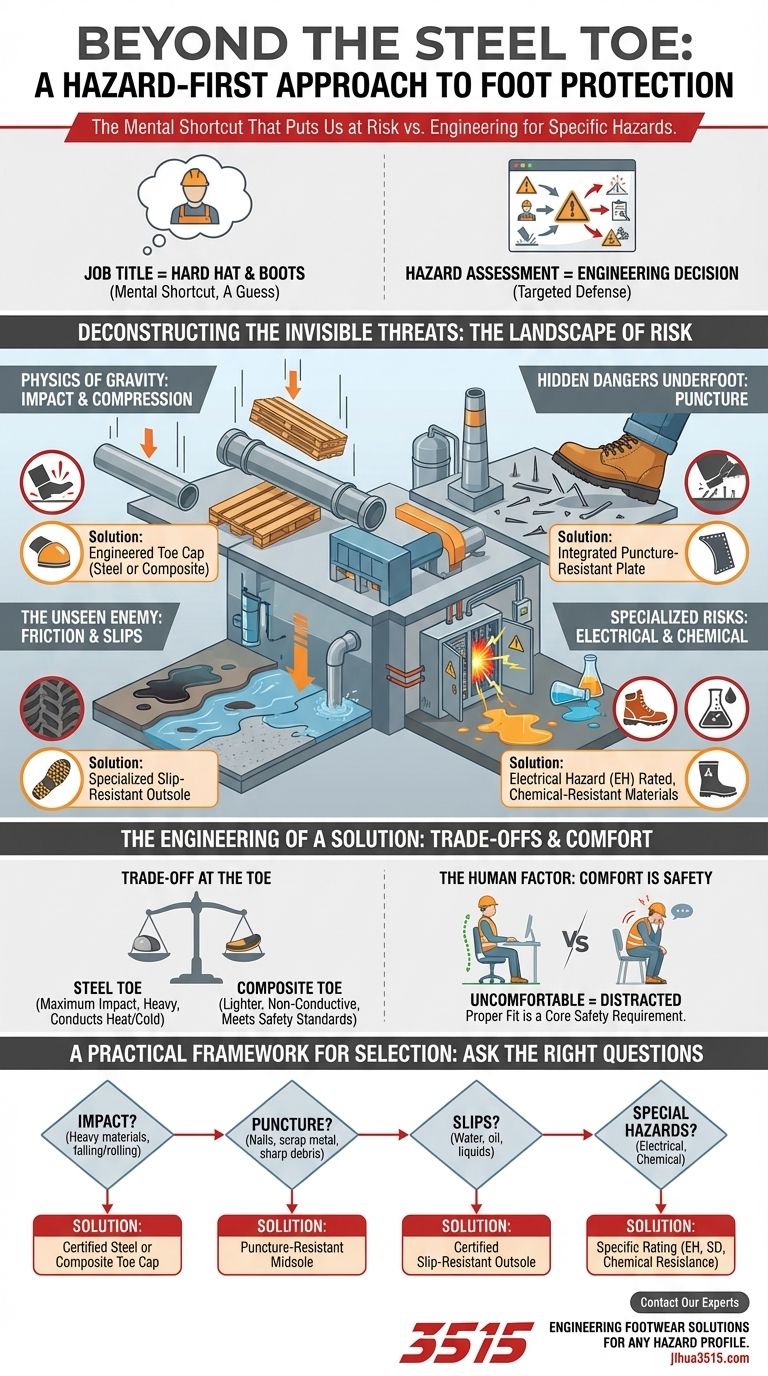
Instead of asking what shoe you need for your job title, ask these questions about your environment:
- Impact: Do I work with or around heavy materials that could fall or roll?
- Solution: Prioritize a certified steel or composite toe cap.
- Puncture: Do I walk across surfaces where nails, scrap metal, or other sharp debris is common?
- Solution: Insist on a puncture-resistant midsole.
- Slips: Are my daily work surfaces frequently exposed to water, oil, or other liquids?
- Solution: Select a shoe with a certified slip-resistant outsole designed for those specific conditions.
- Special Hazards: Am I exposed to live electrical circuits, static-sensitive equipment, or hazardous chemicals?
- Solution: Ensure the footwear carries the specific rating (EH, SD, chemical resistance) for that hazard.
The right safety shoe isn't just a piece of apparel. It's a critical, engineered tool that empowers you to work with confidence. It’s the foundation upon which a culture of safety is built.
To ensure your workforce is equipped with footwear engineered for their specific hazards, Contact Our Experts
Visual Guide
Related Products
- Premium Suede Sport Safety Shoes for Wholesale & Bulk Orders
- Premium Lightweight Safety Shoes for Wholesale & Bulk Orders
- Wholesale Anti-Smash & Puncture-Proof Safety Shoes Custom Manufacturing for Brands
- Premium KPU Injection Athletic Style Safety Shoes
- Premium Safety Shoes with Rotating Buckle Safety Sneakers
Related Articles
- The Ghost in the Machine: Why an Obsolete Footwear Standard Creates Modern Risk
- Beyond the Steel Toe: The Hidden Ergonomics of Workplace Safety
- Why Traditional Laces Are a Hidden Safety Risk—And What to Do About It
- The True Cost of Skipping Safety Shoes: Long-Term Risks and Smart Protection
- How Safety Shoe Engineering Prevents Workplace Injuries Across Industries



















