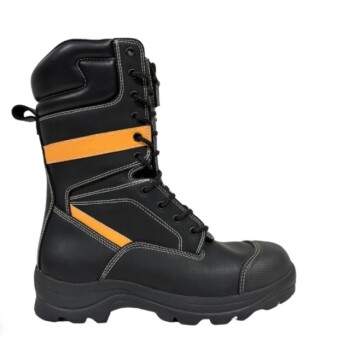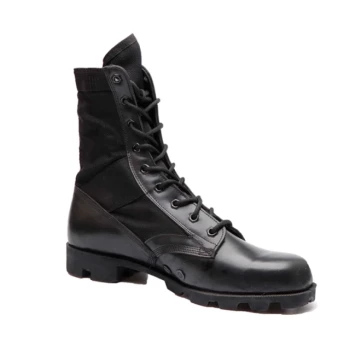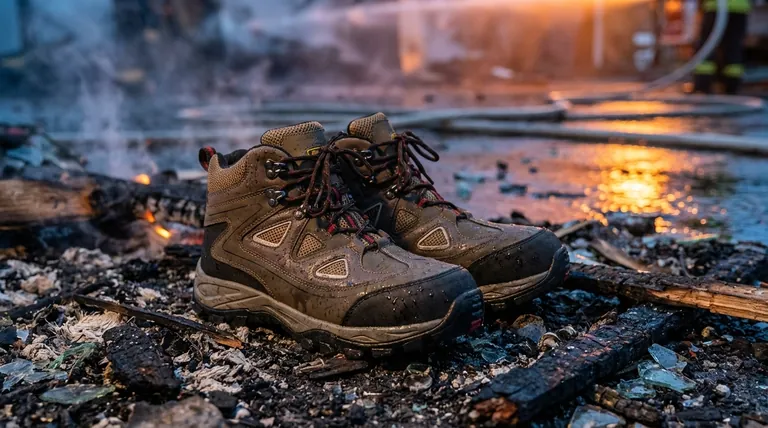
In moments of crisis, trust is not an emotion; it's a tool. For a firefighter entering a burning structure, trust is placed in their team, their training, and the gear that forms a thin line between their body and the hostile environment.
Every piece of that gear is a promise. And no promise is more fundamental than the one made by the boots on their feet.
The Cognitive Trap of "Good Enough"
The human mind often struggles to price extreme risk accurately. A sturdy leather work boot feels safe. It's heavy, thick, and protects against the hazards of a normal construction site.
This creates a dangerous cognitive illusion: the feeling of safety is mistaken for the reality of it.
But a fire ground is not a normal environment. It is a chaotic system of simultaneous failures. The floor is not just unstable; it's a minefield of nails, glass, and superheated metal. The water on the ground isn't just water; it could be mixed with hazardous chemicals or masking a live electrical wire.
Relying on a general safety standard here is a catastrophic failure of imagination.
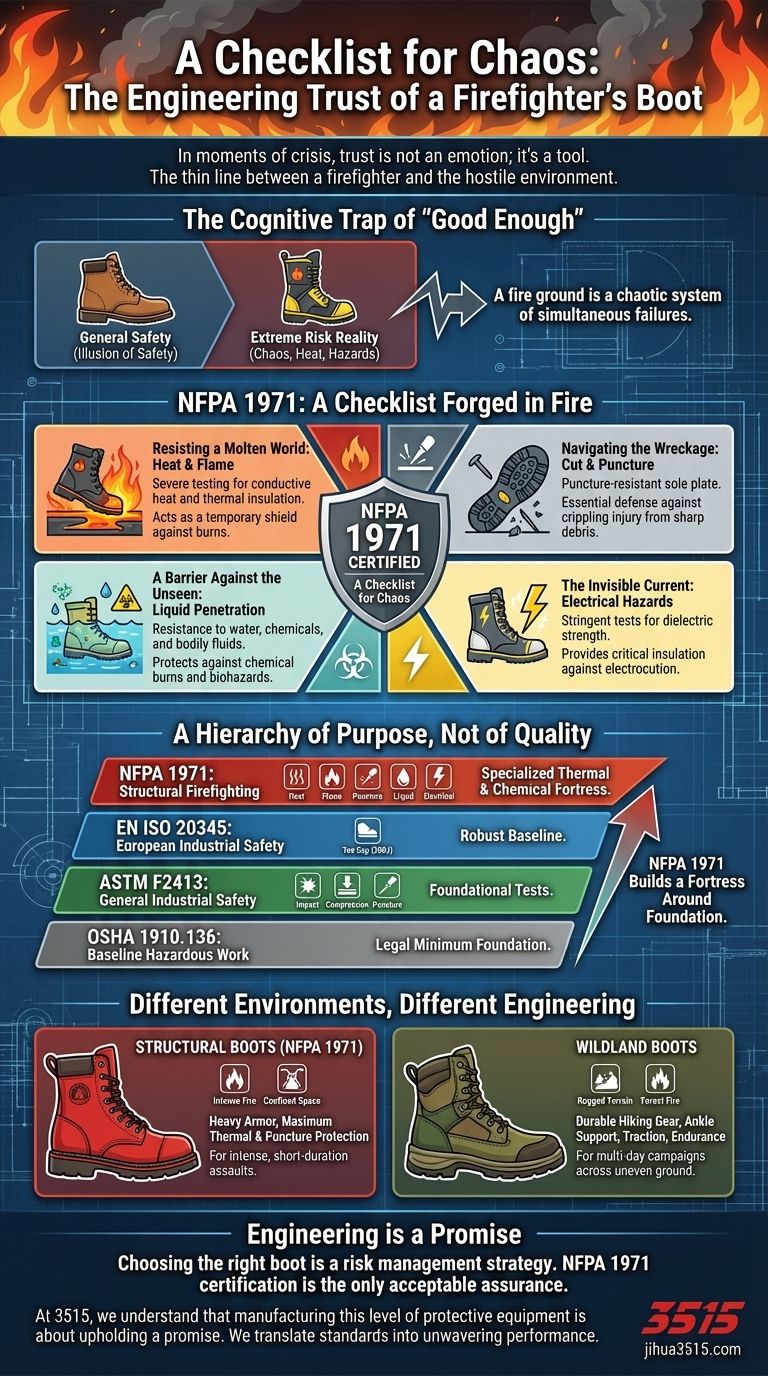
NFPA 1971: A Checklist Forged in Fire
A specific, job-related standard like NFPA 1971 is not bureaucracy. It's the collected wisdom of past tragedies. It's a checklist for chaos, ensuring a piece of equipment has been systematically engineered to survive conditions that defy intuition.
When a boot is NFPA 1971 certified, it has been verified against the fire ground's most brutal questions.
Resisting a Molten World: Heat & Flame
The most obvious danger is heat. NFPA 1971 mandates severe testing for conductive heat and thermal insulation. This ensures the boot functions as a temporary shield, protecting the wearer from burns while walking on surfaces that could melt lesser materials.
Navigating the Wreckage: Cut & Puncture
Visibility is low. The ground is littered with sharp, unpredictable debris. The standard demands a puncture-resistant sole plate, a simple but non-negotiable defense against a crippling injury that could prove fatal in an emergency.
A Barrier Against the Unseen: Liquid Penetration
Boots must keep feet dry, not for comfort, but for safety. The standard verifies resistance to penetration by water, chemicals, and bodily fluids, protecting against both immediate chemical burns and long-term biohazards.
The Invisible Current: Electrical Hazards
In a structure fire, the electrical system is compromised. NFPA 1971 includes stringent tests for dielectric strength, ensuring the boots provide a critical layer of insulation against the risk of electrocution.
A Hierarchy of Purpose, Not of Quality
It's easy to see a list of standards and assume it's a "good, better, best" progression. This is the wrong mental model. The correct model is "the right tool for the right job."
General standards are the foundation, but a foundation is not a house.
- OSHA 1910.136: This is the legal minimum for any hazardous U.S. workplace. NFPA-certified boots exceed this baseline by an enormous margin.
- ASTM F2413: This provides the test methods for basic safety features like impact-resistant toes. NFPA 1971 incorporates these principles and then builds a fortress of fire-specific protections around them.
- EN ISO 20345: A robust European standard for industrial safety, but it lacks the specialized thermal and chemical requirements vital for firefighting.
| Standard | Key Focus | Primary Use Context |
|---|---|---|
| NFPA 1971 | Heat, flame, puncture, liquid penetration, electrical hazards | Structural Firefighting |
| OSHA 1910.136 | General protective footwear requirements | Baseline for all hazardous work |
| ASTM F2413 | Foundational tests for impact, compression, puncture | General industrial safety |
| EN ISO 20345 | Toe cap protection (200 joules) | European industrial safety |
Different Environments, Different Engineering
The elegant logic of engineering demands that form follow function. The function of a structural firefighting boot is vastly different from that of a wildland firefighting boot.
Structural Boots (NFPA 1971) are built for intense, short-duration assaults. They are the heavy armor, prioritizing maximum thermal and puncture protection in a wet, hazardous, and confined space.
Wildland Boots are built for endurance. They are the durable hiking gear for a multi-day campaign across rugged, uneven terrain, prioritizing ankle support, traction, and long-term comfort over the extreme thermal protection of a structural boot. Using one for the other’s job is not just inefficient; it’s dangerous.
Engineering is a Promise
Choosing the right boot is not a procurement decision; it's a risk management strategy. For structural firefighters, NFPA 1971 certification is the only acceptable assurance that their footwear is a reliable tool, not a potential point of failure.
At 3515, we understand that manufacturing this level of protective equipment is about upholding a promise. Our large-scale production capabilities are built to translate the rigorous demands of standards like NFPA 1971 into footwear that provides unwavering performance when it matters most. We supply distributors, brands, and large-scale clients with the certified trust their teams depend on.
To ensure your team is equipped with footwear engineered for the reality of their work, Contact Our Experts.
Visual Guide
Related Products
- High Performance Fire-Retardant Waterproof Safety Boots
- Premium Flame-Retardant Waterproof Safety Boots and Shoes
- Durable Military Combat Boots with Water Drainage for Wholesale & OEM
- Wholesale Lightweight Tactical Boots Custom Manufacturer for Desert & Combat Use
- High-Traction Suede Tactical Boots Wholesale & Custom Manufacturing
Related Articles
- How to Choose Safety Boots That Reduce Fatigue Without Sacrificing Protection
- How Industrial Professionals Can Balance Safety Boot Requirements with Professional Appearance
- The Anatomy of Trust: A Systems Approach to Workplace Foot Protection
- The Lacing Paradox: Why the Safest Boots Contain Their Own Greatest Risk
- How to Choose Waterproof Boots That Actually Work for Your Needs