
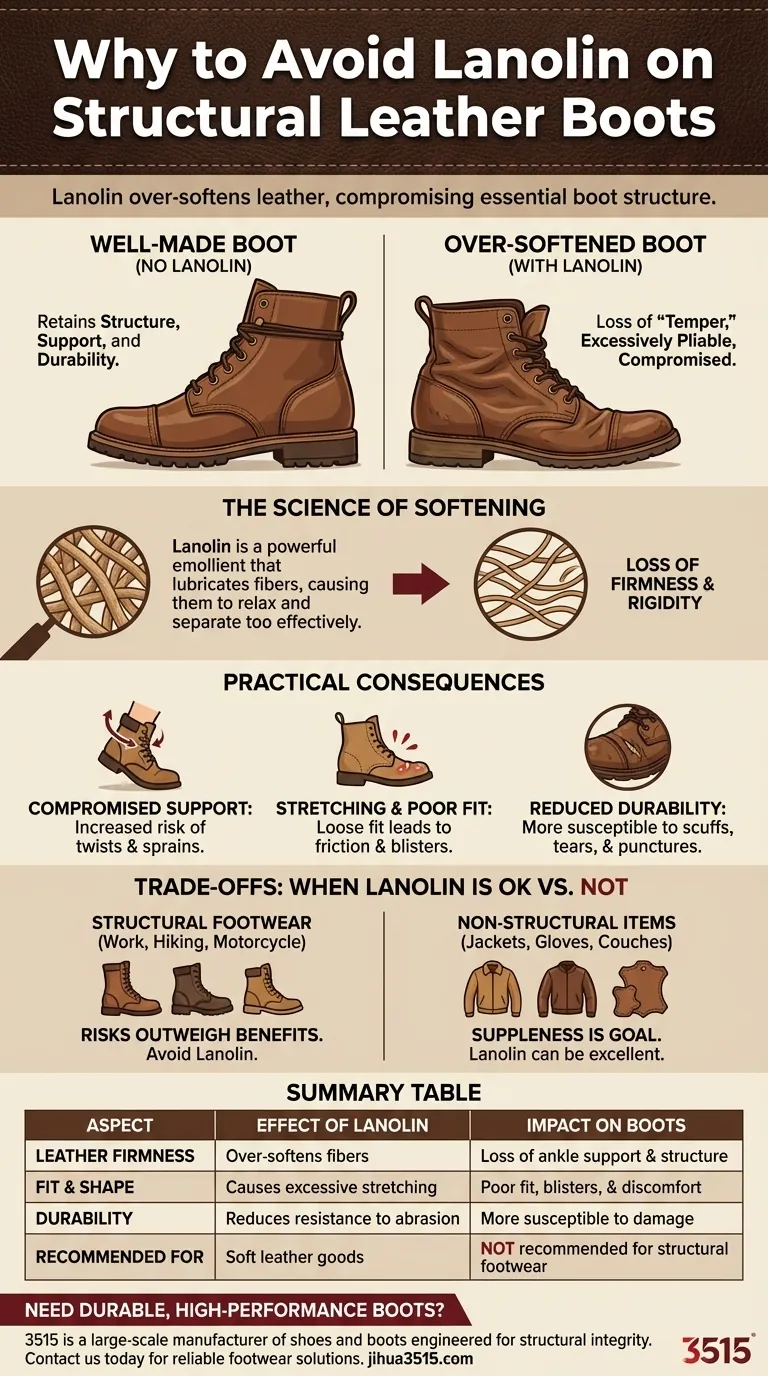
The primary reason to avoid lanolin-based products on leather boots is that lanolin can over-soften the leather. While it is an excellent conditioner, its intense softening effect compromises the structural integrity required for footwear, especially for work or hiking boots that need to provide support and withstand harsh conditions.
The core issue isn't that lanolin is "bad" for leather, but that it is often too effective for its own good. It fundamentally changes the leather's properties in a way that undermines the primary purpose of a boot: to provide durable structure and support.
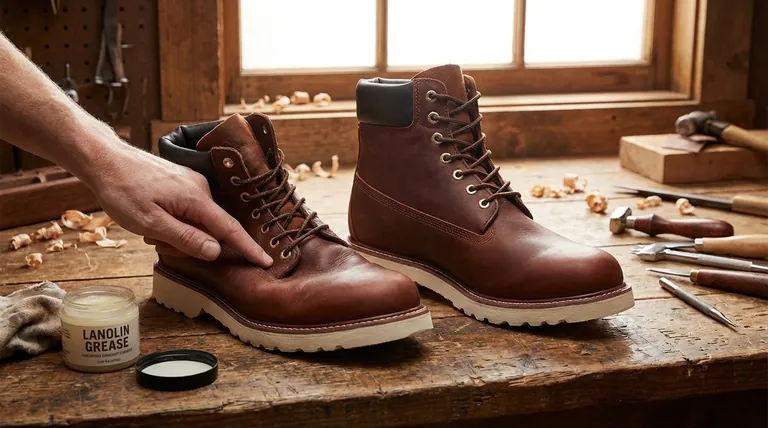
The Role of Leather in Boot Construction
To understand the problem with lanolin, we must first appreciate why leather is the material of choice for quality boots. It isn't just about looks; it's about functional performance.
Structure and Support
The stiffness and shape-holding ability of leather are critical. A well-made boot provides crucial ankle support and protects your feet from impacts, which relies on the leather maintaining its intended form.
Durability and Resistance
Boot leather is tanned and finished to be tough. Its firmness helps it resist abrasions, scuffs, and cuts. This durability is essential for any footwear used in demanding environments.
How Lanolin Affects Leather's Properties
Lanolin is a natural grease derived from sheep's wool, prized for its ability to moisturize and protect. However, its interaction with the fibrous structure of boot leather is where the issue begins.
An Intense Softening Agent
Lanolin is a powerful emollient that penetrates deep into leather's fibers. It lubricates these fibers so effectively that it causes them to relax and separate more than intended.
The Loss of "Temper"
This process essentially removes the leather's "temper"—the term for its firmness and rigidity. The result is leather that feels overly pliable, almost like fabric, rather than a protective material.
The Practical Consequences of Over-Softened Boots
When a boot's leather loses its structural integrity, it leads to tangible and often irreversible problems.
Compromised Foot and Ankle Support
The most immediate danger is a loss of support. A boot that has become too soft can no longer brace your ankle, significantly increasing the risk of twists and sprains on uneven terrain.
Stretching and Poor Fit
Over-softened leather will stretch out of shape quickly. This leads to a loose, sloppy fit, which causes your foot to slide inside the boot, creating friction, blisters, and general discomfort.
Reduced Durability
A softer leather hide is far more susceptible to damage. It will scuff, tear, and puncture more easily because the dense fiber structure that provided its strength has been compromised.
Understanding the Trade-offs
Objectivity requires acknowledging that lanolin has its place, but its application must be carefully considered based on the item's purpose.
The Exception: Non-Structural Items
For leather goods where suppleness is the primary goal and structure is irrelevant—like a soft leather jacket, gloves, or a couch—lanolin can be an excellent choice for conditioning.
The Rule: Structural Footwear
For any footwear that you depend on for protection and support, such as work boots, hiking boots, or motorcycle boots, the risks of using lanolin far outweigh any potential conditioning benefits.
Making the Right Choice for Your Goal
Selecting a conditioner should be based on your boot's specific needs. The goal is to nourish the leather without sacrificing its essential function.
- If your primary focus is durability and support for work or hiking boots: Choose a conditioner based on beeswax or a specialized boot grease blend. These products nourish and waterproof while helping the leather retain its necessary firmness.
- If your primary focus is restoring moisture to heavily used boots: Opt for a purpose-made boot oil or conditioner containing a mix of oils and waxes. These are formulated to replenish the leather without causing it to become structurally weak.
- If your primary focus is treating casual dress shoes or soft leather goods: A product containing a small amount of lanolin may be acceptable, but always test it on an inconspicuous area first to observe its effect.
Ultimately, caring for your boots means preserving the properties that make them effective in the first place.
Summary Table:
| Aspect | Effect of Lanolin | Impact on Boots |
|---|---|---|
| Leather Firmness | Over-softens fibers | Loss of ankle support and structure |
| Fit & Shape | Causes excessive stretching | Leads to poor fit, blisters, and discomfort |
| Durability | Reduces resistance to abrasion | More susceptible to scuffs, tears, and damage |
| Recommended For | Soft leather goods (jackets, gloves) | Not recommended for structural footwear |
Need durable, high-performance work or hiking boots that are built to last?
As a large-scale manufacturer, 3515 produces a comprehensive range of footwear for distributors, brand owners, and bulk clients. Our production capabilities encompass all types of durable shoes and boots, engineered to maintain their structural integrity and support in demanding conditions.
Contact us today to discuss your footwear needs and discover how we can provide you with reliable, high-quality boots.
Visual Guide
Related Products
- Wholesale Classic Leather Lace-Up Ankle Boots for Brand Manufacturing
- Durable Leather High-Ankle Tactical Boots for Wholesale & Custom Manufacturing
- Durable Leather Work Boots Wholesale Manufacturer & Custom Factory
- Durable Leather Work Boots for Wholesale & Custom Manufacturing
- Durable Leather Moc Toe Work Boots for Wholesale & Custom Manufacturing
People Also Ask
- How are oils used to waterproof leather boots? A Guide to Deep Conditioning & Protection
- Why is regular maintenance necessary for the performance of leather boots? Boost Durability & Brand Reputation
- Why might it be beneficial to pre-heat the boots before applying wax? Achieve Deeper, Longer-Lasting Protection
- How can leather boots maintain their water resistance? A Guide to Lasting Protection
- What is the biggest enemy of leather boots? Protect Your Investment from Water Damage














