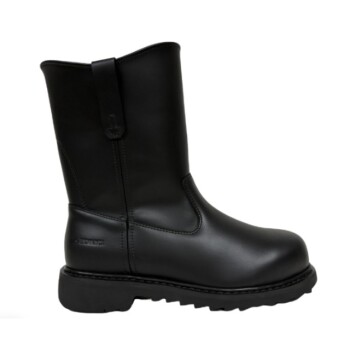
Standardization is the absolute prerequisite for scientific accuracy. Mountaineering boot samples must undergo pre-treatment in constant temperature and humidity equipment to rigorously eliminate uncontrolled variables introduced during storage or transport. By conditioning samples for 24 hours—typically at 22°C and 50% relative humidity—technicians ensure every boot starts from an identical baseline, making subsequent thermal performance data valid and comparable.
Without pre-treatment, residual moisture or temperature variance from the environment can skew thermal insulation data. Conditioning ensures that test results reflect the boot's actual performance capabilities, not its storage history.
The Hidden Variables of Material Storage
The Impact of Moisture Absorption
Mountaineering boots are often constructed from complex layers of leather, synthetics, and foams. These materials can absorb moisture from the air during shipping or warehousing.
If this moisture is not removed, it drastically alters the thermal conductivity of the boot. Wet materials conduct heat differently than dry ones, leading to inaccurate insulation readings.
The Problem with Physical State Variance
Samples arriving from different locations may have been exposed to vastly different environments. One sample might come from a cold warehouse, while another arrives from a hot transport truck.
Testing without stabilization means you are partly measuring the material's reaction to its previous environment. Pre-treatment neutralizes these differences.
Ensuring Scientific Validity
Creating a Uniform Baseline
The primary goal of pre-treatment is to establish an identical initial thermal and physical state for all samples.
This serves as a "reset button" for the materials. It ensures that when the boots enter the climate simulation chamber, the only variable being tested is the design of the boot itself.
Enhancing Data Comparability
To compare the insulation performance of Boot A against Boot B, the playing field must be level.
If Boot A is slightly damp and Boot B is bone dry, the comparison is scientifically void. The 24-hour conditioning cycle guarantees that differences in data are due to the boot's technology, not external factors.
Common Pitfalls to Avoid
The Risk of Skipping Conditioning
Ignoring this step introduces "data noise." This results in erratic test figures that cannot be replicated.
A superior boot might fail a thermal test simply because it held residual humidity from a damp storage room.
Balancing Throughput vs. Accuracy
The 24-hour pre-treatment requirement adds a significant delay to the testing workflow. It limits how quickly a lab can process samples.
However, attempting to rush this process compromises the integrity of the entire experiment. The trade-off of time is necessary for the gain in reliability.
Making the Right Choice for Your Testing Protocol
Reliable data is built on strict variable control. Use the following guide to apply this to your testing strategy:
- If your primary focus is Research & Development: Strict pre-treatment is critical to isolate how specific material changes affect thermal insulation.
- If your primary focus is Quality Assurance: Pre-treatment prevents false negatives, ensuring you don't reject good product batches due to transport conditions.
Ultimately, true performance insight begins before the actual test even starts.
Summary Table:
| Factor | Impact Without Pre-treatment | Benefit of Conditioning |
|---|---|---|
| Moisture Content | Skews thermal conductivity; inconsistent results | Standardizes moisture levels across all samples |
| Storage History | Test measures reaction to previous environment | Neutralizes variables from shipping and warehousing |
| Data Integrity | High 'data noise' and erratic figures | Ensures scientific validity and comparability |
| Testing Baseline | Uneven starting points for different samples | Creates a uniform 'reset' for material physical states |
Partner with 3515 for Rigorously Tested Footwear Solutions
At 3515, we understand that performance reliability begins long before the final product reaches the shelf. As a premier large-scale manufacturer serving global distributors and brand owners, we integrate scientific precision into every stage of production—from our flagship Safety Shoes to specialized mountaineering boots, tactical gear, and training sneakers.
Our comprehensive production capabilities ensure that every pair, whether it's a high-performance outdoor boot or a polished dress shoe, meets the highest standards of thermal and physical integrity. We take the technical details seriously so you can deliver superior value to your customers.
Ready to elevate your product line with a manufacturer that prioritizes scientific accuracy?
Contact 3515 Today to Discuss Your Bulk Requirements
References
- Eleonora Bianca, Ada Ferri. Definition of a thermal comfort rating scale for mountaneering boots. DOI: 10.25367/cdatp.2023.4.p110-119
This article is also based on technical information from 3515 Knowledge Base .
Related Products
- Wholesale High-Traction Camo Boots - Custom Manufacturer for Brands
- Wholesale Lightweight Tactical Boots Custom Manufacturer for Desert & Combat Use
- Durable Rubber Sole Outdoor Shoes Wholesale & Custom Manufacturing
- Durable High-Ankle Tactical Boots Wholesale Manufacturer for Custom & Bulk Orders
- Durable High-Ankle Tactical Boots for Wholesale & Custom Manufacturing
People Also Ask
- What are the key features of the new line of camo boots? Built for Extreme Cold & Rugged Terrain
- Are camo boots necessary for hunting success? Prioritize Performance Over Pattern
- How does the Rank Score Test identify the primary causes of premature failure in tactical and work boots? Key Insights
- What is the technical logic behind using closed-eye testing for tactical boots? Unlocking Peak Footwear Stability
- What shoes to wear for a security job? Durable, Protective Footwear for Long Shifts