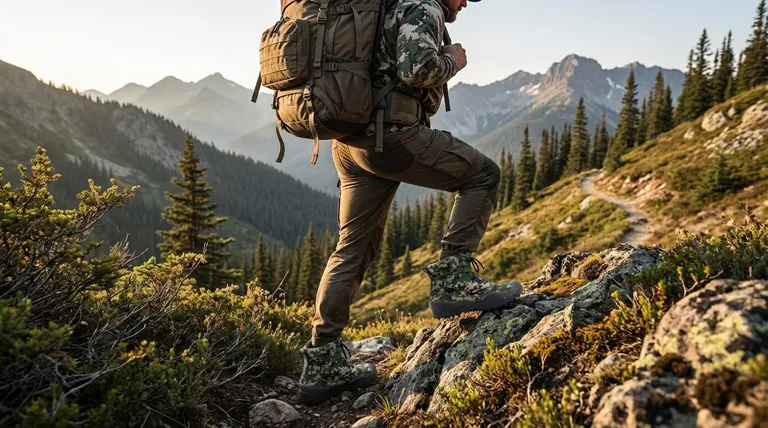
The short answer is that the combined weight of your body and your pack dictates the structural integrity required from your boots. As this total weight increases, it places immense stress on the boot's sole, midsole, and ankle support systems. A boot that is not engineered to handle that specific load will fail, leading to debilitating foot fatigue, a higher risk of injury, and a compromised hunt.
The core principle is this: a hunting boot is not just footwear; it is a load-bearing platform. The total weight you carry is the primary force acting on that platform, and you must match the boot's stiffness and support to the force it is expected to endure.
The Physics of Load: Why Weight Changes Everything
Choosing the right boot is an exercise in applied physics. The forces you exert with every step are magnified by the weight on your back and the unevenness of the terrain. A boot must be built to manage these forces effectively.
The Role of Sole and Midsole Stiffness
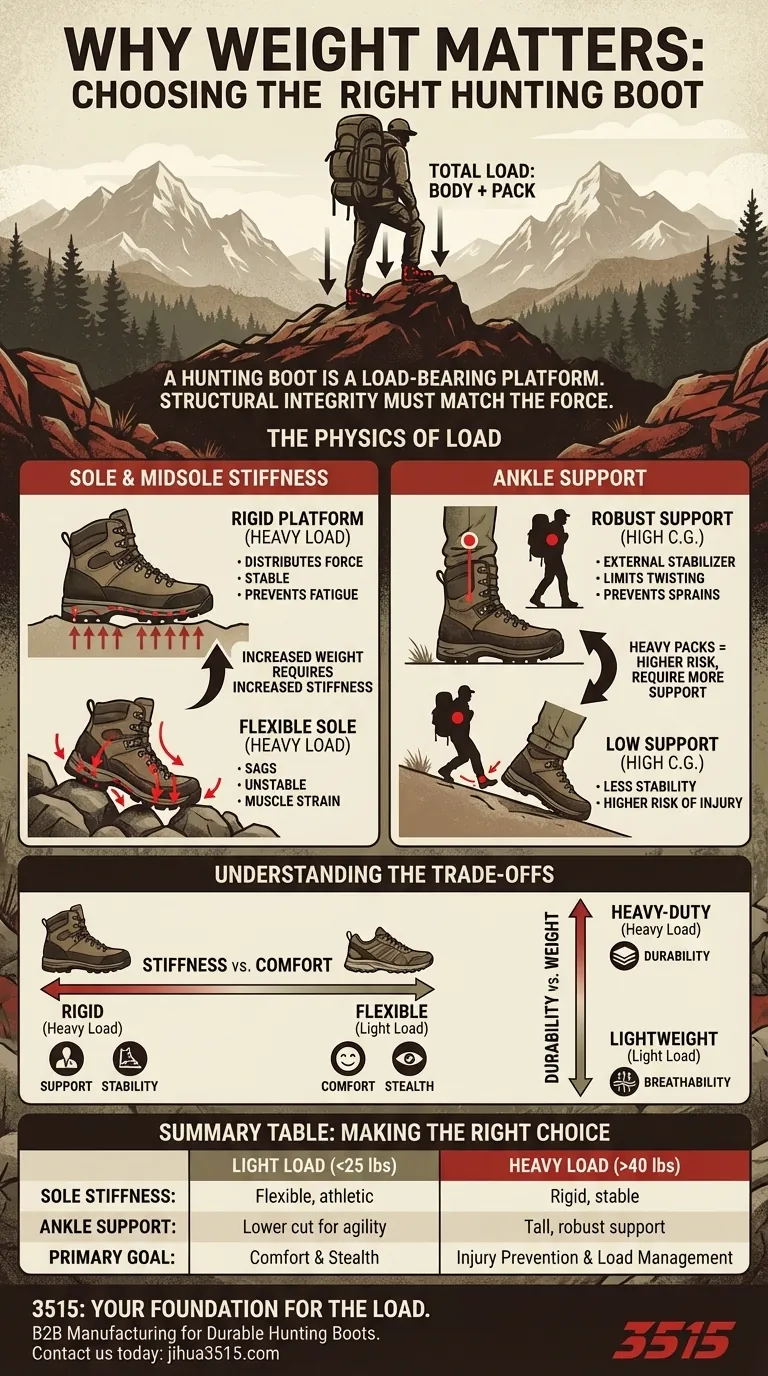
A boot's stiffness, often called its flex, is its most critical load-bearing feature. A stiff sole and midsole act like a bridge, distributing the force of your weight across the entire length of your foot.
Under a heavy load, a soft, flexible sole will sag over rocks and uneven ground. This forces the muscles and tendons in your foot arches to constantly work to maintain stability, leading to rapid fatigue and painful conditions like plantar fasciitis.
A rigid boot, however, creates a stable platform. It prevents your foot from bending in unnatural ways, transferring the load-bearing work from your soft tissues to the structure of the boot itself.
The Necessity of Ankle Support
A heavy backpack significantly raises your center of gravity, making you less stable and more prone to rolling an ankle. This risk is amplified on sidehills or while navigating deadfall.
Robust ankle support in a taller, well-constructed boot acts as an external stabilizer. It's not simply about comfort; it is a critical safety feature that physically limits the ankle's ability to twist beyond its normal range of motion, preventing sprains and other serious injuries far from the trailhead.
The Demands on Overall Construction
Weight is a relentless force that tests every component of a boot. A hunter carrying a 60-pound pack places exponentially more stress on seams, eyelets, laces, and upper materials than a day hiker with a 15-pound pack.
Boots designed for heavy loads use thicker leather, more durable synthetic materials, and reinforced stitching. They are built with the understanding that every component will be subjected to higher tension and abrasion.
Understanding the Trade-offs
Selecting a boot is always a balance of competing characteristics. Understanding these trade-offs is essential for making an informed decision.
Stiffness vs. Comfort
The primary trade-off is between support and flexibility. A highly rigid mountain boot is exceptional for carrying a heavy pack in steep terrain but can feel clumsy and restrictive on flat, easy trails.
A more flexible boot feels more like an athletic shoe and is far more comfortable for stalking or covering ground with a light pack. However, it offers a fraction of the support needed for heavy-duty work.
Durability vs. Weight
A boot built to withstand the abuse of heavy loads is, by necessity, made of heavier and more robust materials. This adds to the overall weight you lift with every single step.
The key is to choose the boot that provides the necessary support for your anticipated maximum load, without burdening you with unnecessary weight for the majority of your hunt.
Waterproofing vs. Breathability
While not a structural issue, this is a critical performance trade-off. Heavy-duty leather boots offer excellent durability and water resistance but can be warm and slow to dry.
Lighter synthetic boots often provide superior breathability, which is vital in warmer conditions to prevent your feet from sweating and developing blisters. However, they may not offer the same long-term durability under heavy use.
Making the Right Choice for Your Hunt
Your decision should be based on a realistic assessment of the loads you will carry.
- If your primary focus is day hunting with light packs (<25 lbs): Prioritize a lighter, more flexible boot that offers comfort and stealth over maximum rigidity.
- If your primary focus is multi-day backcountry hunting with heavy packs (>40 lbs): You must invest in a boot with a stiff sole and robust ankle support to manage the weight and prevent injury.
- If you plan to haul game from the backcountry: Select a boot engineered for the heaviest possible load you anticipate, as this will be the moment of maximum stress on you and your footwear.
Ultimately, treating your boots as a critical piece of your load-bearing system, not just as footwear, is the key to a successful and safe hunt.
Summary Table:
| Boot Selection Factor | Light Load (<25 lbs) | Heavy Load (>40 lbs) |
|---|---|---|
| Sole/Midsole Stiffness | Flexible, athletic feel | Rigid, stable platform |
| Ankle Support | Lower cut for agility | Tall, robust support for stability |
| Primary Goal | Comfort and stealth for stalking | Injury prevention and load management |
Your hunt deserves a foundation built for the load. As a large-scale manufacturer, 3515 produces a comprehensive range of durable hunting boots engineered for distributors, brand owners, and bulk clients. Our boots are designed with the structural integrity to support you and your pack, from day trips to multi-day backcountry expeditions. Contact us today to discuss how our production capabilities can deliver the right load-bearing footwear for your customers.
Get a Quote for Your Hunting Boot Needs
Visual Guide
Related Products
- Wholesale Lightweight Tactical Boots Custom Manufacturer for Desert & Combat Use
- High-Traction Suede Tactical Boots Wholesale & Custom Manufacturing
- Durable Leather Tactical Boots Wholesale & Custom Manufacturing for Brands
- Wholesale High-Traction Camo Boots - Custom Manufacturer for Brands
- Durable Spiked Camouflage Boots Wholesale & Factory Production
People Also Ask
- What are the common types of combat boots? Find the Right Boot for Your Mission
- What specialized protections do tactical boots offer? Maximize Endurance with High-Performance Footwear
- How does additive manufacturing equipment reduce environmental risks? Sustainable Tactics for Modern Footwear Production
- What are the different types of tactical boots available? Find the Right Boot for Your Mission
- How is the compatibility of polymer materials demonstrated in smart footwear? Enhancing Tactical & Training Performance