Trying on work boots is not just a recommendation; it's a critical step in ensuring your safety and daily comfort. An accurate fit is the foundation for foot health and on-the-job performance. Trying on a boot before purchase is the only way to confirm that its unique construction, volume, and safety features align with the specific shape of your feet.
The core reason for trying on work boots extends beyond simply matching a size number. It's about validating the boot's entire structure against your foot's anatomy to prevent long-term health issues, ensure comfort during long hours, and guarantee that safety features function without causing harm.
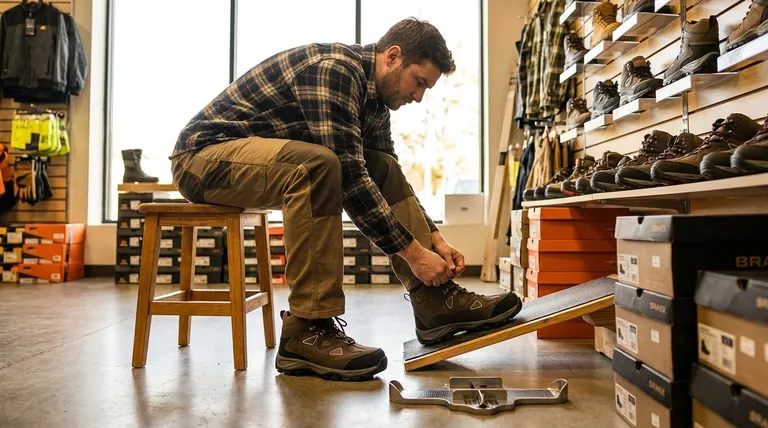
Beyond the Size Tag: The Anatomy of a Proper Fit
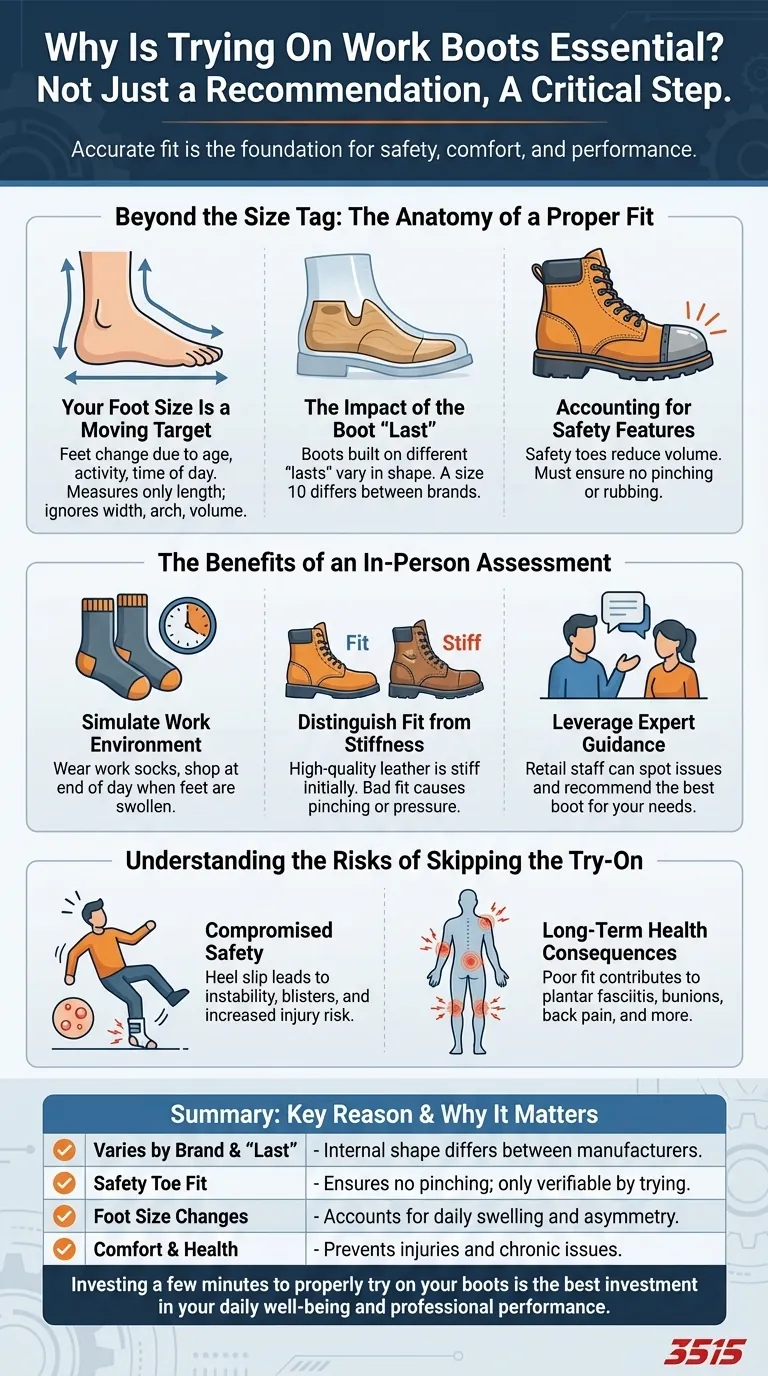
A size "10" is not a universal standard. The internal shape and volume of a work boot can vary dramatically between brands, making a physical try-on the only true test.
Your Foot Size Is a Moving Target
Your feet change over time due to age, activity, and even the time of day. It is also common for one foot to be slightly larger than the other.
Measuring your feet before shopping is a good starting point, but it doesn't account for foot width, arch height, or volume, which are crucial for a proper fit.
The Impact of the Boot "Last"
Every boot is built around a form called a "last," which determines its overall shape and fit. Since manufacturers use different lasts, a size 10 from one brand can feel completely different from a size 10 in another.
This is why a boot that fits a coworker perfectly might be uncomfortable for you, even if you wear the same size.
Accounting for Safety Features
Safety features like steel or composite toes significantly reduce the available volume in the front of the boot.
A boot might be the correct length, but the safety cap can pinch or rub your toes if it doesn't match your foot's shape. You can only identify this by trying it on and walking around.
The Benefits of an In-Person Assessment
Trying on a boot allows you to gather crucial information that online descriptions and reviews can never provide.
Simulating Your Work Environment
Always try on work boots with the same type of thick socks you wear on the job. For the most accurate assessment, shop at the end of the day when your feet are naturally more swollen.
This simple step simulates real-world conditions and helps you avoid buying a boot that feels fine in the morning but becomes painfully tight by the afternoon.
Distinguishing Fit from Stiffness
A new, high-quality leather boot will feel stiff, which is normal. However, you must be able to distinguish this "break-in" stiffness from a genuinely poor fit.
A proper fit feels snug at the heel and midfoot with no slipping, while allowing enough room for your toes to wiggle freely. Any pinching, sharp rubbing, or excessive pressure points are signs of a bad fit, not stiffness.
Leveraging Expert Guidance
Knowledgeable retail assistants can provide invaluable advice. They are trained to spot subtle fit issues, understand the nuances between brands, and recommend a boot that is best suited for your foot type and work demands.
Understanding the Trade-offs: The Risks of Skipping the Try-On
Choosing a work boot based on size alone is a gamble that can lead to significant negative consequences.
Compromised Safety
An ill-fitting boot is a safety hazard. A boot that is too loose can cause heel slip, leading to blisters and instability that increases the risk of trips and ankle injuries. A boot that is too tight can restrict circulation and create painful pressure points that distract you from your work.
Long-Term Health Consequences
Consistently wearing poorly-fitting work boots can contribute to chronic health problems. These can include plantar fasciitis, bunions, hammertoes, and even pain in your knees, hips, and back as your body compensates for improper foot support.
The Hidden Costs of Returns
While you can often return online purchases, it costs you valuable time and effort. Dealing with return shipping and waiting for a replacement means you are without the critical equipment you need to do your job safely.
Making the Right Choice for Your Goal
Use your try-on session to validate the boot against your most important criteria.
- If your primary focus is all-day comfort: Try boots on at the end of the day with your work socks, prioritizing a snug heel and ample room in the toe box.
- If your primary focus is maximum safety: Ensure there is zero heel slip when you walk and that the safety toe does not touch or rub any of your toes, even when you crouch down.
- If you are buying from a brand new to you: Always try them on in-store, as sizing and fit vary significantly due to different manufacturing "lasts."
Investing a few minutes to properly try on your boots is the single best investment you can make in your daily well-being and professional performance.
Summary Table:
| Key Reason to Try On | Why It Matters |
|---|---|
| Varies by Brand & 'Last' | A size 10 is not universal; the internal shape differs between manufacturers. |
| Safety Toe Fit | Ensures steel/composite toes don't pinch or rub, which is only verifiable by trying on. |
| Foot Size Changes | Accounts for daily swelling and differences between your left and right foot. |
| Comfort & Health | Prevents blisters, instability, and long-term issues like plantar fasciitis or back pain. |
Ready to find work boots that combine perfect fit, superior safety, and lasting comfort? As a large-scale manufacturer, 3515 produces a comprehensive range of footwear for distributors, brand owners, and bulk clients. Our production capabilities encompass all types of safety shoes and boots, ensuring you get the right fit and protection for your workforce. Contact us today to discuss your specific needs and discover how we can deliver quality and value directly to you.
Visual Guide
Related Products
- Durable Leather Work Boots for Wholesale & Custom Manufacturing
- Durable Leather Work Boots for Wholesale & Custom OEM Manufacturing
- Durable Leather Work Boots Wholesale Manufacturer & Custom Factory
- Durable Leather Moc Toe Work Boots for Wholesale & Custom Manufacturing
- Wholesale Leather Work Boots with Customizable Wedge Sole for Brands
People Also Ask
- What is the difference between full-grain and top-grain leather? Premium Material Guide for Boot Manufacturers
- What are the common workplace hazards that can be mitigated with the right work boots? Protect Your Workforce
- What are the common foot issues workers face due to uncomfortable work boots? Prevent Pain & Deformities
- What are the advantages of leather versus synthetic work boots? A Guide to Choosing the Right Material
- What are the key components of modern work boots? Engineered for Ultimate Durability and Comfort