
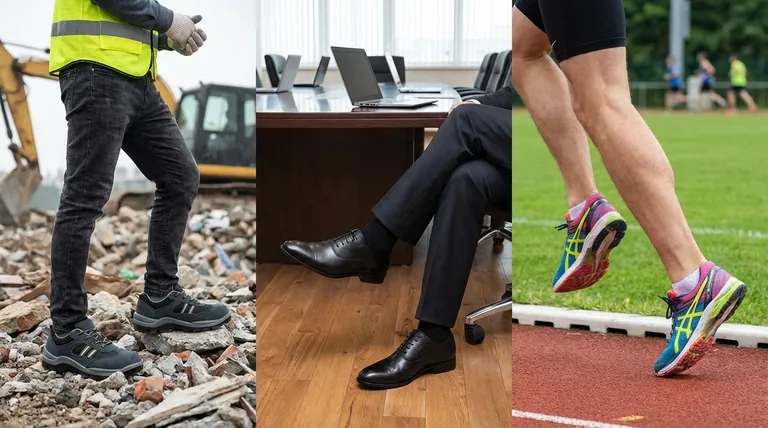
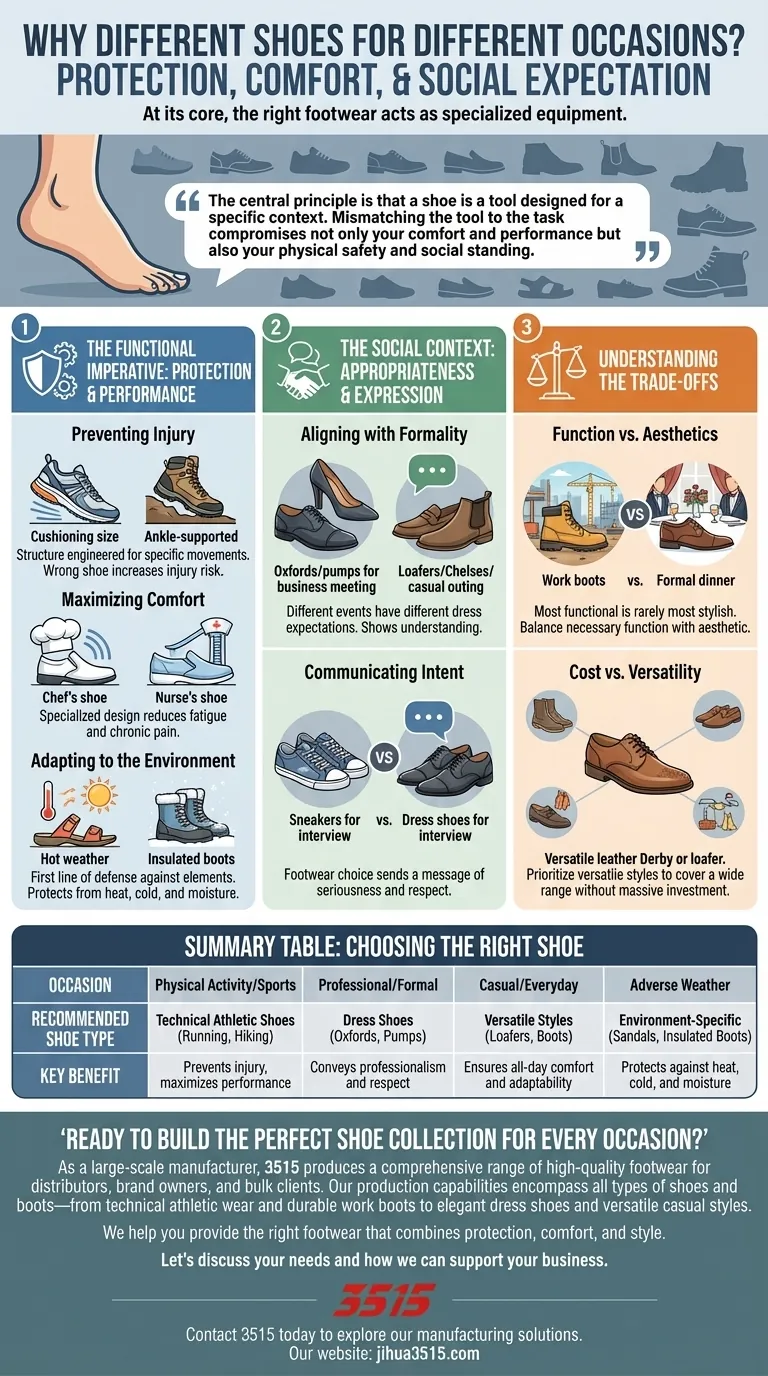
At its core, having different shoes for different occasions is essential for three primary reasons: protecting your feet from injury, ensuring comfort, and adhering to social and professional expectations. The right footwear acts as specialized equipment, whether the task is running a marathon or navigating a boardroom.
The central principle is that a shoe is a tool designed for a specific context. Mismatching the tool to the task compromises not only your comfort and performance but also your physical safety and social standing.
The Functional Imperative: Protection and Performance
Before considering style, a shoe's most critical role is functional. Its design directly impacts your body's interaction with the environment.
Preventing Injury
The structure of a shoe is engineered for specific movements. A running shoe has cushioning to absorb impact, while a hiking boot has a rigid sole and ankle support to prevent twists on uneven terrain.
Wearing the wrong shoe, such as a casual loafer for a long hike, exposes your feet and joints to stress they aren't designed to handle, significantly increasing the risk of injury.
Maximizing Comfort
Comfort is a direct result of proper support. Shoes designed for long periods of standing, like those worn by nurses or chefs, have different support architecture than a dress shoe meant to be worn for a few hours.
This specialized design reduces fatigue and prevents chronic pain in the feet, legs, and back.
Adapting to the Environment
Footwear is your first line of defense against the elements. Sandals are appropriate for summer because they allow your feet to breathe in the heat.
Conversely, insulated, closed-toe boots are necessary in colder weather to protect against low temperatures and moisture.
The Social Context: Appropriateness and Expression
Beyond pure function, footwear plays a key role in non-verbal communication. It signals your understanding of and respect for a given situation.
Aligning with Formality
Different events carry different expectations of dress. Highly formal shoes like Oxfords or classic pumps are appropriate for business meetings or formal events.
More relaxed styles like loafers or Chelsea boots are better suited for casual outings or less formal professional settings.
Communicating Intent
Your choice of footwear sends a message. Arriving at a job interview in athletic sneakers can signal a lack of seriousness, while wearing appropriate dress shoes shows professionalism and respect for the opportunity.
This alignment of attire with occasion is a fundamental aspect of social and professional etiquette.
Understanding the Trade-offs
Choosing footwear often involves balancing competing priorities. Understanding these compromises is key to building a practical collection.
Function vs. Aesthetics
The most functional shoe is rarely the most stylish. A highly protective work boot is essential on a construction site but entirely out of place at a formal dinner.
The goal is to find the shoe that offers the necessary level of function for the activity while meeting the aesthetic requirements of the occasion.
Cost vs. Versatility
Building a comprehensive shoe collection can be expensive. Not everyone needs a dozen pairs of specialized shoes.
Prioritizing versatile styles, such as a classic leather Derby or a simple loafer, can cover a wide range of situations without requiring a massive investment.
Making the Right Choice for Your Goal
Your footwear strategy should align with your primary needs.
- If your primary focus is physical activity: Prioritize technically appropriate athletic footwear for each sport to prevent injury and maximize performance.
- If your primary focus is professional life: Invest in a few pairs of high-quality, classic dress shoes (like Oxfords, Derbies, or pumps) that convey seriousness and respect.
- If your primary focus is everyday comfort and versatility: Focus on well-constructed, supportive options like loafers or boots that can transition between casual and semi-formal settings.
Ultimately, choosing the right shoe is an investment in your health, comfort, and ability to navigate any situation with confidence.
Summary Table:
| Occasion | Recommended Shoe Type | Key Benefit |
|---|---|---|
| Physical Activity / Sports | Technical Athletic Shoes (Running, Hiking) | Prevents injury, maximizes performance |
| Professional / Formal Events | Dress Shoes (Oxfords, Pumps) | Conveys professionalism and respect |
| Casual / Everyday Wear | Versatile Styles (Loafers, Boots) | Ensures all-day comfort and adaptability |
| Adverse Weather | Environment-Specific (Sandals, Insulated Boots) | Protects against heat, cold, and moisture |
Ready to build the perfect shoe collection for every occasion?
As a large-scale manufacturer, 3515 produces a comprehensive range of high-quality footwear for distributors, brand owners, and bulk clients. Our production capabilities encompass all types of shoes and boots—from technical athletic wear and durable work boots to elegant dress shoes and versatile casual styles.
We help you provide the right footwear that combines protection, comfort, and style. Let's discuss your needs and how we can support your business.
Contact 3515 today to explore our manufacturing solutions
Visual Guide
Related Products
- Wholesale Durable Camouflage Canvas Shoes with High-Traction Cleated Rubber Sole
- Lightweight Breathable Training Shoes for Wholesale & Custom OEM Manufacturing
- Wholesale Breathable Training Shoes Custom Athletic Footwear Manufacturer
- Durable Leather High-Ankle Tactical Boots for Wholesale & Custom Manufacturing
- Durable Waterproof Rain Boots | Custom Manufacturer for Wholesale & Brands
People Also Ask
- Why is the selection of high-strength fabric materials necessary in the production of canvas shoes and training shoes?
- What are the properties of canvas as a shoe material? A Guide to Lightweight Comfort & Style
- Can canvas shoes be worn in rainy conditions? The Truth About Water Resistance
- What are some examples of vulcanized shoes? Discover the Flexibility and Board Feel of Classic Sneakers
- What are the characteristics of canvas as a shoe material? A Guide to Lightweight, Breathable Footwear


















