
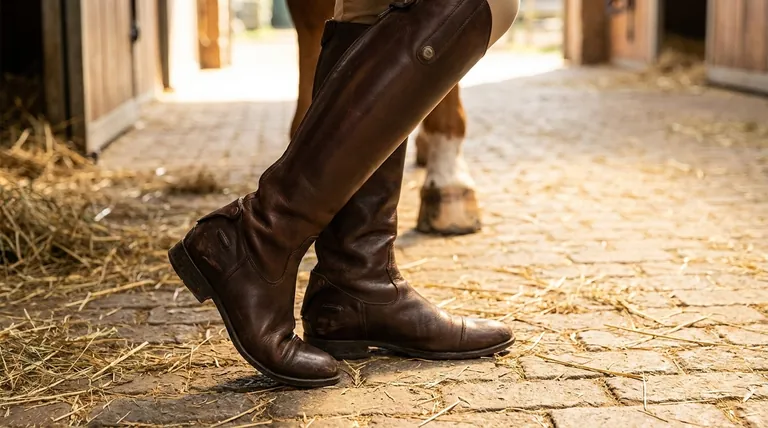
Failing to break in new long riding boots is a direct path to significant discomfort and compromised performance in the saddle. The break-in period is a critical process of molding the boot's initially rigid structure to the unique contours of your leg and foot. This personalization prevents painful blisters and ensures the boot functions as a seamless extension of your body, not a hindrance.
New long riding boots, particularly those made of high-quality leather, are intentionally stiff. The break-in period is not about fixing a flaw; it's a necessary process of adapting the equipment to your anatomy for optimal comfort, clear communication with your horse, and long-term performance.
The Purpose Behind the Process
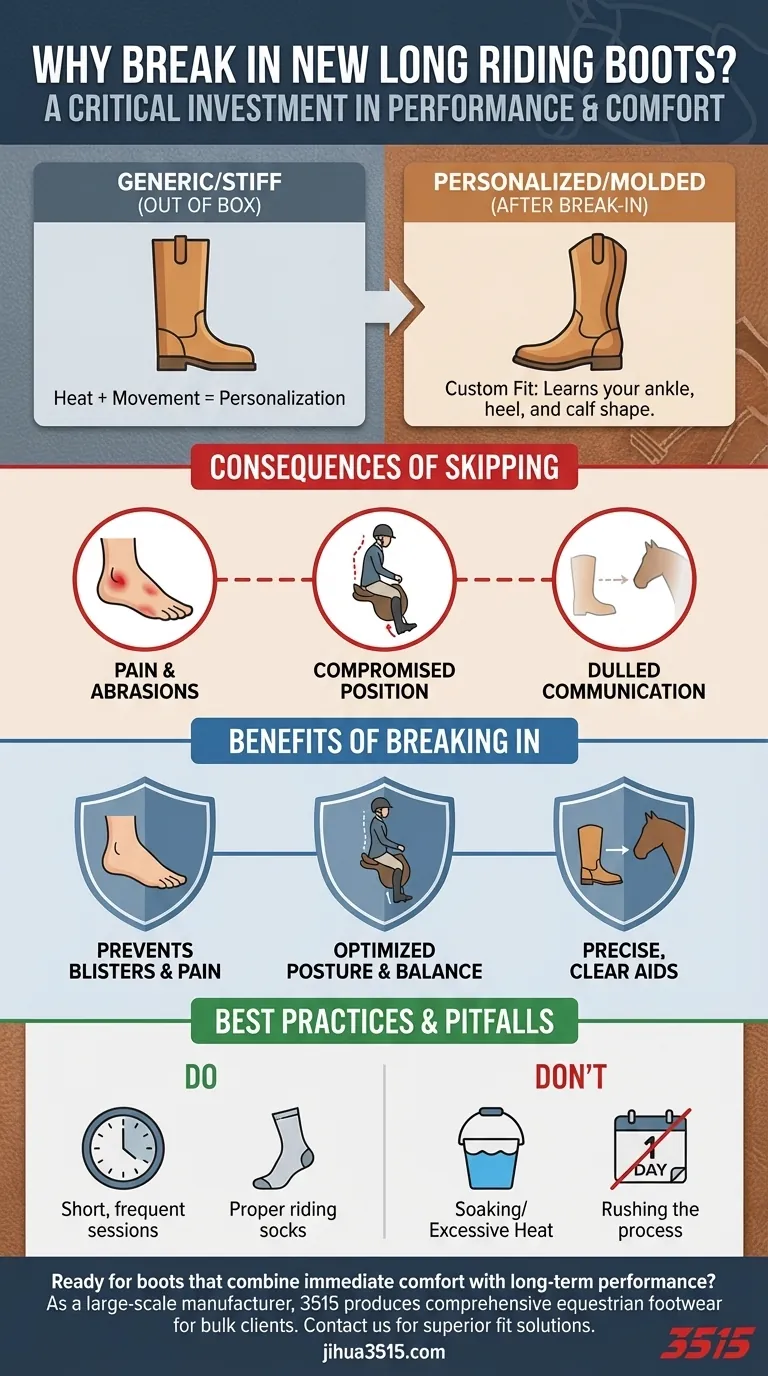
Breaking in a boot is less about "softening" it and more about personalizing its fit through heat and movement. This transforms a generic product into a piece of custom-fitted equipment.
Understanding Initial Stiffness
High-quality leather is a strong, supportive material. This inherent rigidity is what provides the correct structure and posture for your leg, but it also means the boot will not flex easily out of the box.
This initial stiffness is a feature, not a bug. It indicates durable material that will hold its shape for years once it has molded to you.
Molding to Your Anatomy
As you wear the boots, your body heat gently warms the leather. Combined with the repeated flexing of your ankle and calf muscles, this causes the material to gradually shape itself around your specific pressure points and curves.
The result is a custom fit that you cannot achieve otherwise. The boot learns the exact shape of your ankle, the curve of your heel, and the width of your calf.
Enhancing Rider-Horse Communication
A well-molded boot allows for a much closer feel and contact with the horse's side. Stiff, ill-fitting boots create a barrier, dulling the subtle leg aids that are essential for effective riding.
When the boot fits like a second skin, your movements are transferred more precisely and efficiently to the horse.
The Consequences of Skipping the Break-in Period
Ignoring this crucial first step almost always leads to a negative experience that can impact both your physical well-being and your effectiveness as a rider.
The Certainty of Blisters and Abrasions
The most immediate consequence is pain. Stiff leather will rub relentlessly against key friction points like your heel, the back of your knee, and your ankle bones, quickly leading to blisters.
This discomfort is not just annoying; it can make riding unbearable and even lead to raw sores that require time off from the saddle to heal.
Compromised Riding Position
A boot that doesn't flex properly at the ankle can force your foot into an incorrect position. It often prevents the rider from sinking their weight down into their heels, which is fundamental to a secure and balanced seat.
This can negatively affect your entire posture and balance, creating a chain reaction of positional faults.
Performance Under Pressure
Discovering that your boots are agonizingly uncomfortable during a lesson or competition is a scenario to be avoided at all costs.
Pain is a significant distraction that prevents you from focusing on your riding, your horse, and your instructor or judge.
Common Pitfalls to Avoid
The break-in process is straightforward, but a few common mistakes can make it less effective or even damage the boots.
Rushing the Process
Breaking in boots takes time. Trying to do it all in one long, painful session is counterproductive.
The best approach is to wear them for short, frequent periods over several days or weeks, allowing the leather to adapt gradually.
Ignoring Proper Sock Choice
Always wear the same type of socks you intend to ride in, such as thin, moisture-wicking riding socks.
Wearing thick socks to "stretch" the boots can result in a fit that is too loose, while breaking them in with no socks can create a fit that is too tight.
Using Unproven "Hacks"
Avoid shortcuts like soaking boots in water or using excessive heat. These methods can damage the leather, strip its natural oils, and compromise the integrity of the boot's stitching and adhesives, ultimately shortening its lifespan.
How to Apply This to Your Goal
Your strategy for breaking in your boots should align directly with your immediate needs and timeline.
- If your primary focus is immediate comfort: Wear the boots for 30-60 minute intervals around the house for several days before ever getting in the saddle.
- If your primary focus is peak performance in a competition: Begin the break-in process at least two weeks in advance to ensure the boots are fully molded and reliable under pressure.
- If your primary focus is preserving the boot's lifespan: Commit to a gradual break-in period using only wear and movement, as this allows the leather to stretch naturally without causing undue stress.
Properly breaking in your riding boots is a non-negotiable investment in your comfort, your performance, and the longevity of your equipment.
Summary Table:
| Benefit | Consequence of Skipping |
|---|---|
| Prevents Blisters & Pain | Causes abrasions and raw sores |
| Improves Riding Position | Leads to incorrect posture and balance |
| Enhances Horse Communication | Creates a barrier, dulling leg aids |
| Extends Boot Lifespan | Risks damaging the leather and structure |
Ready for boots that combine immediate comfort with long-term performance? As a large-scale manufacturer, 3515 produces a comprehensive range of equestrian and work footwear for distributors, brand owners, and bulk clients. Our production capabilities encompass all types of durable, high-quality riding boots designed for a superior fit. Contact our team today to discuss your specific needs and discover how we can deliver the perfect footwear solution for your customers.
Visual Guide
Related Products
- Durable High-Ankle Tactical Boots Wholesale Manufacturer for Custom & Bulk Orders
- Durable High-Ankle Tactical Boots for Wholesale & Custom Manufacturing
- Wholesale High-Traction Camo Boots - Custom Manufacturer for Brands
- Wholesale Tactical Boots High-Traction & Reflective for Bulk & Brand Orders
- Durable Leather High-Ankle Tactical Boots for Wholesale & Custom Manufacturing
People Also Ask
- What specialized protections do tactical boots offer? Maximize Endurance with High-Performance Footwear
- How do tactical boots protect against injuries? Discover the Integrated Safety System
- What are the ideal use cases for tactical boots? Empower Your Performance in Demanding Scenarios
- Can tactical boots be stylish for everyday wear? Yes, with the right styling and features.
- What are the primary benefits of wearing tactical boots for everyday use? Get All-Day Comfort & Durability


















