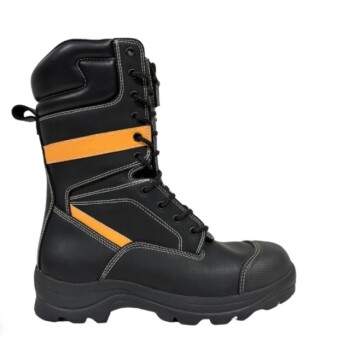
Flame-retardant rubber serves as the primary material for firefighting safety shoes due to its unique combination of thermal defense and chemical isolation. Beyond its obvious ability to withstand extreme heat, this material provides a critical dense barrier against environmental hazards. Specifically, it prevents toxic compounds found on the fire ground from penetrating the footwear and reaching the wearer's skin.
Core Insight: While fire resistance is essential, the defining characteristic of this rubber is its capacity to act as a "pollutant collector." It actively adsorbs high-molecular-weight Polycyclic Aromatic Hydrocarbons (PAHs), fixing these toxins to the shoe's exterior to prevent them from migrating through the material to the firefighter's feet.
The Mechanics of Material Protection
To understand why this specific rubber is the standard, one must look beyond simple heat deflection. The material is engineered to address two distinct threats: physical burns and long-term chemical exposure.
Dense Structural Integrity
The effectiveness of flame-retardant rubber begins with its physical composition. It is manufactured with a highly dense structure.
This density is what provides the foundational resistance against fire. It ensures the material maintains its form and protective qualities even under the extreme thermal stress of a fire scene.
Superior Fire Resistance
The primary, surface-level function of this rubber is to resist combustion.
In an environment where floor temperatures can spike rapidly, the rubber provides an immediate shield. It protects the foot from conductive heat and direct flame contact.
The Hidden Hazard: Chemical Contamination
Modern firefighting involves significant exposure to toxic byproducts of combustion. The primary reference highlights that the choice of rubber is strategic for managing these invisible chemical risks.
Trapping Polycyclic Aromatic Hydrocarbons (PAHs)
Research indicates that flame-retardant rubber possesses a significant adsorption capacity. It is particularly effective at interacting with high-molecular-weight Polycyclic Aromatic Hydrocarbons (PAHs).
PAHs are carcinogenic compounds frequently found in soot and debris at fire scenes. The rubber’s chemical properties allow it to attract and hold these molecules.
Acting as a Pollutant Collector
Rather than repelling contaminants entirely, the rubber functions as a "pollutant collector."
It captures toxic substances from the ground as the firefighter moves through the scene. By fixing these substances to the outer surface, the rubber prevents them from remaining loose and potentially airborne or transferable to other surfaces immediately.
Preventing Dermal Penetration
The ultimate goal of this "collection" mechanism is personal protection.
By trapping the toxins within or on the rubber matrix, the material prevents contaminants from permeating the shoe. This acts as a crucial blockade, stopping hazardous chemicals from passing through layers of footwear to contact the firefighter's feet.
Understanding the Trade-offs
While the "pollutant collector" property is a safety feature, it introduces a critical maintenance requirement that must be managed.
The Risk of Cross-Contamination
Because the rubber is designed to adsorb and fix toxic substances like PAHs, the shoes themselves become hazardous carriers after an operation.
The toxins are not neutralized; they are merely held. This means the footwear retains dangerous pollutants on its surface, posing a risk of secondary exposure if not handled correctly after leaving the fire ground.
Decontamination Requirements
The high adsorption capacity implies that simple rinsing may not be sufficient.
Since the rubber "fixes" these substances, rigorous decontamination protocols are required to remove the captured carcinogens before the gear is stored or used again.
Making the Right Choice for Safety Protocols
Selecting and maintaining gear made from flame-retardant rubber requires understanding its dual role in thermal and chemical protection.
- If your primary focus is Immediate Physical Safety: Rely on this material for its dense composition and ability to withstand high thermal loads without structural failure.
- If your primary focus is Long-Term Health: Recognize that the rubber actively traps carcinogens to protect your skin, necessitating strict cleaning protocols to remove the adsorbed PAHs post-incident.
The effective use of flame-retardant rubber relies not just on wearing it, but on treating the footwear as a contaminated barrier that has actively saved you from chemical exposure.
Summary Table:
| Feature | Protection Benefit | Primary Function |
|---|---|---|
| Dense Structure | Thermal Integrity | Maintains shoe shape under extreme heat stress |
| Flame Resistance | Direct Shielding | Protects against conductive heat and direct flames |
| PAH Adsorption | Chemical Barrier | Traps toxic Polycyclic Aromatic Hydrocarbons |
| Dermal Blockade | Health Preservation | Prevents toxins from penetrating to the wearer's skin |
| Surface Fixing | Pollutant Collection | Immobilizes contaminants to prevent immediate spread |
Secure Your Team with 3515 High-Performance Firefighting Solutions
As a large-scale manufacturer serving distributors and brand owners, 3515 offers comprehensive production capabilities for all footwear types, anchored by our flagship Safety Shoes series. Our flame-retardant footwear is engineered to act as both a thermal shield and a critical chemical barrier, ensuring maximum protection in the harshest environments.
Our extensive portfolio covers work and tactical boots, outdoor shoes, training shoes, and sneakers, as well as Dress & Formal shoes to meet diverse bulk requirements. Partner with a manufacturer that understands the science of safety and the demands of bulk distribution.
Ready to upgrade your protective gear inventory?
Contact us today to discuss your bulk manufacturing needs!
References
- Anna Rabajczyk, Łukasz Bąk. Sorption Processes of Selected PAHs on Selected Fire-Resistant Materials Used in Special Firefighter Clothing. DOI: 10.3390/ma17081741
This article is also based on technical information from 3515 Knowledge Base .
Related Products
- Premium Flame-Retardant Waterproof Safety Boots and Shoes
- High Performance Fire-Retardant Waterproof Safety Boots
- Premium Wholesale Tactical Style Safety Shoes Boots with Quick Lacing
- Premium Lightweight Safety Shoes for Wholesale & Bulk Orders
- Wholesale Anti-Smash & Puncture-Proof Safety Shoes Custom Manufacturing for Brands
People Also Ask
- Why are waterproof safety boots recommended for certain work environments? Essential Protection for Wet & Hazardous Jobs
- What materials are commonly used in waterproof boots? The Complete Guide to Durable, Breathable Protection
- How does boot construction affect waterproofing? The Science Behind Truly Dry Feet
- What should you look for to ensure boots are fully waterproof? The Essential 2-Part System
- What is the advantage of one-piece construction in waterproof boots? Unbeatable Seamless Protection