Abrasion resistance is the primary defense your feet have against the road in a crash. It is the specific quality of a motorcycle boot's outer material that allows it to withstand the intense friction of sliding across asphalt. Without it, the boot would shred apart in seconds, exposing your skin and bone to severe, life-altering injury.
The most important thing to understand is that abrasion resistance isn't just a marketing term for "toughness"—it is a quantifiable, tested safety standard. Knowing the difference between protection levels is critical to making an informed decision that could save your skin.
The Physics of a Motorcycle Slide
Friction as the Primary Threat
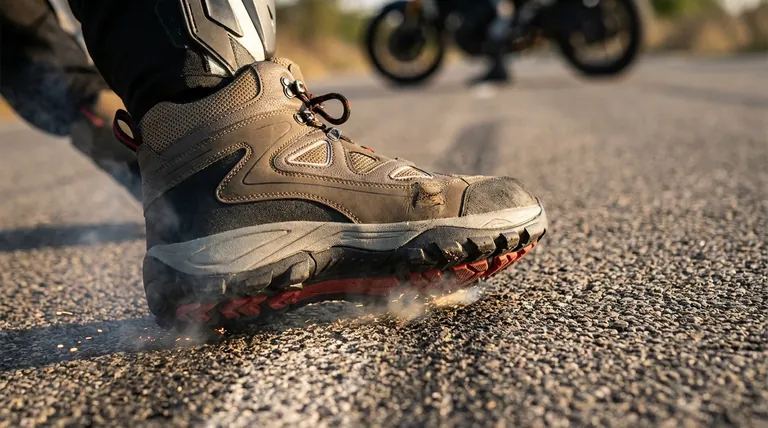
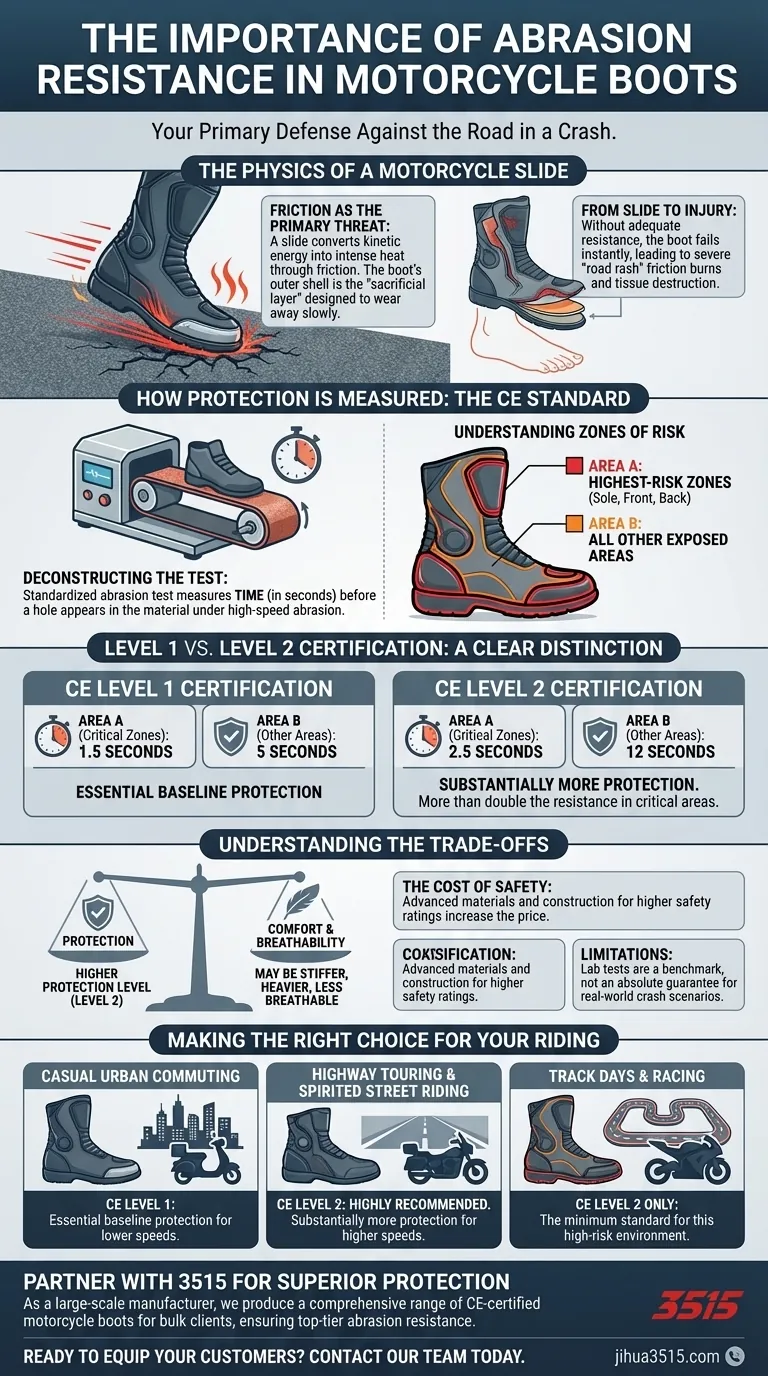
When you fall from a moving motorcycle, your body doesn't just stop. It slides, converting kinetic energy into heat through friction against the road surface.
The outer shell of your boot is designed to be the sacrificial layer in this scenario. It is engineered to wear away slowly, absorbing that frictional force so your foot doesn't have to.
From Slide to Injury
Without adequate abrasion resistance, the boot material fails almost instantly. This leads to "road rash," which is not a minor scrape but a severe friction burn that can destroy layers of skin, muscle, and tissue, often requiring skin grafts and long recovery periods.
How Protection is Measured: The CE Standard
Deconstructing the Test
To provide an objective measure, boots are certified using a standardized abrasion test. A sample of the boot's material is placed on a machine and subjected to an abrasive belt moving at high speed.
The test measures one simple thing: time. Specifically, it measures how many seconds the material can endure the abrasion before a hole appears.
Understanding Zones of Risk (Area A vs. Area B)
Testers recognize that not all parts of a boot face the same risk. They divide the boot into two key zones for testing:
- Area A: The highest-risk zones, including the sole and the front and back of the boot.
- Area B: All other exposed areas.
Level 1 vs. Level 2: A Clear Distinction
The results of this time-based test determine the boot's protection level. There are two certified levels of protection:
Level 1 Certification requires the material to withstand:
- 1.5 seconds in Area A.
- 5 seconds in Area B.
Level 2 Certification requires a significantly higher level of protection:
- 2.5 seconds in Area A.
- 12 seconds in Area B.
As you can see, a Level 2 certified boot offers more than double the abrasion resistance in the most critical areas compared to a Level 1 boot.
Understanding the Trade-offs
Protection vs. Comfort
There is often a direct trade-off between the highest levels of abrasion resistance and comfort. Thicker, tougher materials required for Level 2 certification can make a boot stiffer, heavier, and less breathable.
The Cost of Safety
Materials and construction methods that achieve higher safety ratings are more advanced and expensive. As a result, Level 2 certified boots almost always come at a higher price point than Level 1 boots.
Limitations of the Standard
While the CE test is an excellent benchmark, it is a controlled lab environment. Real-world slides involve tumbling, varying surfaces, and multiple impacts. A certified rating is your best guide, but not an absolute guarantee of invincibility.
Making the Right Choice for Your Riding
A boot's abrasion resistance rating is the clearest indicator of its protective capability in a slide. Your choice should directly reflect your type of riding.
- If your primary focus is casual urban commuting: A CE Level 1 certified boot provides an essential baseline of protection appropriate for lower-speed environments.
- If your primary focus is highway touring or spirited street riding: A CE Level 2 certified boot is highly recommended, as it offers substantially more protection for the higher speeds involved.
- If your primary focus is track days or racing: Only a CE Level 2 boot should be considered, as this represents the minimum standard for such a high-risk environment.
Choosing a boot based on its certified abrasion resistance is one of the most critical safety decisions a rider can make.
Summary Table:
| Protection Level | Area A (Critical Zones) | Area B (Other Areas) |
|---|---|---|
| CE Level 1 | 1.5 seconds | 5 seconds |
| CE Level 2 | 2.5 seconds | 12 seconds |
As a large-scale manufacturer, 3515 produces a comprehensive range of CE-certified motorcycle boots for distributors, brand owners, and bulk clients. Our production capabilities ensure top-tier abrasion resistance and safety standards for every type of rider. Ready to equip your customers with superior protection? Contact our team today to discuss your manufacturing needs.
Visual Guide
Related Products
- High Performance Fire-Retardant Waterproof Safety Boots
- Wholesale Tactical Boots High-Traction & Reflective for Bulk & Brand Orders
- Premium High-Cut Waterproof Safety Boots Manufacturing & Wholesale Solutions
- Durable Goodyear Welt Leather Work Boots for Wholesale & Private Label
- Wholesale High-Traction Camo Boots - Custom Manufacturer for Brands
People Also Ask
- Why are waterproof safety boots recommended for certain work environments? Essential Protection for Wet & Hazardous Jobs
- What roles do 3D vision systems and industrial robots play in the manufacturing of fire safety boots? Smart Automation
- What is the difference between waterproof and water-resistant boots? Choose the Right Footwear for Any Condition
- What should you look for to ensure boots are fully waterproof? The Essential 2-Part System
- What's the difference between waterproof and water-resistant boots? Choose the Right Footwear for Your Environment