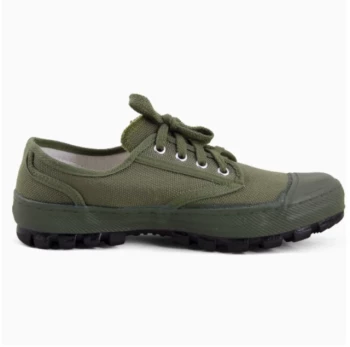
High-load functional footwear embeds composite fiber reinforced inserts to counteract the significant deformation that standard soles experience under heavy weight. These inserts utilize inherent high strength and elasticity to maintain structural integrity, ensuring the heel does not collapse when subjected to intense pressure.
Standard shoe materials often lose their shape under extreme pressure, compromising stability. The composite insert acts as a rigid yet elastic internal skeleton, preserving the shoe's geometry to optimize biomechanical efficiency and prevent injury.
The Mechanics of Load Management
Combating Material Deformation
Standard sole materials are generally designed for cushioning, making them prone to deformation when carrying heavy loads.
Without reinforcement, the heel area compresses significantly. This compression alters the geometry of the shoe, destabilizing the wearer's foundation.
Leveraging High Strength and Elasticity
Composite fiber reinforced inserts are engineered to possess both high strength and elasticity.
This combination allows the insert to resist crushing forces while maintaining resilience. It creates a sturdy support structure that standard foam or rubber cannot provide on its own.
Biomechanical Control and Stability
Controlling Foot Movement
When a sole collapses under weight, the foot is often forced into unnatural positions.
The reinforced insert actively controls excessive pronation (rolling inward) and supination (rolling outward). By maintaining a stable platform, it keeps the foot aligned with the leg.
Enhancing Walking Efficiency
Instability causes the body to waste energy trying to balance.
By preventing the sole from collapsing, the insert enhances overall walking stability. This leads to greater biomechanical efficiency, allowing for smoother movement even when bearing significant weight.
Understanding the Trade-offs
Rigidity vs. Compliance
The primary goal of these inserts is to provide a rigid boundary against collapse.
However, this increased structural integrity naturally results in a stiffer ride. Users accustomed to ultra-soft, unreinforced footwear may find the heel area feels harder or less forgiving during initial use.
Specialized Functionality
This design is specifically optimized for high-load scenarios.
While beneficial for carrying weight, the aggressive support structure may be overkill for casual, unladen walking. The features that prevent collapse under 50lbs of gear may feel unnecessary during a light commute.
Making the Right Choice for Your Goal
Selecting the correct footwear depends on the specific demands you place on your equipment.
- If your primary focus is carrying heavy loads: Prioritize footwear with composite reinforcement to prevent heel collapse and maximize energy efficiency.
- If your primary focus is stability on uneven terrain: Look for this feature to strictly control pronation and supination, reducing the risk of rolling an ankle.
The composite insert essentially transforms the heel from a passive cushion into an active structural tool for load management.
Summary Table:
| Feature | Standard Sole Material | Composite Fiber Insert |
|---|---|---|
| Load Response | Compresses and deforms | Maintains structural shape |
| Strength/Elasticity | Low to moderate | Exceptionally high |
| Stability Control | Passive / Minimal | Active pronation/supination control |
| Durability | Wears out under heavy weight | Long-term resistance to crushing |
| Best For | Casual walking & light activities | Heavy load bearing & tactical use |
Elevate Your Product Performance with 3515 Footwear
As a large-scale manufacturer serving global distributors and brand owners, 3515 offers professional-grade production capabilities for all functional footwear. Whether you need the structural integrity of our flagship Safety Shoes or high-performance tactical, outdoor, and training footwear, we provide the technical expertise to integrate advanced composite reinforcements for your bulk requirements.
From rugged work boots to sophisticated Dress & Formal shoes, our manufacturing scale ensures quality and reliability at every step. Contact us today to discuss your production needs and see how our engineering can strengthen your brand's footwear lineup.
References
- Verônica Cimolin, Paolo Capodaglio. A Comparative Analysis of Shoes Designed for Subjects with Obesity Using a Single Inertial Sensor: Preliminary Results. DOI: 10.3390/s22030782
This article is also based on technical information from 3515 Knowledge Base .
Related Products
- Durable High-Ankle Tactical Boots Wholesale Manufacturer for Custom & Bulk Orders
- Durable High-Ankle Tactical Boots for Wholesale & Custom Manufacturing
- High-Traction Suede Tactical Boots Wholesale & Custom Manufacturing
- Durable Leather High-Ankle Tactical Boots for Wholesale & Custom Manufacturing
- Wholesale Tactical Boots High-Traction & Reflective for Bulk & Brand Orders
People Also Ask
- What specialized protections do tactical boots offer? Maximize Endurance with High-Performance Footwear
- How do tactical boots protect against injuries? Discover the Integrated Safety System
- What are the ideal use cases for tactical boots? Empower Your Performance in Demanding Scenarios
- Can tactical boots be stylish for everyday wear? Yes, with the right styling and features.
- What are the primary benefits of wearing tactical boots for everyday use? Get All-Day Comfort & Durability