
At its core, a wide toe box is important in a work boot because it allows your foot to function naturally. By giving your toes the space to spread out, or "splay," it enhances your stability, prevents painful conditions like blisters and bunions, and dramatically increases comfort over a long workday.
A wide toe box is not a luxury feature; it is a fundamental requirement for long-term foot health and on-the-job endurance. It allows your feet to act as a natural, stable foundation, which is critical for anyone who spends hours standing, walking, or working.
The Problem with Conventional Boot Design
For decades, footwear design has often prioritized a tapered aesthetic over anatomical function. In a demanding work environment, this design flaw has significant consequences.
The Impact of Toe Compression
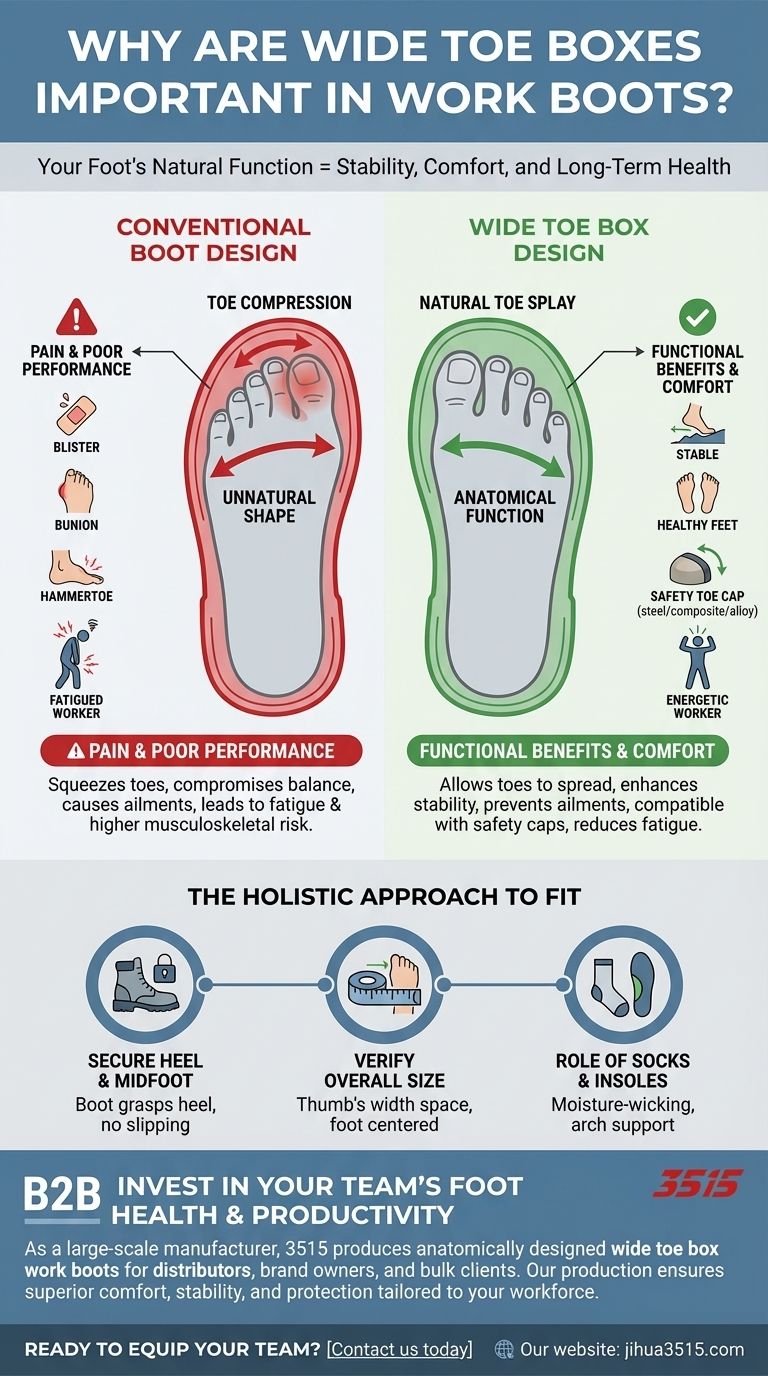
Most standard work boots squeeze your toes together into an unnatural, pointed shape. This constant compression prevents the foot from bearing weight as it was designed to.
Your toes are meant to spread under load, providing a wide, stable base of support. When they are forced together, your balance is compromised, and pressure is unevenly distributed across your foot.
The Result: Pain and Poor Performance
This compression is a direct cause of common foot ailments. Blisters, bunions, hammertoes, and nerve pain are often the direct result of a toe box that is too narrow.
Over an 8 or 12-hour shift, this discomfort leads to fatigue, reduced focus, and a higher risk of musculoskeletal issues extending to your ankles, knees, and back.
The Functional Benefits of a Wide Toe Box
Choosing a work boot with an appropriately wide, anatomically shaped toe box is one of the most effective ways to protect your long-term health and comfort on the job.
It Enables Natural Foot Splay
The most critical benefit is allowing for natural toe splay. When your toes can spread freely, they create a wider, more stable foundation for every step you take. This is essential for maintaining balance on uneven surfaces and for generating power when lifting or pushing.
It Prevents Common Foot Ailments
By eliminating the lateral pressure on your toes, a wide toe box drastically reduces the friction that causes blisters. More importantly, it helps prevent the gradual development of chronic conditions like bunions, which are deformities caused by long-term pressure on the big toe joint.
It Works With Safety Toes
Protective toe caps are essential in hazardous environments. Modern safety boots are often designed with wider safety caps—whether steel, composite, or alloy—to provide certified impact and compression protection without cramping your toes. A steel toe, in particular, often provides a naturally roomier fit.
A Wide Toe Box is Only Part of the Equation
While critical, a spacious toe box cannot compensate for a boot that fits poorly in other areas. Achieving true comfort and support requires a holistic approach to fit.
Secure Your Heel and Midfoot
A proper fit means the boot firmly grasps your heel and midfoot while allowing the toes to move. Your heel should not lift or slip when you walk. Use proper lacing techniques to ensure your foot is locked into the back of the boot.
Verify the Overall Size
Boot sizing can vary significantly between manufacturers. A wide toe box in a boot that is too short or too long is ineffective. Always ensure your foot feels centered and you have a thumb's width of space between your longest toe and the end of the boot.
The Role of Socks and Insoles
The right accessories complete the system. Moisture-wicking socks prevent the sweat and friction that lead to blisters, while cushioned socks or custom insoles can provide necessary arch support that the boot alone may lack.
Making the Right Choice for Your Goal
Your specific job and physical needs should guide your final decision.
- If your primary focus is maximum protection in hazardous environments: Seek a certified safety toe boot (steel, composite, or alloy) that is specifically built on an anatomically shaped last with a wide toe box.
- If your primary focus is agility and all-day movement: A soft toe work boot with a wide toe box offers the best combination of flexibility, light weight, and natural foot function.
- If you are trying to solve existing foot pain: Prioritize a boot with the widest possible toe box to relieve pressure, and complement it with supportive insoles to address any underlying arch or alignment issues.
Ultimately, choosing a boot that respects the natural shape of your foot is a direct investment in your daily comfort and long-term well-being.
Summary Table:
| Benefit | Key Impact |
|---|---|
| Natural Toe Splay | Enhances stability and balance on uneven surfaces. |
| Prevents Foot Ailments | Reduces risk of blisters, bunions, and hammertoes. |
| Compatible with Safety Toes | Offers protection without compromising toe room. |
| Reduces Fatigue | Improves comfort and focus during long shifts. |
Invest in Your Team's Foot Health and Productivity
As a large-scale manufacturer, 3515 produces a comprehensive range of work boots with anatomically designed wide toe boxes for distributors, brand owners, and bulk clients. Our production capabilities ensure superior comfort, stability, and protection tailored to the demands of your workforce.
Ready to equip your team with boots that support long-term health and performance? Contact us today to discuss your specific needs and explore our catalog!
Visual Guide
Related Products
- Durable Leather Moc Toe Work Boots for Wholesale & Custom Manufacturing
- Durable Moc-Toe Wedge Work Boots | Wholesale Manufacturing for Brands
- Wholesale Durable Safety Boots Manufacturer Customizable Steel Toe Work Boots
- Durable Moc Toe Wedge Sole Work Boots for Wholesale and Private Label
- Wholesale Durable 6-Inch Work Boots | Custom & Private Label Manufacturer
People Also Ask
- What are moc toe work boots designed for? Superior Comfort and Mobility for Tradespeople
- What are the key features to look for when purchasing moc toe boots? A Guide to Durability & Fit
- How did moc toe boots originate? A Legacy of Workwear Durability and Style
- What clothing items complement the Outdoorsman/Heritage Look with moc toe boots? Build a Timeless, Rugged Wardrobe
- What types of outfits can moc toe boots be worn with? Versatile Style Guide











