
Riding boots are far more than just footwear. They are a critical investment in your safety, your ability to communicate effectively with your horse, and your long-term performance in the saddle. Their value is measured not just in cost, but in years of reliable function, protection, and support.
The true investment in a riding boot lies in its specialized design for equestrian-specific needs. A quality boot provides essential safety features, enhances leg stability for clearer communication with the horse, and is built from durable materials to withstand the rigors of the barn for years.

The Functional Pillars of a Riding Boot
To understand the value of a riding boot, you must first see it as a piece of specialized equipment. Each feature is purpose-built to address the unique demands of being in the saddle.
Ensuring Rider Safety
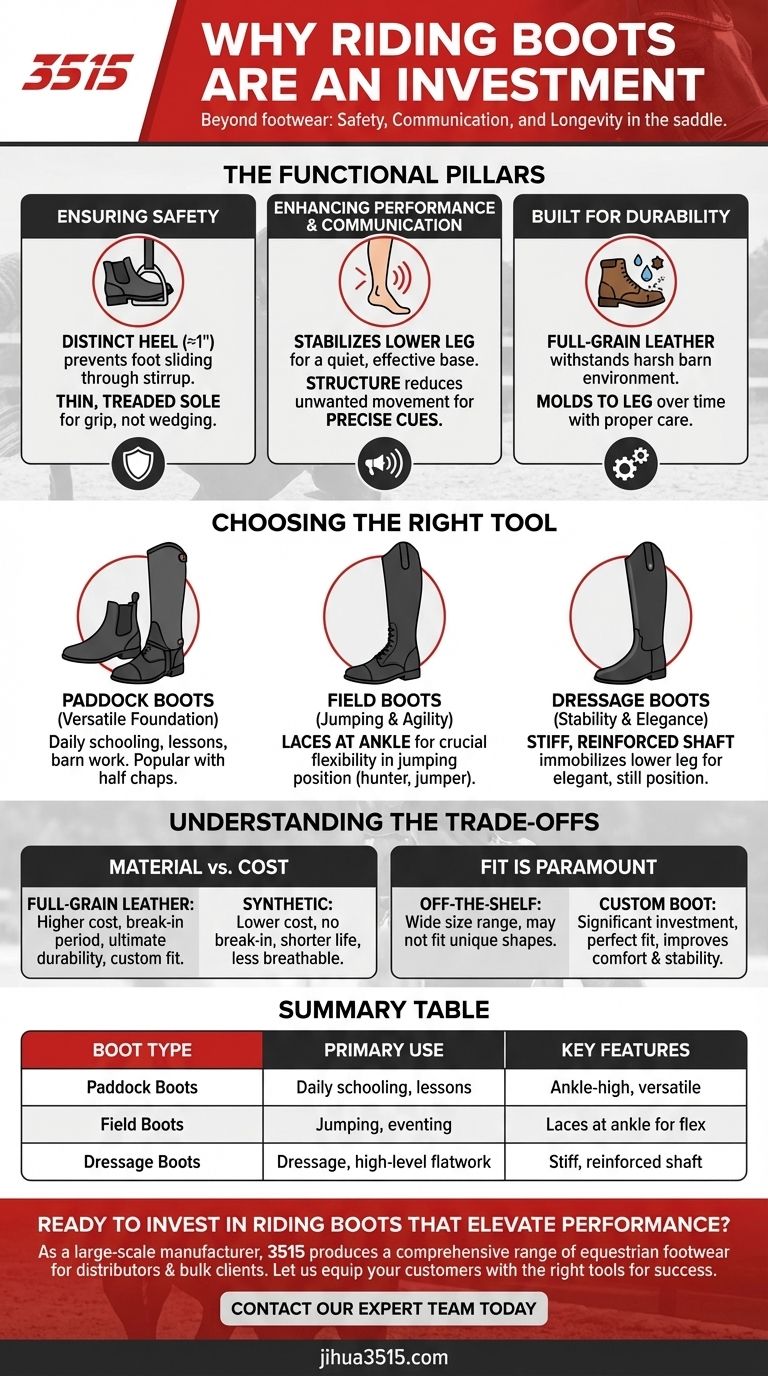
A proper riding boot is your first line of defense against common accidents. Its most critical safety feature is the distinct heel, typically about one inch high.
This heel is designed to prevent your foot from accidentally sliding all the way through the stirrup, a dangerous situation that could lead to being dragged in a fall. The boot also has a thin, treaded sole that provides just enough grip without being so thick that it gets wedged in the stirrup.
Enhancing Performance and Communication
Your leg is the primary tool for communicating with your horse. A well-designed boot stabilizes your lower leg, creating a quieter, more effective base from which to give aids.
The structure of the boot, from the ankle support to the stiffness of the shaft, reduces unwanted muscle movement. This allows for more precise, subtle cues, which is the hallmark of advanced riding.
Built for Durability and Longevity
The equestrian environment is harsh. Boots are exposed to dirt, moisture, manure, and constant friction against the saddle.
An investment in boots made from materials like full-grain or calfskin leather pays off over time. These materials, when properly cared for, can last for many years, molding to your leg for a custom-like fit and withstanding daily wear and tear far better than cheaper alternatives.
Choosing the Right Tool for the Discipline
The type of boot you invest in should directly reflect your primary riding discipline. Each style is engineered to solve a different set of challenges.
Paddock Boots: The Versatile Foundation
Also known as jodhpur boots, these ankle-high boots are the workhorses of the equestrian world. They are a practical choice for daily schooling, lessons, and barn work.
When paired with half chaps (leather coverings for the lower leg), they offer the look and function of a tall boot, making them a popular and cost-effective choice for riders who are growing or who participate in multiple activities.
Field Boots: For Jumping and Agility
Field boots are a type of tall boot easily identified by the laces at the ankle. This feature is not just for style.
The laces provide crucial flexibility, allowing the rider's heel to drop down comfortably when in a two-point or jumping position. This makes them the standard for hunter, jumper, and eventing disciplines.
Dressage Boots: For Stability and Elegance
Dressage boots are the most formal and rigid type of tall boot. They have a very stiff, reinforced outer shaft and typically a full-length zipper on the inner side of the calf.
This rigidity is intentional. It helps to immobilize the rider's lower leg, encouraging a long, still, and elegant leg position essential for the subtle aids required in high-level dressage.
Understanding the Trade-offs
Investing in the right boot requires balancing cost, materials, and long-term function. There is no single "best" boot, only the best boot for a specific need.
Material vs. Cost
Full-grain leather offers the ultimate in durability, breathability, and a custom-molded fit over time, but it comes at a higher initial price and requires a break-in period.
Manmade synthetic materials offer a lower entry price and no break-in time, but they typically have a much shorter lifespan and are less breathable, which can be uncomfortable.
The Myth of "One Size Fits All"
Fit is paramount. A poorly fitting boot, no matter how expensive, will hinder your riding and cause discomfort.
Off-the-shelf boots come in a wide range of sizes, but they may not accommodate unique calf or ankle shapes. A custom boot is a significant financial investment, but it provides a perfect fit that can dramatically improve comfort and leg stability.
Making the Right Investment for Your Goals
Your ideal boot depends entirely on your primary riding activities and long-term ambitions.
- If your primary focus is daily schooling and versatility: A quality pair of leather paddock boots combined with half-chaps offers the best balance of function and value.
- If your primary focus is competitive jumping (hunters or jumpers): Field boots are specifically designed to provide the ankle flexibility required for a secure position over fences.
- If your primary focus is dressage: The rigidity of a dedicated dressage boot is a non-negotiable tool for achieving the necessary leg stability and stillness.
Choosing the right boot is an investment in your safety, your progress as a rider, and your partnership with your horse.
Summary Table:
| Boot Type | Primary Use | Key Features |
|---|---|---|
| Paddock Boots | Daily schooling, lessons, barn work | Ankle-high, versatile, often paired with half chaps |
| Field Boots | Jumping, eventing, agility | Laces at ankle for flexibility in jumping position |
| Dressage Boots | Dressage, high-level flatwork | Stiff, reinforced shaft for leg stability and stillness |
Ready to invest in riding boots that elevate your performance?
As a large-scale manufacturer, 3515 produces a comprehensive range of equestrian footwear for distributors, brand owners, and bulk clients. Our production capabilities encompass all types of riding boots—from durable paddock boots to specialized field and dressage boots—ensuring superior safety, communication, and longevity for riders.
Let us help you equip your customers with the right tools for success. Contact our expert team today to discuss your specific needs and discover how our quality manufacturing can support your business.
Visual Guide
Related Products
- Heavy-Duty Waterproof Nubuck Safety Boots Safety Shoes for Bulk Supply
- Premium Wholesale Tactical Style Safety Shoes Boots with Quick Lacing
- Wholesale High-Traction Camo Boots - Custom Manufacturer for Brands
- Durable Goodyear Welt Leather Work Boots for Wholesale & Private Label
- Wholesale Tactical Boots High-Traction & Reflective for Bulk & Brand Orders
People Also Ask
- What primary protective functions do professional safety boots provide in urban solid waste recovery and waste picking processes? Discover Dual-Layer Protection.
- How do safety boots reduce cutting hazards? Essential Protection for Your Workforce
- Which organizations develop safety standards for work boots? Ensure Compliance & Worker Safety
- What are the common types of safety boots and their primary uses? A Guide to Industrial Footwear
- Why is ankle and arch support important in safety footwear? Prevent Injury & Fatigue



















