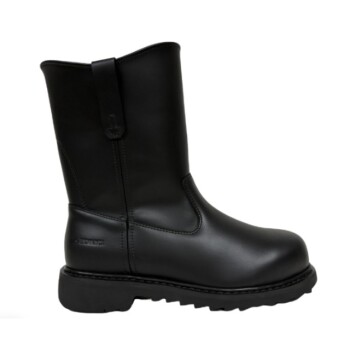
High-rigidity carbon fiber inserts are essential because they transform a standard, flexible shoe into a rigid-bottom stabilizer. By significantly increasing the bending and torsional resistance of the sole, these inserts limit abnormal motion in the forefoot, directly reducing the mechanical stress placed on the metatarsals during movement.
The biological healing of a fracture requires a stable physical environment. Carbon fiber inserts provide this by acting as a rigid stabilizer that minimizes forefoot motion and alleviates the mechanical load on the healing bone.
The Biomechanics of Stabilization
To understand why these inserts are required, one must look at how they alter the mechanics of the shoe to protect the foot structure.
Enhancing Bending Resistance
The primary function of a high-rigidity carbon fiber insert is to drastically increase the stiffness of the shoe sole.
Standard footwear allows the foot to flex, which is beneficial for normal walking but detrimental to a fractured metatarsal.
By inserting this rigid layer, you effectively prevent the sole from bending, shielding the forefoot from the forces generated during the push-off phase of walking.
Preventing Torsional Twisting
In addition to stopping forward bending, these inserts enhance the torsional resistance of the shoe.
This prevents the shoe—and consequently the foot—from twisting side-to-side during uneven steps or weight shifts.
Acting as a rigid-bottom stabilizer, the insert restricts abnormal motion that could disrupt the alignment of the fracture.
Facilitating Biological Healing
The mechanical intervention provided by the insert is directly linked to the biological requirements of bone recovery.
Reducing Mechanical Stress
The immediate goal of conservative treatment is to lower the mechanical stress applied to the metatarsals.
By restricting motion in the forefoot, the insert redistributes forces away from the injured area during walking and recovery exercises.
Creating a Stable Environment
Bones cannot heal effectively if they are constantly subjected to micro-movements and strain.
The insert creates a stable physical environment, which is the prerequisite for biological healing at the fracture site.
This stability ensures that the body's natural repair processes can occur without disruption caused by daily activity.
Understanding the Trade-offs
While high-rigidity inserts are critical for healing, they fundamentally alter the dynamics of walking.
Sacrifice of Natural Motion
The insert works by intentionally sacrificing the foot's natural flexibility.
You are trading the ability to roll through a natural step for the necessary protection of the bone structure.
This restriction is not a side effect but the intended mechanism: normal motion must be suspended to prevent further injury.
Making the Right Choice for Your Recovery
The use of high-rigidity inserts is a calculated decision to prioritize structural integrity over flexibility during the healing window.
- If your primary focus is biological healing: You must prioritize the use of the insert to minimize mechanical stress and ensure the bone remains undisturbed.
- If your primary focus is mobility during recovery: Recognize that the insert allows you to remain ambulatory (walking) only because it artificially restricts the motion that would otherwise cause damage.
By rigidly stabilizing the foundation of the foot, you provide the silence the bone needs to knit itself back together.
Summary Table:
| Feature | Function | Benefit for Stress Fractures |
|---|---|---|
| High Bending Resistance | Prevents sole flexion during push-off | Shields forefoot from mechanical load |
| Torsional Stability | Restricts side-to-side twisting | Maintains alignment and reduces micro-movements |
| Rigid-Bottom Design | Transforms flexible shoes into stabilizers | Creates the physical environment needed for bone repair |
| Load Redistribution | Shifts force away from metatarsals | Minimizes pain and prevents further injury during recovery |
Partner with 3515 for High-Performance Footwear Solutions
As a large-scale manufacturer serving global distributors and brand owners, 3515 provides professional-grade production capabilities across all footwear categories. Our flagship Safety Shoes series is engineered for maximum durability, while our extensive portfolio—including tactical boots, outdoor shoes, sneakers, and formal dress shoes—meets the highest standards for structural integrity and comfort.
Whether you need rigid-bottom stabilizers for medical recovery lines or high-performance work boots for bulk distribution, our expertise ensures your brand delivers superior protection to the end-user. Contact us today to discuss your bulk requirements and see how our manufacturing excellence can add value to your product line.
References
- Philip Catalá-Lehnen. Stress Fractures in Sports. DOI: 10.31579/2690-1897/098
This article is also based on technical information from 3515 Knowledge Base .
Related Products
- Durable High-Ankle Tactical Boots Wholesale Manufacturer for Custom & Bulk Orders
- Wholesale Durable Safety Boots Manufacturer Customizable Steel Toe Work Boots
- Heavy-Duty Goodyear Welted Pull-On Safety Rigger Boot
- Durable Leather High-Ankle Tactical Boots for Wholesale & Custom Manufacturing
- Wholesale Modern Business Shoes with Dial Closure System for Bulk Orders
People Also Ask
- What specialized protections do tactical boots offer? Maximize Endurance with High-Performance Footwear
- How do tactical boots protect against injuries? Discover the Integrated Safety System
- What are the ideal use cases for tactical boots? Empower Your Performance in Demanding Scenarios
- Can tactical boots be stylish for everyday wear? Yes, with the right styling and features.
- What are the primary benefits of wearing tactical boots for everyday use? Get All-Day Comfort & Durability