Rubber floor tiles act as the standardized foundation layer for foot haptic research platforms, serving distinct functions beyond simple flooring. They primarily provide essential safety cushioning and noise suppression while creating a uniform support surface for various test materials. This setup ensures that the physical baseline of the experiment remains consistent, isolating the specific variables being tested from the irregularities of the building's structure.
The Core Objective: Variable Isolation Rubber tiles do more than protect the user; they protect the data. By standardizing physical damping and surface uniformity, the rubber base prevents external environmental factors—such as uneven concrete or acoustic feedback—from corrupting the subject’s tactile perception.
Ensuring Data Integrity and Precision
Eliminating Perceptual Bias
Building floors are rarely perfectly flat or mechanically consistent. Rubber tiles create a uniform support layer underneath all test materials.
This prevents subjects from subconsciously detecting irregularities in the rigid sub-floor. By removing these inconsistent inputs, you prevent perceptual bias that creates false positives in haptic feedback data.
Enhancing Experimental Repeatability
Reliable research demands that every footstep yields comparable data. Rubber offers consistent physical damping properties across the entire testing area.
This consistency ensures that ground reaction forces remain within controllable baseline values. Regardless of the gait being tested, the "return" force from the floor remains predictable, increasing the repeatability of your results.
Managing Environmental Factors
Essential Safety Cushioning
Foot haptic research often involves testing unstable textures or requiring subjects to adopt unnatural gaits. The rubber base serves as a critical safety net.
It acts as a shock absorber during these experiments. This protects subjects from potential impact injuries or fatigue caused by repetitive strikes against hard surfaces.
Acoustic Control and Noise Suppression
Sensory perception is multisensory; what a subject hears can influence what they feel. Hard interactions with building floors generate auditory cues that can confuse data.
Rubber tiles provide necessary noise suppression. This dampening ensures that the subject focuses solely on tactile sensations, rather than inferring surface properties from the sound of their footsteps.
Understanding Implementation Trade-offs
Balancing Damping and Feedback
While damping is essential for baseline control, it introduces a mechanical variable. The rubber must absorb noise and shock without absorbing the intended haptic signal.
If the rubber base is too compliant, it may dampen the specific tactile feedback of the test material placed on top. The goal is a firm foundation that neutralizes the sub-floor without masking the experiment.
Optimizing Your Experimental Setup
To ensure your environment supports valid research, select your foundation based on your specific experimental needs:
- If your primary focus is reducing bias: Ensure the tiles provide a completely level surface to eliminate any proprioceptive cues caused by the underlying building floor.
- If your primary focus is gait analysis: Prioritize tiles with consistent density to keep ground reaction forces standardized across all trials.
By treating the sub-floor as a controlled variable rather than a passive element, you secure the validity of your haptic research.
Summary Table:
| Function | Benefit to Research | Impact on Data Quality |
|---|---|---|
| Variable Isolation | Neutralizes sub-floor irregularities | Eliminates perceptual bias |
| Physical Damping | Provides consistent ground reaction forces | Enhances experimental repeatability |
| Noise Suppression | Eliminates auditory cues from footsteps | Ensures pure tactile sensory focus |
| Safety Cushioning | Absorbs shock during gait testing | Protects subjects from impact/fatigue |
Elevate Your Specialized Footwear Development with 3515
As a premier large-scale manufacturer serving global distributors and brand owners, 3515 delivers the precision and durability required for high-performance footwear. Whether you are conducting foot haptic research or developing commercial products, our comprehensive production capabilities—ranging from our flagship Safety Shoes to tactical boots, sneakers, and formal dress shoes—ensure your bulk requirements are met with unparalleled quality.
Partner with a leader in footwear engineering to bring your designs to life. Contact us today to discuss your production needs!
References
- Jack Topliss, Thammathip Piumsomboon. Manipulating Underfoot Tactile Perceptions of Flooring Materials in Augmented Virtuality. DOI: 10.3390/app132413106
This article is also based on technical information from 3515 Knowledge Base .
Related Products
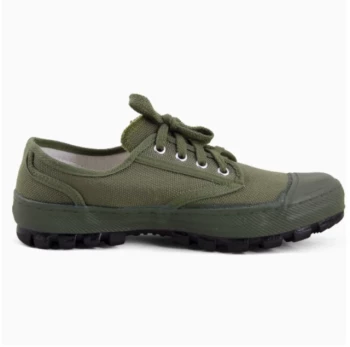
- Wholesale Durable Camouflage Canvas Shoes with High-Traction Cleated Rubber Sole
- Durable Rubber Sole Outdoor Shoes Wholesale & Custom Manufacturing
- Durable High-Traction Canvas Sneakers Wholesale & Custom Manufacturing
- Lightweight Breathable Sneakers with Wet-Traction Grip for Wholesale & Private Label
- Wholesale Durable Safety Boots Manufacturer Customizable Steel Toe Work Boots
People Also Ask
- Why is the selection of high-strength fabric materials necessary in the production of canvas shoes and training shoes?
- What are the properties of canvas as a shoe material? A Guide to Lightweight Comfort & Style
- Can canvas shoes be worn in rainy conditions? The Truth About Water Resistance
- What are some examples of vulcanized shoes? Discover the Flexibility and Board Feel of Classic Sneakers
- What are the characteristics of canvas as a shoe material? A Guide to Lightweight, Breathable Footwear