
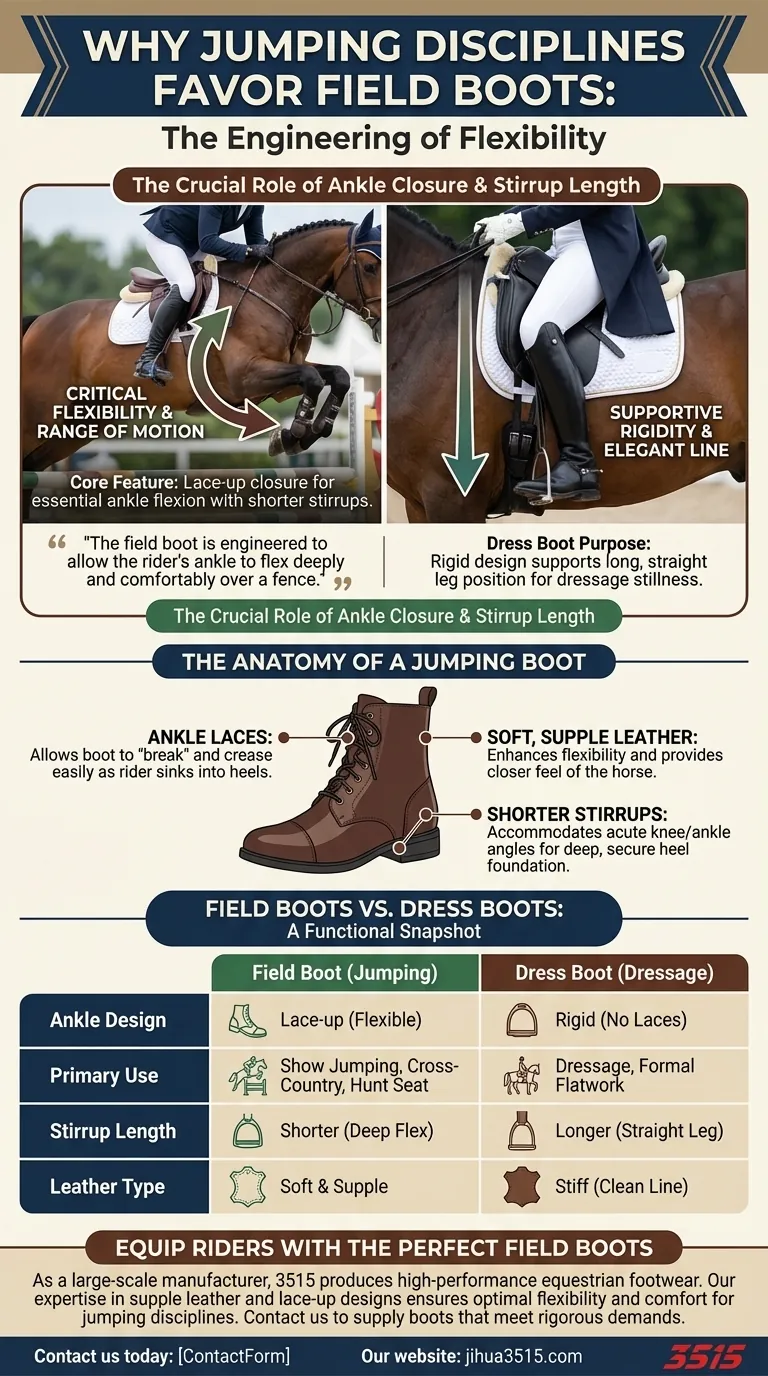
At its core, the preference for field boots in jumping disciplines comes down to a single, critical feature: the lace-up closure at the ankle. This design is not merely stylistic; it is a direct engineering solution that provides the essential ankle flexibility required for riding with the shorter stirrups used in show jumping, cross-country, and hunt seat equitation.
The fundamental difference is one of function. While a rigid dress boot is designed for the long, still leg of a dressage rider, the field boot is engineered to allow the rider's ankle to flex deeply and comfortably over a fence.

The Anatomy of a Jumping Boot
The design of a field boot is entirely centered on accommodating the unique physical demands of riding over fences. This requires a boot that can move with the rider, not against them.
The Critical Role of Ankle Laces
The most defining feature of a field boot is the lacing at the instep. This small section allows the boot to "break" or crease easily as the rider sinks their weight into their heels.
Without this feature, a tall leather boot would pinch and restrict the ankle's range of motion, making it uncomfortable and difficult to maintain proper balance.
Shorter Stirrups Demand More Flex
Riders in jumping disciplines use much shorter stirrup lengths than those who ride on the flat. This creates a more acute angle in the knee and ankle joints.
The field boot's flexible design accommodates this severe angle, allowing the rider to maintain a deep, secure heel, which is the foundation of a stable jumping position.
Soft Leather for Enhanced Feel
Field boots are typically crafted from very soft and supple leather. This complements the lace-up design, further enhancing flexibility.
This soft construction also allows the rider to have a closer feel of the horse's sides, aiding in the subtle communication required at high speeds and over complex courses.
Field Boots vs. Dress Boots: A Functional Comparison
Understanding the field boot is easier when you compare it to its formal counterpart, the dress boot. Each is a specialized tool for a different job.
The Purpose of the Dress Boot
Dress boots, favored in dressage, are intentionally more rigid. They lack ankle laces, presenting a clean, uninterrupted line from top to bottom.
This rigidity provides support for the rider's long, straight leg position, promoting stillness and formal elegance, which are the hallmarks of the dressage discipline. Extreme ankle flexion is not a requirement.
Where Crossover Occurs
While specialized, it is not uncommon to see riders use field boots for flatwork. Their inherent comfort and flexibility make them a versatile choice.
However, using a stiff dress boot for jumping is highly impractical and uncomfortable. It actively works against the rider's need for a flexible ankle and deep heel.
Making the Right Choice for Your Discipline
Selecting the correct boot is crucial for both comfort and effectiveness in the saddle. Your decision should be guided entirely by your primary riding activity.
- If your primary focus is show jumping, cross-country, or hunt seat equitation: The superior ankle flexibility of a field boot is non-negotiable for proper form and comfort.
- If your primary focus is dressage or formal flatwork: The supportive rigidity and clean aesthetic of a dress boot are specifically designed to complement your position.
- If you are a multi-discipline rider on a single budget: A quality field boot offers the most versatility, as it is comfortable for flatwork and essential for jumping.
Ultimately, choosing the right boot is about matching your equipment to the specific athletic demands of your discipline.
Summary Table:
| Feature | Field Boot (Jumping) | Dress Boot (Dressage) |
|---|---|---|
| Ankle Design | Lace-up closure for flexibility | Rigid, no laces for support |
| Primary Use | Show jumping, cross-country, hunt seat | Dressage, formal flatwork |
| Stirrup Length | Shorter, requiring deep ankle flexion | Longer, promoting a straight leg |
| Leather Type | Soft and supple for enhanced feel | Stiff for a clean, elegant line |
Ready to equip riders with the perfect field boots? As a large-scale manufacturer, 3515 produces a comprehensive range of high-performance equestrian footwear for distributors, brand owners, and bulk clients. Our expertise in crafting supple leather boots with functional lace-up designs ensures optimal ankle flexibility and rider comfort. Let us help you supply boots that meet the rigorous demands of jumping disciplines. Contact us today to discuss your production needs!
Visual Guide
Related Products
- Durable Military Combat Boots with Water Drainage for Wholesale & OEM
- Wholesale Lightweight Tactical Boots Custom Manufacturer for Desert & Combat Use
- High-Traction Suede Tactical Boots Wholesale & Custom Manufacturing
- Durable Leather Tactical Boots Wholesale & Custom Manufacturing for Brands
- Durable Leather Work Boots for Wholesale & Custom Manufacturing
People Also Ask
- Why must gait validation for military applications be conducted in combat boots? Ensure Data Accuracy for Soldiers
- What are the common types of combat boots? Find the Right Boot for Your Mission
- What factors should be considered when choosing military boots for hiking? Durability vs. Weight for Your Terrain
- What are the key considerations when choosing military boots? Prioritize Compliance, Environment & Fit
- How should the midfoot and heel fit in military boots? Achieve a Snug, Secure Fit for Blister Prevention


















