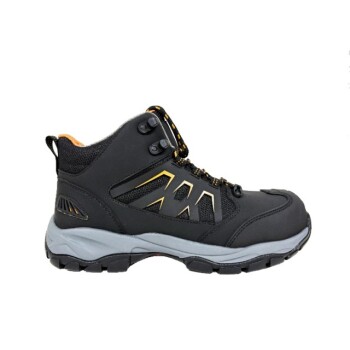
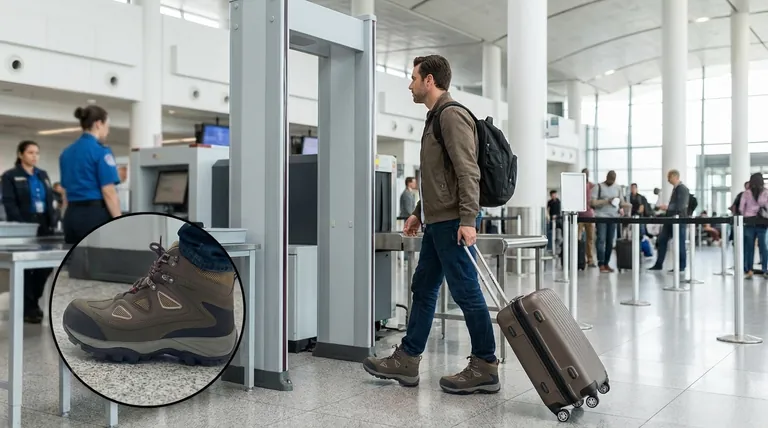
For FIFO workers and frequent travelers, the primary advantage of composite toe boots is their non-metallic construction. This allows you to pass through airport security and other high-security checkpoints without triggering metal detectors, eliminating a significant travel hassle while still meeting mandatory worksite safety standards.
The core insight is that composite toe boots resolve the conflict between worksite compliance and travel efficiency. They merge the protective qualities of a traditional safety boot with the lightweight, metal-free convenience required by the modern mobile professional.
The Airport Advantage: Seamless Security Screening
For anyone whose job involves regular flights, the efficiency of their journey is paramount. Composite toe boots are engineered specifically to address a major bottleneck: security screening.
Metal-Free by Design
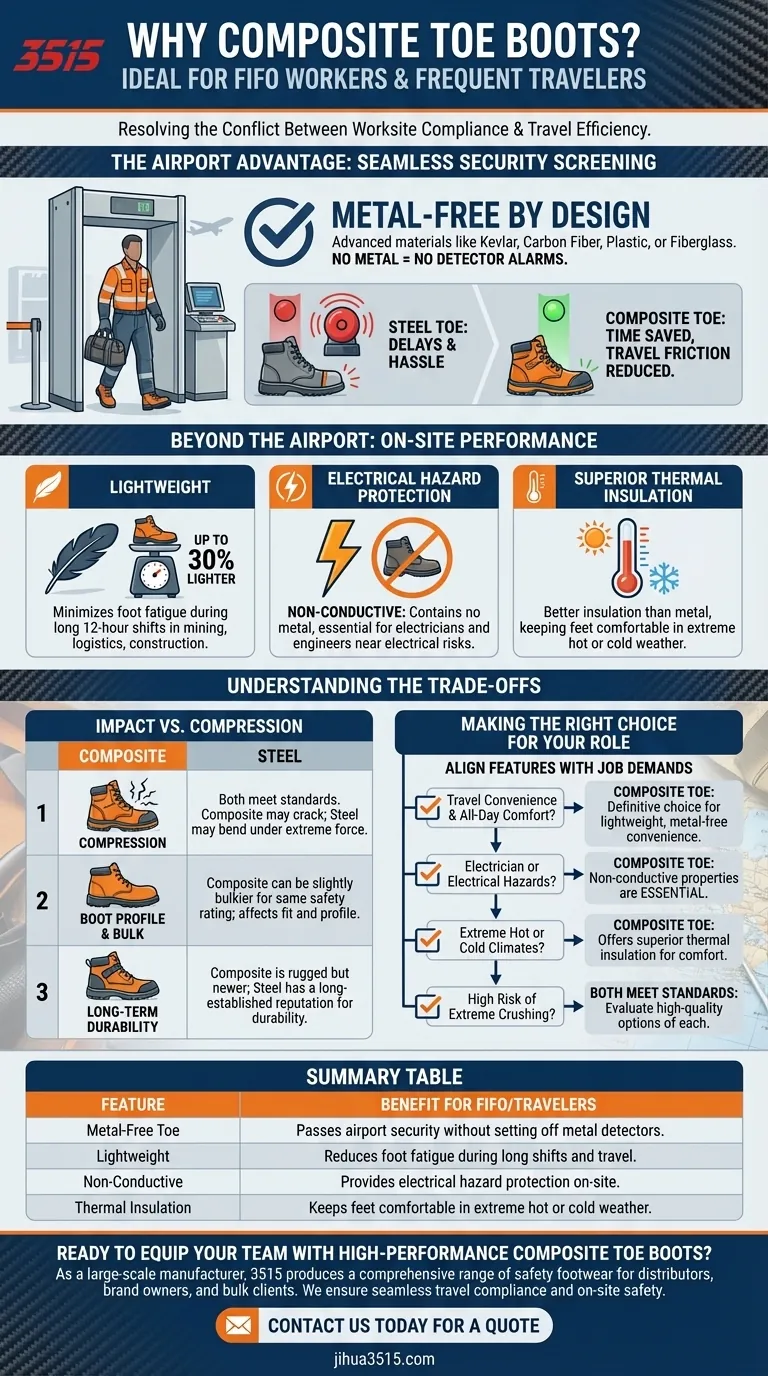
Composite safety caps are made from materials like Kevlar, carbon fiber, plastic, or fiberglass. Unlike steel, these advanced materials are entirely non-metallic and do not set off the sensors used in airport metal detectors.
The Impact on FIFO and Business Travel
This metal-free design means you no longer need to remove your work boots during security screening. For a FIFO worker making frequent trips to remote sites, this saves valuable time and reduces travel friction.
Beyond the Airport: On-Site Performance
While the travel benefits are clear, composite toe boots must also perform under demanding worksite conditions. Their material properties offer distinct advantages over traditional steel.
The Weight Factor
Composite toe boots are significantly lighter than their steel counterparts, often by as much as 30 percent. This reduction in weight minimizes foot fatigue over long 12-hour shifts, a crucial benefit in industries like mining, logistics, and construction.
Electrical Hazard Protection
Because they contain no metal, composite boots are non-conductive. This is a critical safety feature for electricians, engineers, and anyone working in environments with a risk of electrical hazards.
Superior Thermal Insulation
Metal is an excellent conductor of temperature, making steel toe boots uncomfortably hot in the sun and frigid in the cold. Composite materials provide far better thermal insulation, keeping your feet more comfortable in extreme outdoor weather conditions.
Understanding the Trade-offs
No single solution is perfect for every scenario. To make an informed decision, it's vital to understand the inherent trade-offs of composite materials compared to steel.
Impact vs. Compression
Both composite and steel toe boots must meet the same official safety standards for impact and compression resistance. However, the materials behave differently under stress that exceeds those standards. Steel may bend under extreme force, while a composite cap is more likely to crack.
Boot Profile and Bulk
To achieve the required safety rating, a composite cap sometimes needs to be slightly thicker or bulkier than a steel cap. This can subtly change the fit and profile of the boot, which comes down to personal preference.
Long-Term Durability
While modern composite boots are exceptionally rugged, featuring full-grain leather and abrasion-resistant materials, steel has a long-established reputation for durability against daily wear and tear. High-quality composite boots are built to last, but they are a newer technology by comparison.
Making the Right Choice for Your Role
Selecting the proper safety footwear requires you to align the boot's features with the primary demands of your job.
- If your primary focus is travel convenience and all-day comfort: Composite toe boots are the definitive choice due to their lightweight, metal-free construction.
- If you are an electrician or work near electrical hazards: The non-conductive properties of composite toe boots are an essential safety requirement.
- If you work in extreme hot or cold climates: Composite toes offer superior thermal insulation that directly translates to greater comfort and safety.
- If your work involves a high risk of extreme crushing forces: Both boot types meet the standard, but it's worth evaluating high-quality options of each to see which provides the best protection for your specific environment.
Ultimately, choosing the right safety boot means matching modern material science to the real-world demands of your job and your journey.
Summary Table:
| Feature | Benefit for FIFO/Travelers |
|---|---|
| Metal-Free Toe | Passes airport security without setting off metal detectors. |
| Lightweight | Reduces foot fatigue during long shifts and travel. |
| Non-Conductive | Provides electrical hazard protection on-site. |
| Thermal Insulation | Keeps feet comfortable in extreme hot or cold weather. |
Ready to equip your team with high-performance composite toe boots?
As a large-scale manufacturer, 3515 produces a comprehensive range of safety footwear for distributors, brand owners, and bulk clients. Our production capabilities encompass all types of composite toe boots, designed to meet the specific needs of FIFO workers and frequent travelers. We ensure seamless travel compliance and on-site safety without compromise.
Contact us today to discuss your requirements and get a quote!
Visual Guide
Related Products
- Wholesale Durable Safety Boots Manufacturer Customizable Steel Toe Work Boots
- Durable Leather Moc Toe Work Boots for Wholesale & Custom Manufacturing
- Wholesale Mesh Steel Toe Safety Shoes with Dial Closure Factory Production
- Wholesale Durable Breathable Safety Boots Custom OEM Manufacturer
- Wholesale Customizable Safety Boots Durable & Protective Footwear Manufacturing
People Also Ask
- What are the pros and cons of steel toe work boots? A Guide to Maximum Protection vs. Comfort
- What are the different types of steel toe work boots? Choose the Right Boot for Your Job
- What is the history of steel toe work boots? From German Invention to Modern Safety Standard
- How much weight can steel toe work boots withstand? Unpacking the 3,372 lb. Safety Standard
- What are some common myths about steel toe work boots? Debunked for Modern Workers