
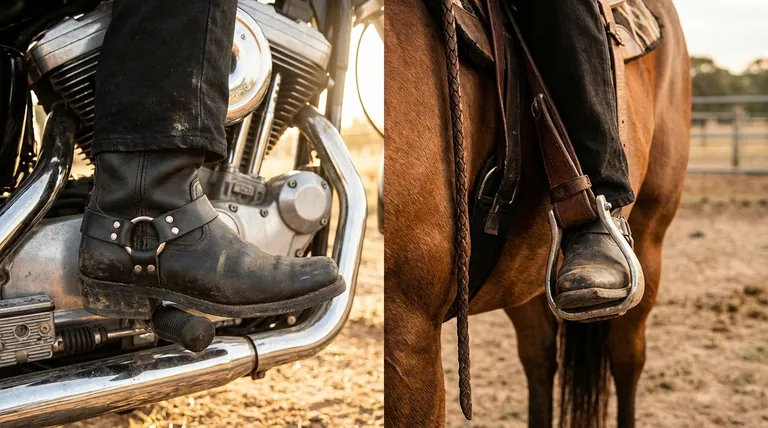
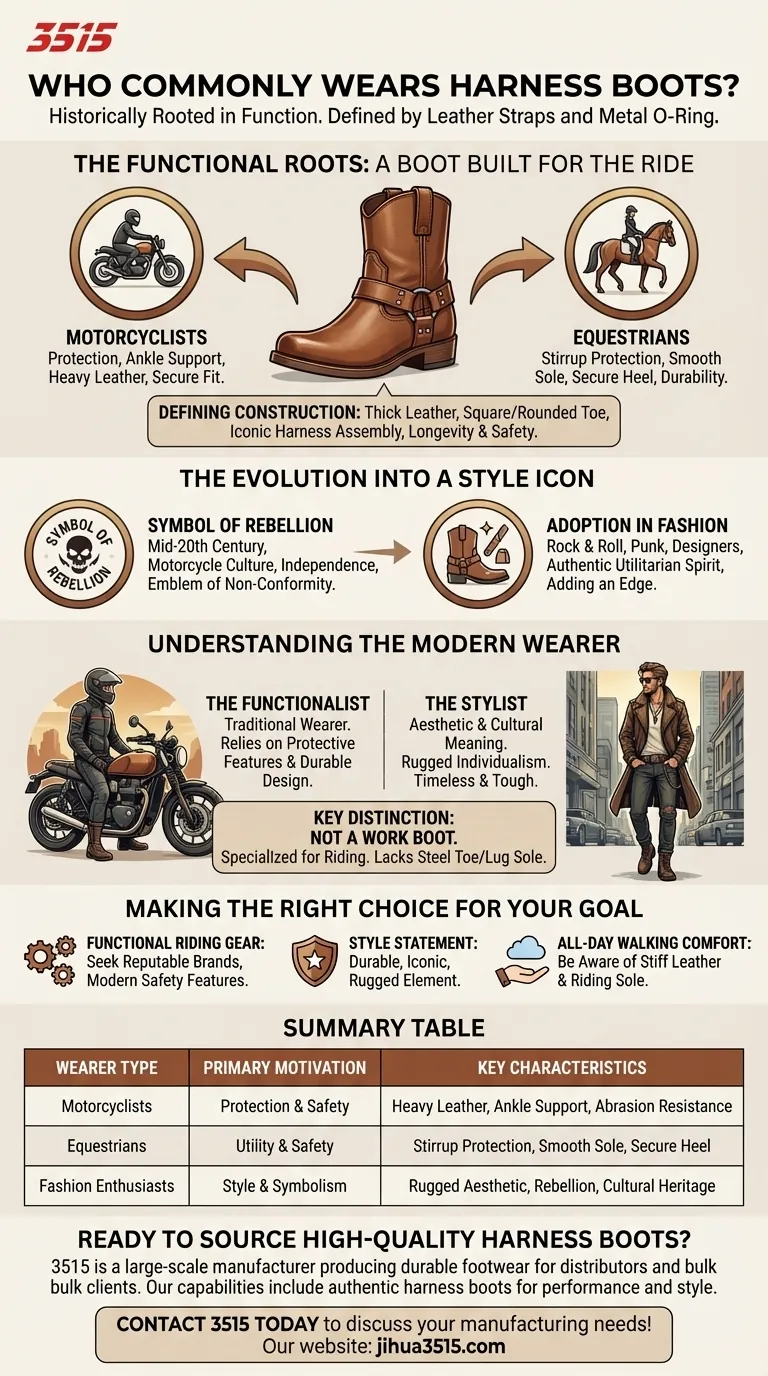
Historically rooted in function, harness boots are most commonly worn by motorcycle and horse riders. Their defining feature—the leather straps and metal O-ring—was originally designed for durability and protection in the stirrup, an origin that continues to define their modern identity.
The harness boot's journey from a purely functional piece of riding equipment to a cultural style icon is key to understanding who wears it today. It's chosen as much for its rugged aesthetic and symbolic heritage as for its original purpose.
The Functional Roots: A Boot Built for the Ride
The harness boot wasn't born from a fashion trend; it was engineered to solve specific problems for riders. Its core design elements directly reflect the needs of those on a motorcycle or a horse.
Protection for Motorcyclists
For motorcycle enthusiasts, the harness boot offers a blend of protection and classic style. The heavy leather shields against road debris and abrasion, while the sturdy construction provides crucial ankle support. The signature harness adds a layer of structural integrity and a secure fit.
Utility for Equestrians
The boot's origin is closely tied to horseback riding. The harness straps were designed to protect the boot's leather from the constant friction of the stirrups. The smooth sole and distinct heel prevent the foot from slipping too far forward, a critical safety feature for any equestrian.
The Defining Construction
Whether for two wheels or four legs, the boot's construction is its signature. It features thick, durable leather, a square or rounded toe box, and the iconic harness assembly of straps meeting at a metal ring on each side of the ankle. This design prioritizes longevity and rider safety above all else.
The Evolution into a Style Icon
Over time, the harness boot's rugged, no-nonsense appearance began to represent the cultures that wore it. It transitioned from practical gear into a powerful symbol.
A Symbol of Rebellion
Through its close association with motorcycle culture in the mid-20th century, the harness boot became an emblem of independence and rebellion. It was a visual shorthand for a life lived on the open road, outside of mainstream conventions.
Adoption in Fashion
This powerful symbolism was not lost on fashion and subculture. The harness boot was adopted by rock and roll artists, punks, and designers who wanted to channel its inherent toughness and authentic, utilitarian spirit. It became a way to add an edge to an otherwise conventional look.
Understanding the Modern Wearer
Today, the person wearing a harness boot might be a dedicated rider or someone who has never been near a motorcycle. The boot's appeal has broadened significantly.
The Functionalist
This is the traditional wearer: the motorcyclist or equestrian who still relies on the boot's protective features and durable design for its intended purpose. For them, it is essential gear that also happens to look good.
The Stylist
This individual wears the harness boot for its aesthetic and cultural meaning. They appreciate its history and use it to communicate a sense of rugged individualism. It’s a deliberate choice to ground an outfit with something timeless and tough.
A Key Distinction: Not a Work Boot
It's crucial to understand that despite its robust appearance, the harness boot is not a traditional work boot. It typically lacks features like a steel toe or a high-traction lug sole designed for construction sites or industrial environments. Its design is specialized for the act of riding.
Making the Right Choice for Your Goal
Deciding if a harness boot is right for you depends entirely on what you need it to do.
- If your primary focus is functional riding gear: Seek out harness boots from reputable equestrian or motorcycle brands that prioritize modern safety features alongside the classic design.
- If your primary focus is making a style statement: The harness boot is a superb choice for adding a durable, iconic, and rugged element to your personal style.
- If your primary focus is all-day walking comfort: Be aware that the stiff leather and riding-specific sole may be less comfortable for extensive walking than a dedicated walking shoe or boot.
Ultimately, choosing a harness boot is an investment in a piece of history that speaks to both utility and identity.
Summary Table:
| Wearer Type | Primary Motivation | Key Characteristics |
|---|---|---|
| Motorcyclists | Protection & Safety | Heavy leather, ankle support, abrasion resistance |
| Equestrians | Utility & Safety | Stirrup protection, smooth sole, secure heel |
| Fashion Enthusiasts | Style & Symbolism | Rugged aesthetic, rebellion, cultural heritage |
Ready to Source High-Quality Harness Boots?
As a large-scale manufacturer, 3515 produces a comprehensive range of durable footwear for distributors, brand owners, and bulk clients. Our production capabilities encompass all types of boots, including authentic harness boots built for both performance and style.
We help you deliver the quality and heritage your customers expect.
Contact 3515 today to discuss your manufacturing needs!
Visual Guide
Related Products
- Premium Wholesale Tactical Style Safety Shoes Boots with Quick Lacing
- Wholesale Durable Safety Boots | Custom Steel Toe & Puncture-Resistant Manufacturing
- Premium Waterproof High-Cut Industrial Safety Boots for Wholesale and Bulk Orders
- Durable Leather High-Ankle Tactical Boots for Wholesale & Custom Manufacturing
- Durable High-Ankle Tactical Boots Wholesale Manufacturer for Custom & Bulk Orders
People Also Ask
- How are gait analysis research findings applied to the functional design of safety shoes and tactical boots?
- Why is the synchronization of craftsmanship and UX development emphasized for bulk customization of safety shoes?
- How do quality certification standards for safety shoes reduce perceived risk? Buy Online with Technical Certainty
- How does anthropomorphic design influence material selection? Enhance Footwear Performance through Biological Alignment
- How can specialized footwear mitigate safety risks? High-Volume OEM/ODM Solutions since 1951



















