First, I see the user wants to know about the most vulnerable area on a cowboy boot for snake bites. Seems straightforward, right? But I know better. My experience tells me there's a deeper question – they're really concerned about their safety and want to know how much protection these boots actually provide. I must address both those needs.
So, I’ll start by giving the answer directly: The top and sides of the foot, the vamp area, is the weak spot. But then, I'll zoom out and give the bigger picture. I'll explain that the real concern isn't just the boot's anatomy; it's mitigating the risk of snake bites overall. I'll get into the details – the sole's strength, the vamp's potential vulnerability, the fact that bites often happen on the calf, and how boots aren't foolproof. I’ll make sure it's structured, with clear sections and headings. I'll be direct and authoritative, with empathy, keeping it all short and easy to scan.
The opening will hit the vulnerable spot first, and the core takeaway will be the key insight about the vamp, the calf, and the limitations of cowboy boots. I’ll give the specifics in the body, comparing the boot's protective layers and putting the risks in context. I'll address the tradeoffs, too, the difference between what the boots provide in general use versus a specific danger. Then, the conclusion will give them clear, actionable advice to help them choose the right footwear depending on the situation.
I'll lean heavily on the sources – the vamp, the thick sole, the vulnerable calf – using them to build a comprehensive picture of the reality of snake protection. I'll always be mindful of that deeper need for safety. Finally, before sending it off, I'll go through and make sure everything is in order and that the message is getting across. When wearing cowboy boots, the most vulnerable area of the foot to a snake bite is the material covering the top and sides, known as the vamp. While the thick sole provides robust protection from below, the thinner, more flexible leather of the vamp can potentially be penetrated by the fangs of a determined snake.
While cowboy boots offer more protection than standard shoes, they are not a substitute for dedicated snake-proof boots. The key vulnerability is the thinner leather of the vamp, but the most common strike zone—the calf—is often above the boot line entirely, shifting the true risk from the foot to the lower leg.
Analyzing the Boot's Protective Layers
To understand the risk, we must assess the boot not as a single object, but as a system of different components, each with a varying level of defense.
The Fortified Sole
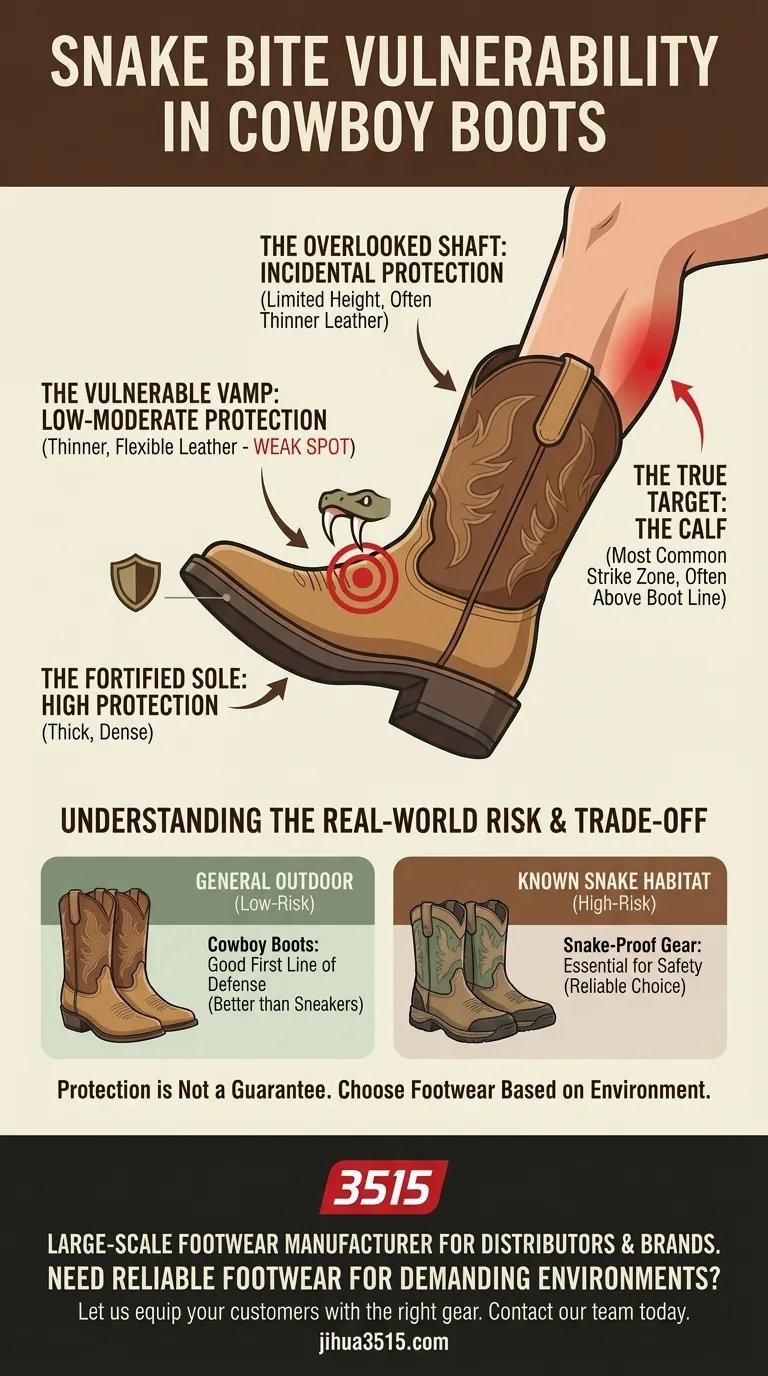
The sole of a quality cowboy boot is its strongest defensive feature. It is constructed from thick, dense layers of leather or hard rubber. This construction makes it nearly impossible for a snake's fangs to penetrate from underneath.
The Vulnerable Vamp
The vamp is the section of the boot that covers the top and sides of your foot. To allow for flexibility and comfort, this area is made of a thinner, more pliable leather than the sole. This flexibility is also its primary weakness, as it presents a potential point of failure against a direct and forceful bite.
The Overlooked Shaft
The tall shaft of a cowboy boot provides incidental protection to the ankle and lower leg. However, its effectiveness is limited by its height and the fact that it is often made of the same thinner leather as the vamp.
Understanding the Real-World Risk
The anatomy of the boot is only half of the equation. Understanding how and where snakes typically strike is critical for a complete picture of your safety.
The True Target: The Calf
Field data consistently shows that the vast majority of snake bites on humans occur on the lower leg, specifically the calf area. This is often above the top of a standard-height cowboy boot, making the boot's protection irrelevant in many real-world encounters.
Protection is Not a Guarantee
The effectiveness of any boot depends on variables beyond its construction. The species of snake, the length of its fangs, and the angle of the strike all determine whether a bite can penetrate the material. A cowboy boot may deflect a glancing blow but fail against a direct hit.
The Trade-off: Everyday Wear vs. Specialized Protection
It is essential to distinguish between a "better" option and the "right" option for a specific environment. Cowboy boots fall squarely into this distinction.
A Good First Line of Defense
Compared to sneakers, hikers, or open-toed shoes, a well-made leather cowboy boot offers a substantial upgrade in protection. For casual or work-related activities in areas with a low-to-moderate snake population, they provide a meaningful barrier.
The Limit of General-Purpose Footwear
Cowboy boots are designed for riding and general work, not specifically for snake protection. Their protective qualities are a byproduct of their durable construction, not their primary design goal. This inherent limitation is their most critical trade-off.
When to Demand Snake-Proof Gear
For any activity that involves intentionally moving through high-risk environments—such as wading through tall grass, exploring dense underbrush, or hiking in known snake habitats—specialized snake-proof boots are the only reliable choice.
Making the Right Choice for Your Situation
Your choice of footwear should be a conscious risk assessment based on your environment and activity level.
- If your primary focus is general outdoor activity in low-risk areas: Standard leather cowboy boots offer a significant and practical upgrade in protection over most casual footwear.
- If your primary focus is working or hiking in known snake habitats: You must invest in certified snake-proof boots, as the vulnerabilities of a cowboy boot's vamp and shaft height present an unacceptable risk.
Understanding the specific limitations of your gear is the first step toward ensuring your safety in the outdoors.
Summary Table:
| Boot Area | Protection Level | Vulnerability |
|---|---|---|
| Sole | High | Nearly impenetrable due to thick leather/rubber. |
| Vamp (Top/Sides) | Low to Moderate | Thinner, flexible leather can be penetrated by fangs. |
| Shaft (Calf Area) | Incidental | Often too short; most bites occur above the boot line. |
Need Reliable Footwear for Demanding Environments?
As a large-scale manufacturer, 3515 produces a comprehensive range of durable footwear for distributors, brand owners, and bulk clients. Our production capabilities encompass all types of work boots and specialized footwear designed for safety and performance in challenging conditions.
Let us help you equip your customers with the right gear. Contact our team today to discuss your specific needs and explore our manufacturing solutions.
Visual Guide
Related Products
- Wholesale High-Traction Camo Boots - Custom Manufacturer for Brands
- Durable Spiked Camouflage Boots Wholesale & Factory Production
- High-Traction Suede Tactical Boots Wholesale & Custom Manufacturing
- Wholesale Lightweight Tactical Boots Custom Manufacturer for Desert & Combat Use
- Durable Leather Tactical Boots Wholesale & Custom Manufacturing for Brands
People Also Ask
- What are the key features of the new line of camo boots? Built for Extreme Cold & Rugged Terrain
- Are camo boots necessary for hunting success? Prioritize Performance Over Pattern
- How does the Rank Score Test identify the primary causes of premature failure in tactical and work boots? Key Insights
- What is the technical logic behind using closed-eye testing for tactical boots? Unlocking Peak Footwear Stability
- What shoes to wear for a security job? Durable, Protective Footwear for Long Shifts