My Approach: Solving the Problem
I see the user wants a quick answer, but I know what they really need is a framework to understand this whole world of snow boots. They're probably overwhelmed by all the options. So, I'll provide the straightforward answer up front, and then immediately dive into the "why" – the crucial factors that determine the best boot for their specific situation.
Building Blocks: The "Core Four" and Context
The references highlight four key areas: warmth, waterproofing, durability, and traction. That's my starting point. The best boot is the one that's a perfect blend of those four things, but here's the kicker: it's all about their individual needs. Commuting in slushy sidewalks is totally different from trekking in deep snow. Weather is a huge factor too. I can't stress this enough - and this comes from my own experience- fit is absolutely non-negotiable.
Structure is Everything
The article will start strong with a bold statement – the direct recommendation. Then, I'll emphasize the core idea: it's not about a single "best" boot, but about finding the right boot for their environment and activities. I'll break everything down into digestible sections:
- "The Four Pillars": I'll dive deep into each factor – warmth (talking insulation and temperature ratings), waterproofing (explaining the differences between water-resistant and waterproof), traction (the importance of a solid outsole), and durability (materials and craftsmanship). I'll use simple terms that anyone can understand.
- "Context is King": I'll show how to apply those principles by considering the user's lifestyle and location (commuter vs. hiker, slush vs. deep freeze). This helps drive the point that there is no one best boot.
- "Understanding Trade-offs": I'll be really upfront here. A heavy-duty boot isn't ideal for everyone, and style might sometimes take a backseat to functionality. I'll reiterate the critical importance of a proper fit.
- Actionable Advice: The conclusion will provide clear, actionable steps. If you live in this environment, buy this type of snow boot, for example.
The Mental Walkthrough
I'm imagining how this guide will read. The initial hook will be concise and direct. I'll establish that it all comes down to finding a balance tailored to their specific needs. I'll use a direct statement as a pull quote to hammer the core message home. I'll then move into the "Pillars" section. Using the information provided by the references, I'll use clear, easy-to-understand language. I'll also use direct examples throughout to create clear use cases, like comparing city walkers to backcountry trekkers. I'll be honest and transparent about the trade-offs. The goal is to make the reader feel empowered to make an informed decision. The final advice will be really specific, providing concrete recommendations for different situations. My goal is for the reader to feel confident and informed. The best men's snow boot is not a single product, but one that perfectly balances four key elements: warmth, waterproofing, durability, and traction. The right choice depends entirely on your specific activities, local climate, and personal needs, making a one-size-fits-all recommendation impossible. A boot designed for deep-snow hiking is fundamentally different from one meant for navigating slushy city streets.
The search for the single "best" snow boot is often misleading. The true goal is to identify the right boot for your winter by correctly matching its technical features to your specific environment and daily activities.
The Four Pillars of an Effective Snow Boot
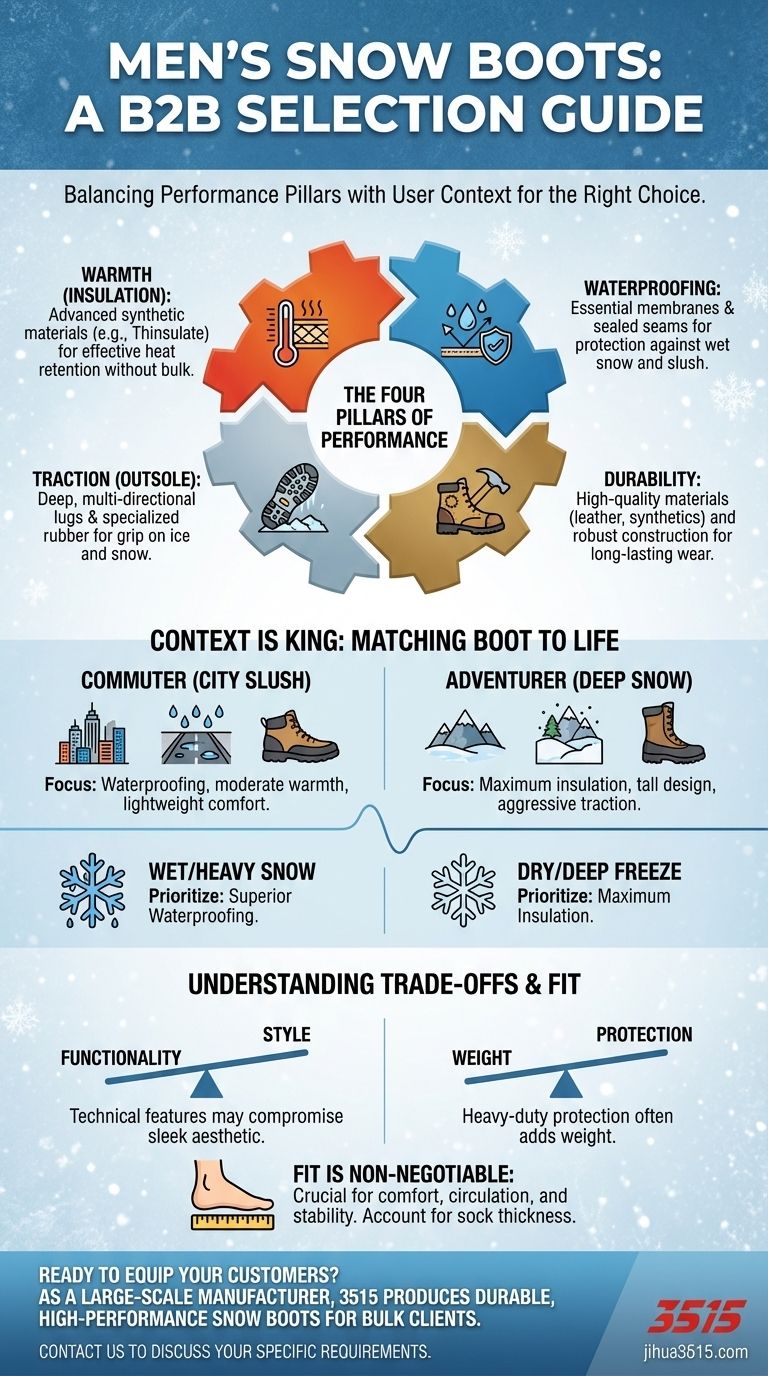
Every quality snow boot is built upon a foundation of four critical performance characteristics. Understanding each one allows you to assess a boot's suitability for your intended use.
Pillar 1: Warmth (Insulation)
Insulation is what keeps your feet warm in freezing temperatures. It is often measured in grams, with higher numbers typically indicating more warmth.
Look for modern synthetic insulation materials like 3M Thinsulate, which provide significant warmth without excessive bulk. The right amount of insulation depends entirely on your climate and activity level.
Pillar 2: Waterproofing
Keeping feet dry is just as important as keeping them warm. Wet feet lose heat rapidly and lead to extreme discomfort and potential health risks.
Materials like leather or high-quality synthetics with waterproof membranes are essential. Be aware of the difference between "water-resistant," which handles light moisture, and "waterproof," which is necessary for slush, deep snow, and wet conditions.
Pillar 3: Traction (The Outsole)
The outsole is the part of the boot that contacts the ground. Its design is critical for stability on icy and snowy surfaces.
A sturdy outsole with deep, multi-directional lugs (the tread pattern) provides the best grip. Softer rubber compounds tend to offer better traction in cold weather, as they remain flexible.
Pillar 4: Durability (Materials & Construction)
A snow boot is an investment in safety and comfort, and it must withstand harsh conditions.
High-quality materials and solid craftsmanship are key indicators of durability. Pay attention to the quality of the stitching and how the sole is attached to the upper part of the boot.
Context is Everything: Matching the Boot to Your Life
The technical specifications of a boot are meaningless without context. The most important step in your decision is to honestly assess how and where you will be using them.
Define Your Activity: The Commuter vs. The Adventurer
Your primary use case dictates the boot's required features. A boot for a city commuter needs to be waterproof for slush and have decent traction, but it can be less bulky and lower-cut.
Conversely, someone hiking or snowshoeing in deep snow needs a taller boot to keep snow out, a higher insulation rating for prolonged exposure, and an aggressive outsole for variable terrain.
Assess Your Climate: Slush vs. Deep Freeze
The winter you experience is a major factor. A climate with wet, heavy snow and temperatures hovering around freezing demands excellent waterproofing above all else.
An environment with consistently deep cold and dry, powdery snow requires a focus on maximum insulation to prevent heat loss during periods of low activity.
Understanding the Trade-offs
Choosing a snow boot is a balancing act. Excelling in one area often means a compromise in another. Acknowledging this is key to avoiding frustration.
Functionality vs. Style
The most technically advanced winter hiking boot is rarely the most stylish option for casual wear. Materials like treated suede or sleek leather can offer good protection for city life but may not be suitable for extreme conditions.
Determine if your priority is maximum protection for outdoor activity or a versatile look that can handle a typical winter day around town.
Weight vs. Protection
Heavy-duty insulation, thick waterproof materials, and a rugged outsole add weight. While this provides maximum protection, it can also make boots feel cumbersome for all-day wear or quick trips.
A lighter boot may be more comfortable for daily use but might not provide enough warmth or support for more demanding winter activities.
The Critical Importance of Fit
Even the most expensive, feature-packed boot will fail if it doesn't fit correctly. A boot that is too tight can restrict circulation, leading to cold feet, while a boot that is too loose can cause blisters and instability.
Always consider your sock thickness when trying on boots, and look for brands that offer wide-width options if you have wider feet. Proper fit is non-negotiable for both comfort and performance.
Making the Right Choice for Your Goal
Filter your options by first defining your primary need. This clarity will guide you to the right balance of features.
- If your primary focus is daily commuting in a city: Prioritize excellent waterproofing to handle slush and a comfortable, lightweight design with moderate insulation.
- If your primary focus is active winter recreation (hiking, snowshoeing): Seek out maximum insulation, a tall and durable waterproof design, and an aggressive outsole with deep lugs for superior traction.
- If your primary focus is a balance of style and moderate protection: Look for boots made from leather or treated suede that offer basic water resistance and insulation suitable for moving between indoor and outdoor environments.
By first defining your personal context, you can confidently select a boot that delivers precisely the protection you need for the winter ahead.
Summary Table:
| Key Factor | What to Look For | Why It Matters |
|---|---|---|
| Warmth | Insulation rating (e.g., Thinsulate), temperature rating. | Prevents heat loss and keeps feet warm in freezing conditions. |
| Waterproofing | Waterproof membrane (e.g., Gore-Tex), sealed seams, full-grain leather. | Keeps feet dry from slush, snow, and wet conditions. |
| Traction | Deep, multi-directional lugs on the outsole, soft rubber compound. | Provides stability and prevents slips on ice and snow. |
| Durability | High-quality materials (leather, synthetics), robust construction. | Ensures the boot withstands harsh winter elements for multiple seasons. |
Ready to equip your customers with the perfect winter footwear?
As a large-scale manufacturer, 3515 produces a comprehensive range of durable, high-performance snow boots for distributors, brand owners, and bulk clients. Our production capabilities ensure you get the right balance of warmth, waterproofing, and traction for any market need.
Contact us today to discuss your specific requirements and get a quote. Let us help you build a winter footwear line that stands up to the elements.
Visual Guide
Related Products
- Factory Direct Wholesale Rain Boots Durable Waterproof & Fully Customizable
- Wholesale Leather Ankle Boots with Lug Soles for Custom Brand Manufacturing
- Durable Waterproof Rain Boots | Custom Manufacturer for Wholesale & Brands
- Wholesale Waterproof Tactical Boots Custom Suede & High-Traction Soles
- Factory Direct Wholesale Leather Comfort Shoes with Dial Closure
People Also Ask
- What are the characteristics of rain boots? A Guide to Waterproof Footwear for Every Need
- What factors should be considered when choosing rain boots? Find the Perfect Boot for Your Needs
- What are the main differences between rain boots and snow boots? Choose the Right Boot for Your Climate
- How should one decide between PVC and rubber for rain boots? A Guide to Choosing the Right Material
- Why are rain boots more flexible and comfortable than snow boots? The Key Differences Explained