
In a military career, tactical boots are foundational equipment used from the very beginning. They are most critically employed during initial phases like basic training, ongoing fieldwork, and drills where personnel must adapt to extreme physical demands. Their design is a direct response to the need for protection, support, and mobility in challenging and unpredictable conditions.
Tactical boots are not just footwear; they are an essential system for ensuring a service member's mobility, safety, and operational effectiveness, especially during the physically demanding initial stages of their career.
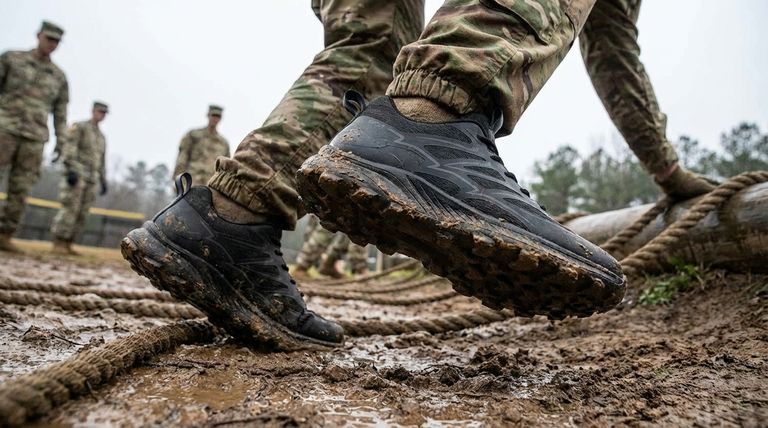
The Foundational Role: From Day One
The introduction to military life is a physical trial by fire. The footwear issued to service members is specifically chosen to mitigate risk and build fundamental skills on a solid, supportive base.
The Demands of Basic Training
In basic training, recruits are constantly on their feet, learning to march, run in formation, and navigate obstacle courses. Reinforced ankle support is non-negotiable to prevent sprains and stress fractures under constant strain.
The boots must be durable enough to withstand weeks of continuous abuse on pavement, dirt, and gravel without failure.
Essential for Fieldwork and Drills
As training progresses to fieldwork, the environment becomes more unforgiving. Tactical boots provide the stability and protection needed to carry heavy loads, such as rucksacks and equipment, over uneven and unpredictable terrain.
Their rugged construction ensures a service member can focus on the mission, confident that their feet are shielded from common field hazards.
Key Features Dictated by Mission Needs
Tactical boots are purpose-built tools. Every feature is a solution to a problem faced by military operators in the real world.
Unyielding Support and Protection
The core function of a tactical boot is to protect the feet and ankles. Puncture-resistant soles guard against sharp objects, while the boot's structure supports the foot when carrying heavy gear, reducing the risk of long-term injury.
Durability in Harsh Conditions
Military operations occur in every climate imaginable, from scorching deserts to frozen landscapes. Boots are constructed from durable materials and often feature heat-resistant outsoles to withstand these extremes without degrading.
A moisture-wicking lining is also critical, helping to keep feet dry to prevent blisters and fungal infections during long-duration missions.
Balancing Mobility and Comfort
Despite their protective features, tactical boots must allow for a high degree of movement. They are designed to blend the support of a traditional boot with the ease of movement closer to an athletic shoe, enabling all-day wear without excessive fatigue.
Understanding the Trade-offs
No single boot is perfect for every scenario. The standard-issue tactical boot represents a carefully considered compromise designed to serve the broadest range of needs.
Specialization vs. General Use
A boot designed for general field use will be a master of none. It provides good all-around performance but may be heavier than a boot for rapid assault operations or less insulated than a dedicated cold-weather boot.
Weight vs. Protection
There is a direct trade-off between the level of protection and the boot's weight. Heavier, more rigid boots offer maximum support but can increase fatigue over long distances. Lighter boots enhance speed and agility but may sacrifice some durability and ankle protection.
How Boot Requirements Evolve
The type of tactical boot needed changes as a service member's role becomes more defined.
- For Initial Entry Training: The primary need is for a durable, all-around boot that provides excellent support to prevent injury while foundational skills are developed.
- For Garrison and Standard Field Duty: The focus is on a reliable, comfortable boot that performs well across a variety of common tasks and predictable terrains.
- For Specialized Operations: Personnel may require mission-specific boots, such as lighter footwear for rapid movement, insulated boots for cold climates, or boots with enhanced water resistance.
Ultimately, the tactical boot is the critical interface between the service member and the ground they operate on, making its function essential to their safety and success.
Summary Table:
| Phase of Military Career | Primary Use of Tactical Boots |
|---|---|
| Basic Training | Reinforced ankle support, durability for marching, running, and obstacle courses. |
| Fieldwork & Drills | Stability and protection for carrying heavy loads over uneven terrain. |
| Specialized Operations | Mission-specific needs (e.g., lightweight, insulated, or water-resistant boots). |
As a large-scale manufacturer, 3515 produces a comprehensive range of tactical footwear for distributors, brand owners, and bulk clients. Whether you need durable boots for basic training or specialized models for elite operations, our production capabilities ensure top-tier quality, protection, and comfort. Enhance your supply chain with reliable tactical boots—contact us today to discuss your needs!
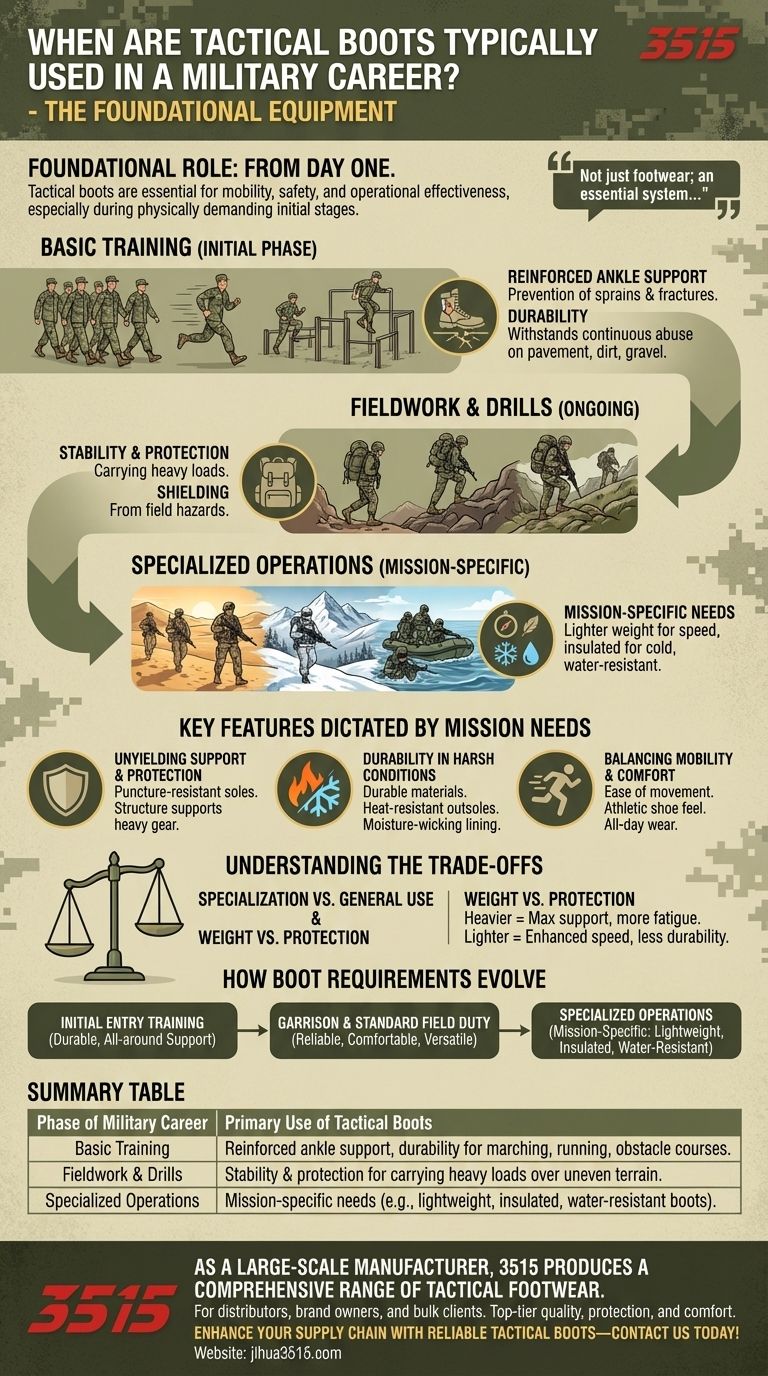
Visual Guide
Related Products
- Durable Leather Tactical Boots Wholesale & Custom Manufacturing for Brands
- High-Traction Suede Tactical Boots Wholesale & Custom Manufacturing
- Durable Leather High-Ankle Tactical Boots for Wholesale & Custom Manufacturing
- Durable Mid-Cut Tactical Boots for Wholesale & Private Label
- Wholesale Waterproof Tactical Boots Custom Suede & High-Traction Soles
People Also Ask
- What specialized protections do tactical boots offer? Maximize Endurance with High-Performance Footwear
- What features should law enforcement officers look for in tactical boots? Essential Guide for Safety & Performance
- Importance of Professional Tactical Boots in Loess Gully Regions: Ensure Safety and Precision for Field Monitoring
- What is rucking, and why are tactical boots suitable for it? Discover the Ultimate Footwear for Heavy Loads
- What makes the traction of tactical boots superior? Unlock the Science of Unbeatable Grip















