
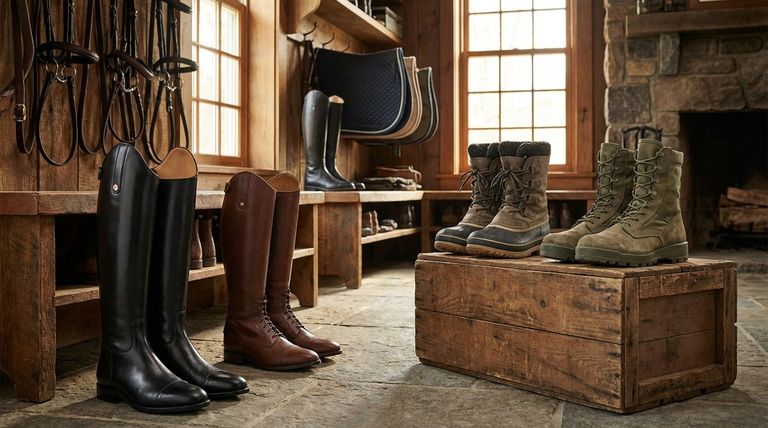
At its core, the term "tall boots" most commonly refers to classic English equestrian styles, which are primarily categorized as Field boots, Dress boots, and Dressage boots. However, the term also encompasses other functional categories designed for specific environments, such as insulated winter boots and durable military boots. Each type is purpose-built, with its design dictated by the activity it supports.
The essential difference between types of tall boots is not just style, but function. The design of any tall boot represents a deliberate choice between ankle flexibility, leg support, and environmental protection, tailored specifically to its intended use.
Tall Equestrian Boots: The Classic Styles
When people refer to "tall boots," they are most often discussing the traditional leather boots used in English riding disciplines. These boots are designed to provide a stable leg position and clear communication with the horse.
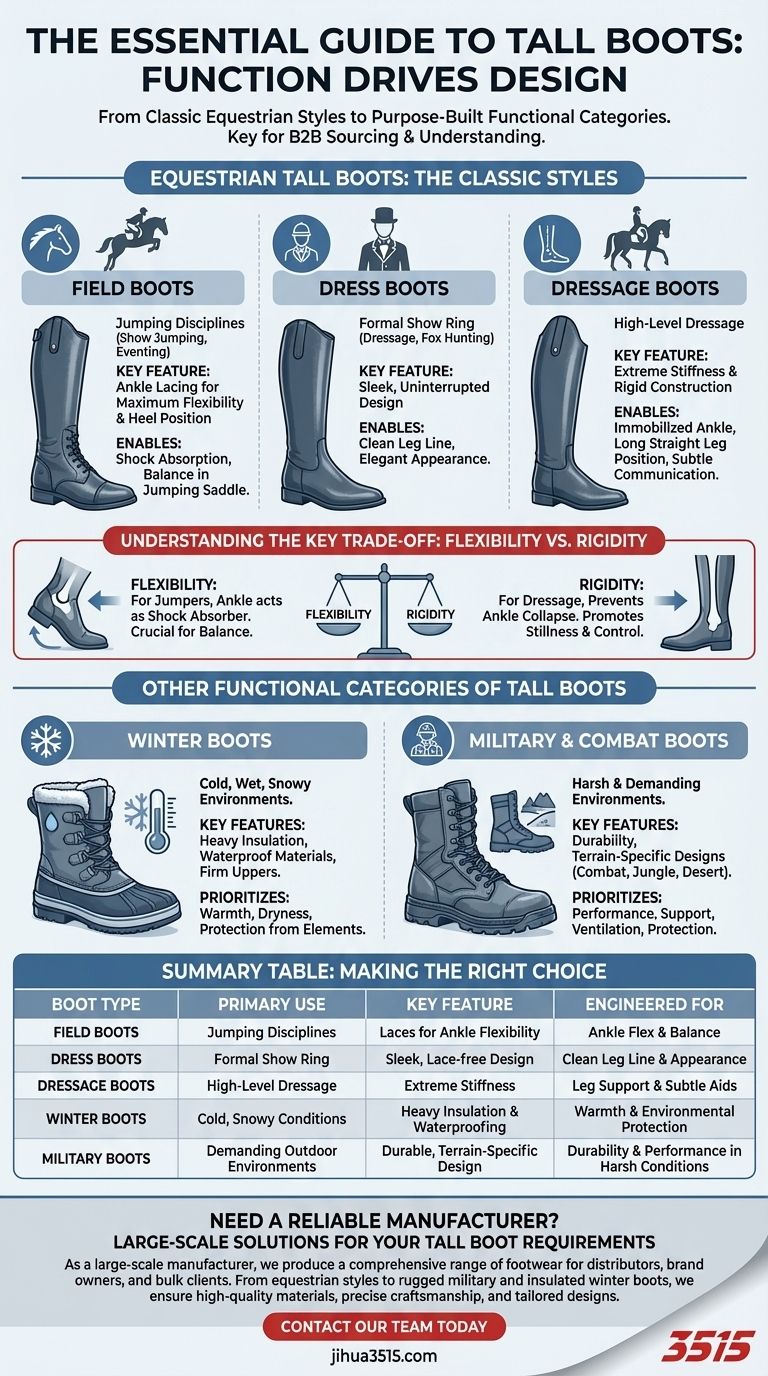
Field Boots
Field boots are the go-to choice for jumping disciplines like show jumping and eventing.
Their defining feature is lacing at the ankle. This design provides the necessary flexibility for a rider to shorten their stirrups and sink into a deep heel position required for going over fences.
Dress Boots
Dress boots (or dress riding boots) are the most formal and traditional style. They are sleek and elegant, with no laces at the ankle.
Originally used in disciplines like dressage and formal fox hunting, they offer a clean, uninterrupted leg line. They are now popular across many disciplines for their polished appearance in the show ring.
Dressage Boots
Dressage boots are a specialized and more extreme version of the dress boot. They are characterized by their extreme stiffness.
This rigid construction helps to immobilize the rider's ankle and leg, promoting the long, straight leg position prized in dressage. They are often cut higher on the outside of the leg to elongate the rider's silhouette.
Understanding the Key Trade-off: Flexibility vs. Rigidity
The design of an equestrian boot is a masterclass in functional trade-offs. The choice between a field boot and a dressage boot is a clear example of prioritizing one quality over another for a specific outcome.
The Need for Flexibility
For jumpers, the ankle must act as a shock absorber. The laces on a field boot allow the ankle to flex forward and down, which is crucial for maintaining balance and security in a jumping saddle. A boot that is too stiff would be restrictive and unsafe.
The Need for Rigidity
In dressage, the goal is subtle communication through a still, elongated leg. The stiff shaft of a dressage boot prevents the ankle from collapsing, helping the rider maintain the correct leg position with minimal muscle strain. This stillness allows for nearly imperceptible aids to be given to the horse.
Other Functional Categories of Tall Boots
Beyond the equestrian world, several other categories of tall boots are defined by their ability to protect the wearer from specific environmental challenges.
Winter Boots
Tall winter boots are built for warmth and protection from the elements. Key features include heavy insulation and water-resistant or waterproof materials.
Their construction prioritizes keeping the feet dry and warm in cold, wet, or snowy conditions. Some are even designed with specific features for activities like snowshoeing, such as firm uppers and heel welts.
Military & Combat Boots
Military boots are engineered for durability and performance in harsh environments. Different types exist for specific conditions.
Combat boots offer a balance of support and flexibility for varied terrain. Jungle boots are lightweight and feature drainage holes for humid climates, while desert boots use breathable materials for ventilation in hot, dry conditions.
Making the Right Choice for Your Purpose
Choosing the correct tall boot comes down to identifying your primary activity.
- If your primary focus is an English jumping discipline: You need the ankle flexibility provided by Field Boots.
- If your primary focus is high-level Dressage: You will benefit from the rigid leg support of specialized Dressage Boots.
- If your primary focus is a formal, classic show ring look (without jumping): The sleek profile of Dress Boots is the traditional choice.
- If your primary focus is warmth and protection in snow: Look for insulated and waterproof Winter Boots.
- If your primary focus is durability in demanding outdoor environments: A purpose-built Military Boot will offer the best performance.
Ultimately, selecting the right tall boot is about matching the boot's engineered purpose to your specific needs.
Summary Table:
| Boot Type | Primary Use | Key Feature |
|---|---|---|
| Field Boots | Jumping Disciplines | Laces for ankle flexibility |
| Dress Boots | Formal Show Ring | Sleek, lace-free design |
| Dressage Boots | High-Level Dressage | Extreme stiffness for leg support |
| Winter Boots | Cold, Snowy Conditions | Heavy insulation & waterproofing |
| Military Boots | Demanding Outdoor Environments | Durable, terrain-specific design |
Need a reliable manufacturer for your tall boot requirements?
As a large-scale manufacturer, 3515 produces a comprehensive range of footwear for distributors, brand owners, and bulk clients. Our production capabilities encompass all types of tall boots—from equestrian styles to rugged military and insulated winter boots. We ensure high-quality materials, precise craftsmanship, and designs tailored to specific functional needs.
Let's discuss your project: Contact our team today to get a quote and learn how we can support your business with reliable, high-performance footwear.
Visual Guide
Related Products
- Durable Leather High-Ankle Tactical Boots for Wholesale & Custom Manufacturing
- Durable High-Ankle Tactical Boots Wholesale Manufacturer for Custom & Bulk Orders
- Durable High-Ankle Tactical Boots for Wholesale & Custom Manufacturing
- Wholesale Tactical Boots High-Traction & Reflective for Bulk & Brand Orders
- High-Traction Suede Tactical Boots Wholesale & Custom Manufacturing
People Also Ask
- How do military uniforms and tactical boots impact the prediction of thermal risk? Essential Safety Insights
- How does the material of tactical boots affect their performance? Choose the Right Material for Your Mission
- Why is sequential analysis utilized to evaluate tactical boots? Master Dynamic Boot Development and Ergonomic Performance
- How do tactical boots differ from regular boots? Performance, Durability & Design Explained
- What are the primary differences between tactical boots and combat boots? Choose the Right Boot for Your Mission

















