
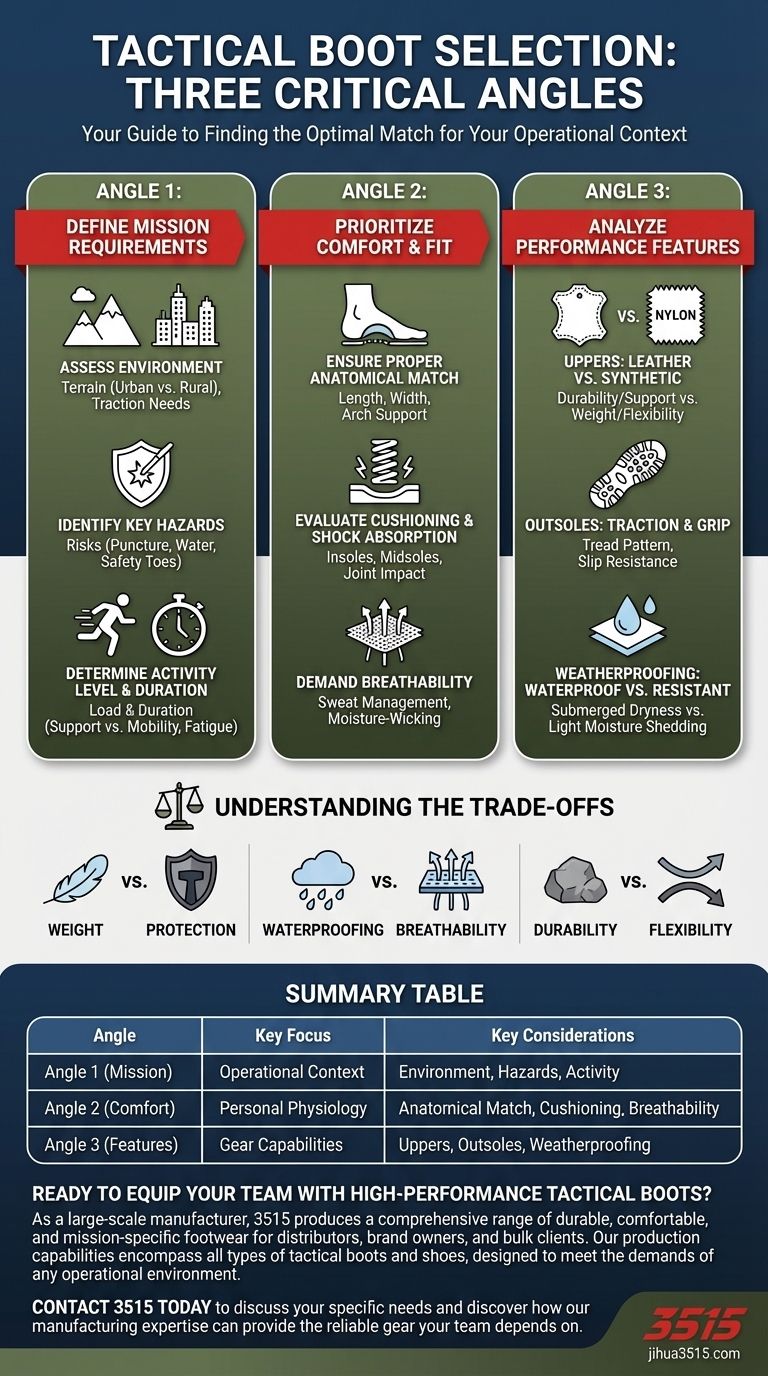
When selecting tactical boots, your decision should be guided by three critical angles: the specific requirements of your mission, the non-negotiable need for personal comfort and fit, and a clear analysis of the boot's performance features. This framework ensures your choice supports your objective instead of hindering it.
Choosing the right tactical boot is not about finding a single "best" product, but about finding the optimal match for your specific operational context. The ideal boot lies at the intersection of your environment, your physiology, and the gear's engineered capabilities.

Angle 1: Define Your Mission Requirements
Before you look at a single boot, you must first define the context in which it will be used. The environment and task dictate the necessary features.
Assess Your Environment
The terrain is your primary consideration. Operations in an urban setting demand different outsole traction than patrols in a rural, wooded, or desert landscape.
Identify Key Hazards
Consider the most likely risks. If you are in law enforcement or security, you may need puncture-resistant soles or certified safety toes. For wet environments, water resistance is key.
Determine Activity Level and Duration
Long-duration patrols under a heavy load require boots with substantial support and cushioning to prevent fatigue. In contrast, short, high-intensity movements demand lightweight, flexible boots that maximize mobility.
Angle 2: Prioritize Comfort and Fit
A boot that doesn't fit correctly is more than an inconvenience; it is a liability that can cause injury and compromise your performance.
Ensure a Proper Anatomical Match
A boot must match the length and width of your foot. Pay close attention to arch support, as inadequate support is a primary cause of foot fatigue during long hours of wear.
Evaluate Cushioning and Shock Absorption
Your boots are your suspension system. Look for cushioned insoles and shock-absorbing midsoles, which are critical for reducing the impact on your joints during dynamic movement on hard surfaces.
Demand Breathability
Your feet will sweat. Boots with breathable materials, such as mesh panels and moisture-wicking linings, are essential for keeping your feet dry, preventing blisters, and maintaining comfort in all temperatures.
Angle 3: Analyze Key Performance Features
With your mission and fit requirements defined, you can now assess the specific components and materials of the boot itself.
Uppers: Leather vs. Synthetic
Full-grain leather offers maximum durability and support, while nylon and other synthetic uppers provide a lighter weight, increased flexibility, and better breathability right out of the box.
Outsoles: Traction and Grip
The outsole is where the boot meets the ground. Ensure the tread pattern and rubber compound are designed for slip resistance and traction on the surfaces you will encounter most often.
Weatherproofing: Waterproof vs. Water-Resistant
Understand the distinction. A waterproof boot, often featuring a membrane liner, is designed to keep your feet dry when submerged. Water-resistant boots will shed light moisture but will eventually soak through.
Understanding the Trade-offs
No single boot excels in every category. Making an informed decision means understanding the inherent compromises in design.
Weight vs. Protection
Heavier, more robust boots typically offer greater ankle support and protection from impact. However, this comes at the cost of mobility and can lead to faster fatigue. Lightweight boots enhance speed but may sacrifice durability.
Waterproofing vs. Breathability
A fully waterproof membrane is excellent for keeping water out, but it can also trap sweat and heat inside the boot. In hot, dry climates, a more breathable, non-waterproof boot is often the superior choice for comfort.
Durability vs. Flexibility
The toughest, most durable materials are often stiffer and may require a break-in period. More flexible boots offer immediate comfort and agility but may not withstand the same level of long-term abuse.
Making the Right Choice for Your Goal
Use your analysis of mission, comfort, and features to guide your final selection.
- If your primary focus is rapid response in an urban environment: Prioritize lightweight, flexible boots with excellent slip-resistance and cushioning.
- If your primary focus is long-duration patrols with a heavy load: Seek out boots with superior ankle support, proven durability, and robust arch support.
- If your primary focus is operating in wet or varied weather: A certified waterproof and breathable membrane is non-negotiable, paired with an aggressive, multi-terrain outsole.
By systematically evaluating these three angles, you can select gear that functions as a reliable and effective extension of yourself.
Summary Table:
| Angle | Key Focus | Key Considerations |
|---|---|---|
| 1. Mission Requirements | Operational Context | Environment, Hazards, Activity Level & Duration |
| 2. Comfort & Fit | Personal Physiology | Anatomical Match, Cushioning, Breathability |
| 3. Performance Features | Gear Capabilities | Uppers, Outsoles, Weatherproofing |
Ready to equip your team with high-performance tactical boots?
As a large-scale manufacturer, 3515 produces a comprehensive range of durable, comfortable, and mission-specific footwear for distributors, brand owners, and bulk clients. Our production capabilities encompass all types of tactical boots and shoes, designed to meet the demands of any operational environment.
Contact 3515 today to discuss your specific needs and discover how our manufacturing expertise can provide the reliable gear your team depends on.
Visual Guide
Related Products
- Durable Leather Tactical Boots Wholesale & Custom Manufacturing for Brands
- High-Traction Suede Tactical Boots Wholesale & Custom Manufacturing
- Durable Leather High-Ankle Tactical Boots for Wholesale & Custom Manufacturing
- Durable Mid-Cut Tactical Boots for Wholesale & Private Label
- Wholesale Waterproof Tactical Boots Custom Suede & High-Traction Soles
People Also Ask
- What specialized protections do tactical boots offer? Maximize Endurance with High-Performance Footwear
- What features should law enforcement officers look for in tactical boots? Essential Guide for Safety & Performance
- Importance of Professional Tactical Boots in Loess Gully Regions: Ensure Safety and Precision for Field Monitoring
- What is rucking, and why are tactical boots suitable for it? Discover the Ultimate Footwear for Heavy Loads
- What makes the traction of tactical boots superior? Unlock the Science of Unbeatable Grip














