
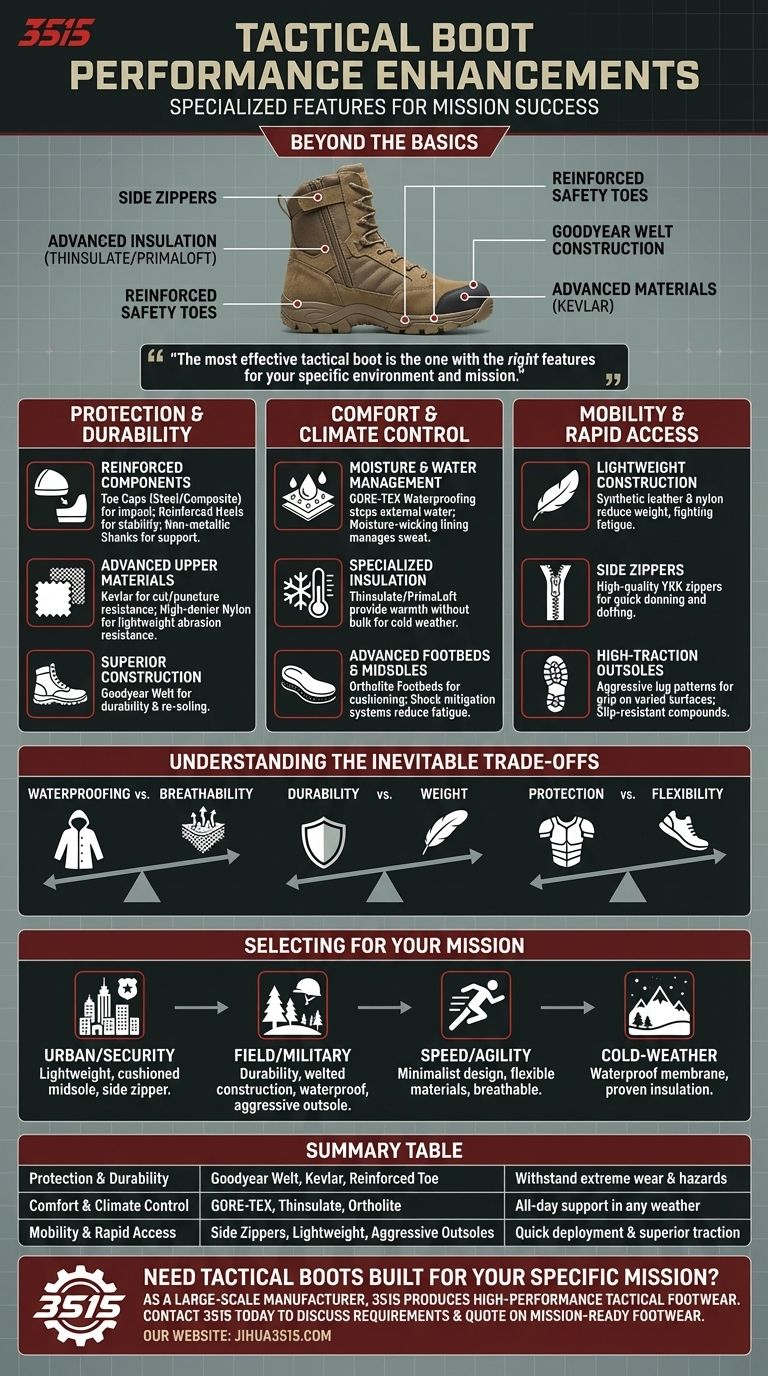
Beyond the basics, a high-performance tactical boot is defined by specialized features engineered for specific challenges. Key enhancements include side zippers for rapid deployment, advanced insulation like Thinsulate or PrimaLoft for cold weather, reinforced safety toes for protection, Goodyear welt construction for extreme durability, and advanced materials like Kevlar for puncture resistance.
The most effective tactical boot is not the one with the most features, but the one with the right features for your specific environment and mission. Understanding these enhancements allows you to move beyond marketing and choose a genuine tool for your feet.
The Anatomy of Performance: Key Feature Categories
Tactical boot features are not random additions; they are part of an integrated system. We can group them into three core benefit categories: Protection & Durability, Comfort & Climate Control, and Mobility & Access.
Category 1: Protection and Durability
These features are designed to shield you from environmental hazards and ensure the boot withstands rigorous use.
Reinforced Components
A boot's structure is its first line of defense. Reinforced toe caps (both steel and composite) protect against impact and compression, while reinforced heels provide stability and guard against abrasion.
Many boots also incorporate a shank—a rigid piece between the insole and outsole. Non-metallic shanks offer support without setting off metal detectors, a critical feature for security and law enforcement professionals.
Advanced Upper Materials
While traditional leather remains a staple for its durability, modern tactical boots often use a combination of materials. Kevlar uppers provide exceptional resistance to cuts and punctures, while high-denier nylon fabrics offer a lightweight, breathable, and abrasion-resistant alternative.
Superior Construction Methods
The way a boot is assembled directly impacts its lifespan. Goodyear welt construction, a method where the upper is stitched to the sole, creates an incredibly durable and water-resistant bond. This also allows the boot to be re-soled, significantly extending its service life.
Category 2: Comfort and Climate Control
In a tactical environment, comfort is not a luxury—it is a performance multiplier. Features in this category are focused on keeping your feet dry, supported, and at a stable temperature.
Moisture and Water Management
There is a crucial distinction between "waterproof" and "moisture-wicking." A waterproof membrane (like a GORE-TEX bootie) prevents external water from entering the boot.
A moisture-wicking lining, however, pulls sweat away from your skin to the boot's surface to evaporate. High-end boots use both to keep feet dry from the outside and the inside.
Specialized Insulation
For cold-weather operations, insulation is non-negotiable. Materials like Thinsulate and PrimaLoft provide exceptional warmth without adding significant bulk or weight, preserving mobility in frigid conditions.
Advanced Footbeds and Midsoles
The engine of comfort is the sole system. Ortholite footbeds are often used for their cushioning, breathability, and anti-microbial properties.
The midsole is responsible for shock absorption. Modern shock mitigation systems and cushioned midsoles dissipate the force of impact, reducing fatigue during long patrols or movements on hard surfaces.
Category 3: Mobility and Rapid Access
These features are engineered to help you move quickly, confidently, and efficiently.
Lightweight Construction
Fatigue is the enemy of performance. By using modern materials like synthetic leather and nylon panels, manufacturers significantly reduce boot weight. A lighter boot means less energy expended with every step, enabling you to stay effective for longer.
Side Zippers
A side zipper is a key feature for first responders or anyone who needs to don or doff their boots quickly. While it can be a potential point of failure or water ingress, a high-quality YKK zipper offers unmatched convenience.
High-Traction Outsoles
The outsole is where the boot meets the terrain. Tactical boots feature aggressive lug patterns designed for superior grip on a wide variety of surfaces, from wet pavement to loose gravel and mud. The rubber compounds are formulated for slip-resistance and durability.
Understanding the Inevitable Trade-offs
No single boot can be perfect for every situation. Choosing the right features always involves balancing competing priorities.
Waterproofing vs. Breathability
A fully waterproof boot is excellent at keeping water out, but it can trap sweat inside, leading to moisture buildup in hot climates. A non-waterproof but highly breathable boot will excel in dry, hot weather but will fail in a downpour.
Durability vs. Weight
A boot built with a Goodyear welt and thick leather will be incredibly durable but also heavier. A lightweight boot made of nylon and cemented construction will be faster and more agile but will not withstand the same level of abuse.
Protection vs. Flexibility
A rigid boot with a stiff shank and reinforced toe provides maximum protection and support under heavy loads. However, that same rigidity can limit flexibility, making it harder to run or navigate complex obstacles.
Selecting the Right Features for Your Mission
Your choice should be dictated entirely by your primary operational environment and tasks.
- If your primary focus is urban law enforcement or security: Prioritize a lightweight design, a cushioned midsole for hard surfaces, and a side zipper for rapid response.
- If your primary focus is field operations or military use: Emphasize durability with welted construction, ankle support, a waterproof membrane, and a highly aggressive outsole.
- If your primary focus is speed and agility: Look for minimalist boots made from flexible synthetic materials with excellent breathability and a lower shaft height.
- If your primary focus is cold-weather environments: Your non-negotiable features are a waterproof membrane and proven insulation like Thinsulate or PrimaLoft.
By matching the boot's features to your specific needs, you ensure your footwear is an asset, not a liability.
Summary Table:
| Feature Category | Key Enhancements | Primary Benefit |
|---|---|---|
| Protection & Durability | Goodyear Welt, Kevlar Uppers, Reinforced Toe | Withstand extreme wear & hazards |
| Comfort & Climate Control | GORE-TEX Waterproofing, Thinsulate Insulation, Ortholite Footbeds | All-day support in any weather |
| Mobility & Rapid Access | Side Zippers, Lightweight Construction, Aggressive Outsoles | Quick deployment & superior traction |
Need Tactical Boots Built for Your Specific Mission?
As a large-scale manufacturer, 3515 produces a comprehensive range of high-performance tactical footwear for distributors, brand owners, and bulk clients. Our production capabilities encompass all types of boots, allowing us to integrate the exact features—from side zippers and advanced insulation to durable Goodyear welt construction—that your operations demand.
Contact 3515 today to discuss your requirements and get a quote on mission-ready footwear.
Visual Guide
Related Products
- Durable Leather Tactical Boots Wholesale & Custom Manufacturing for Brands
- High-Traction Suede Tactical Boots Wholesale & Custom Manufacturing
- Durable Leather High-Ankle Tactical Boots for Wholesale & Custom Manufacturing
- Durable Mid-Cut Tactical Boots for Wholesale & Private Label
- Wholesale Waterproof Tactical Boots Custom Suede & High-Traction Soles
People Also Ask
- What specialized protections do tactical boots offer? Maximize Endurance with High-Performance Footwear
- What features should law enforcement officers look for in tactical boots? Essential Guide for Safety & Performance
- Importance of Professional Tactical Boots in Loess Gully Regions: Ensure Safety and Precision for Field Monitoring
- What is rucking, and why are tactical boots suitable for it? Discover the Ultimate Footwear for Heavy Loads
- What makes the traction of tactical boots superior? Unlock the Science of Unbeatable Grip













