
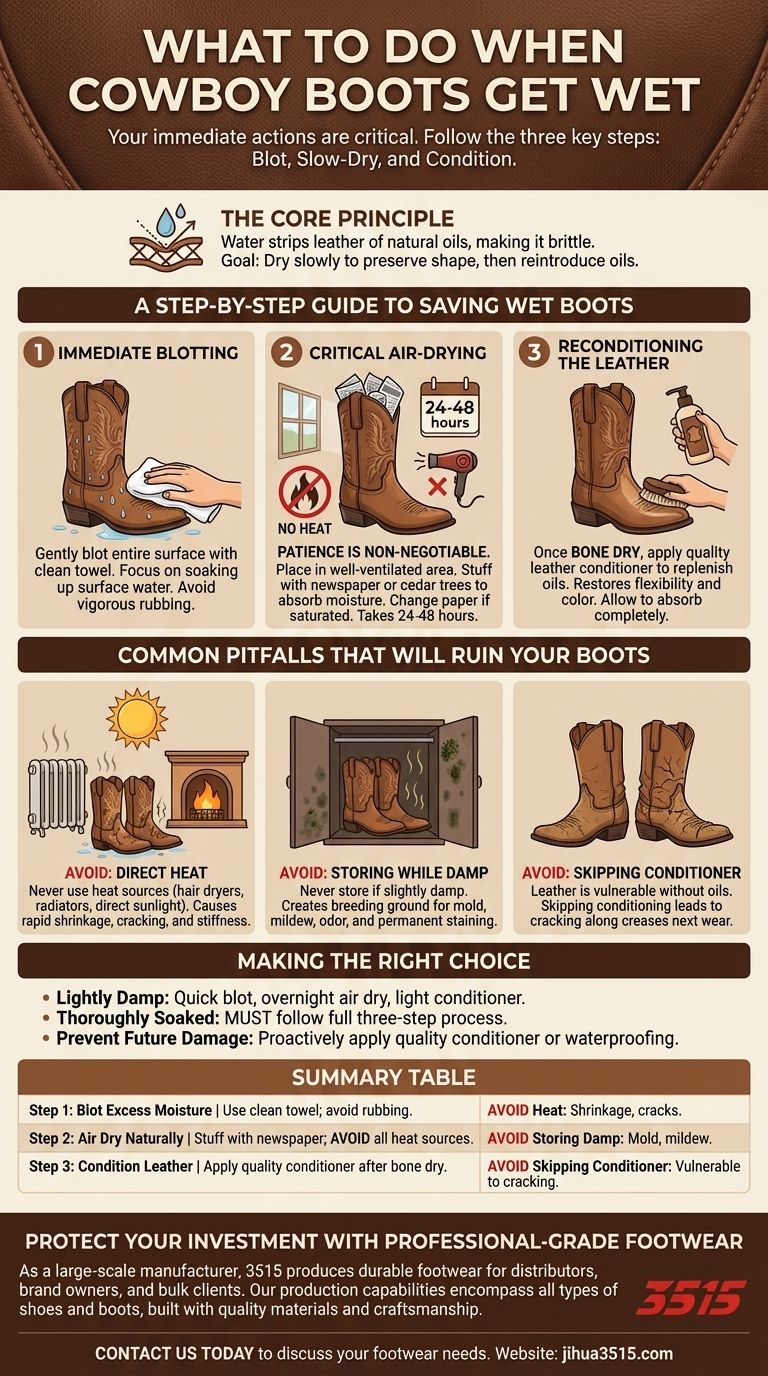
When your cowboy boots get wet, your immediate actions are critical to preventing permanent damage. The correct process involves three key steps: carefully blotting away excess moisture with a towel, allowing the boots to dry slowly and naturally away from any heat source, and finally, applying a quality leather conditioner once they are completely dry to restore essential oils.
The core principle is simple: water strips leather of its natural oils, making it brittle and prone to cracking. Your goal is to dry the boots slowly to preserve their shape and then reintroduce those oils with a conditioner.
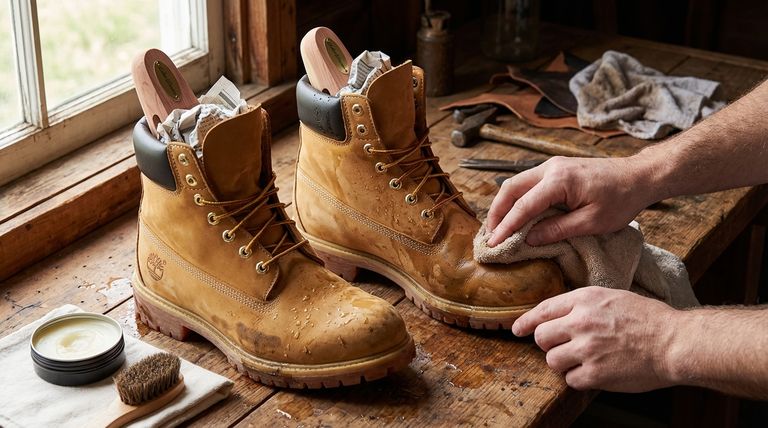
A Step-by-Step Guide to Saving Wet Boots
Leather is a durable material, but forcing it to dry too quickly can cause irreversible damage. Follow this process to ensure your boots recover fully.
Step 1: Immediate Blotting
The moment you can, gently blot the entire surface of the boots with a clean, dry towel or cloth.
Focus on soaking up as much surface water as possible. Avoid vigorous rubbing, which can push moisture deeper into the leather's pores.
Step 2: The Critical Air-Drying Phase
This is the most important step. Patience is non-negotiable.
Place your boots in a well-ventilated area at room temperature. To help them maintain their shape and absorb internal moisture, stuff them with newspaper or insert unvarnished cedar boot trees.
Change the newspaper every few hours if the boots were heavily saturated. This slow, natural process can take anywhere from 24 to 48 hours.
Step 3: Reconditioning the Leather
Once the boots are bone dry to the touch, it's time to restore what the water took away.
Apply a high-quality leather conditioner according to the product's instructions. This replenishes the oils that water leached out, restoring the leather's flexibility, color, and strength.
Work the conditioner in thoroughly and allow it to absorb completely before wearing the boots again.
Common Pitfalls That Will Ruin Your Boots
Avoiding mistakes is just as important as following the right steps. Many well-intentioned owners ruin their boots by trying to speed up the process.
The Danger of Direct Heat
Never use an external heat source to dry your boots. This is the single fastest way to destroy them.
Heat sources like hair dryers, radiators, fireplaces, or even direct sunlight cause the moisture to evaporate too quickly. This rapid drying shrinks and cracks the leather, making it stiff and brittle.
Storing Boots While Damp
Never put your boots away in a closet or box while they are still even slightly damp.
A dark, enclosed space with moisture is the perfect breeding ground for mold and mildew. This will not only create a foul odor but can also permanently stain and weaken the leather fibers.
Skipping the Conditioner
Even if your boots appear fine after drying, they are not. The leather's internal structure has been compromised by the loss of oils.
Skipping the conditioning step leaves the leather vulnerable. The next time you wear them, the stress of flexing and walking is far more likely to cause cracking along the creases.
Making the Right Choice for Boot Recovery
Your specific actions should match the level of saturation to ensure the long-term health of your investment.
- If your boots got lightly damp: A quick blot with a towel and an overnight air dry is often sufficient, but applying a light coat of conditioner is still recommended.
- If your boots were thoroughly soaked: You must follow the full three-step process—blot, slow-dry, and deep-condition—without compromise to prevent permanent damage.
- To prevent future water damage: Proactively treat your boots by regularly applying a quality leather conditioner or a suitable waterproofing product to create a protective barrier.
Proper care ensures that a single downpour won't be the end of your favorite pair of boots.
Summary Table:
| Step | Action | Key Detail |
|---|---|---|
| 1 | Blot Excess Moisture | Use a clean, dry towel; avoid rubbing. |
| 2 | Air Dry Naturally | Stuff with newspaper; avoid all heat sources. |
| 3 | Condition Leather | Apply a quality conditioner after boots are bone dry. |
| AVOID | Using Direct Heat | Causes leather to shrink, crack, and become brittle. |
| AVOID | Storing While Damp | Leads to mold and mildew growth. |
| AVOID | Skipping Conditioner | Leaves leather vulnerable to cracking. |
Protect Your Investment with Professional-Grade Footwear
As a large-scale manufacturer, 3515 produces a comprehensive range of durable footwear for distributors, brand owners, and bulk clients. Our production capabilities encompass all types of shoes and boots, built with quality materials and craftsmanship to withstand the elements.
Let us help you provide your customers with boots that last.
Contact us today to discuss your footwear needs and discover how our manufacturing expertise can add value to your business.
Visual Guide
Related Products
- Wholesale High-Traction Camo Boots - Custom Manufacturer for Brands
- High-Traction Suede Tactical Boots Wholesale & Custom Manufacturing
- Wholesale Lightweight Tactical Boots Custom Manufacturer for Desert & Combat Use
- Durable Leather Tactical Boots Wholesale & Custom Manufacturing for Brands
- Wholesale Durable Mid-Cut Tactical Boots for Custom & Private Label Brands
People Also Ask
- What are the key features of the new line of camo boots? Built for Extreme Cold & Rugged Terrain
- Are camo boots necessary for hunting success? Prioritize Performance Over Pattern
- What is the technical logic behind using closed-eye testing for tactical boots? Unlocking Peak Footwear Stability
- How does the Rank Score Test identify the primary causes of premature failure in tactical and work boots? Key Insights
- What shoes to wear for a security job? Durable, Protective Footwear for Long Shifts

















