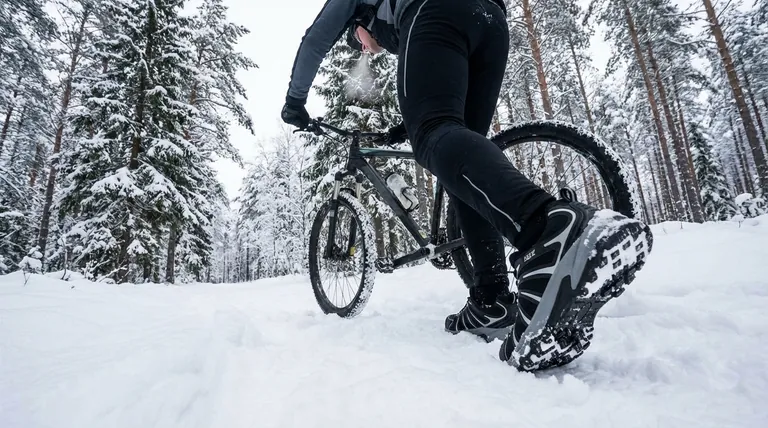
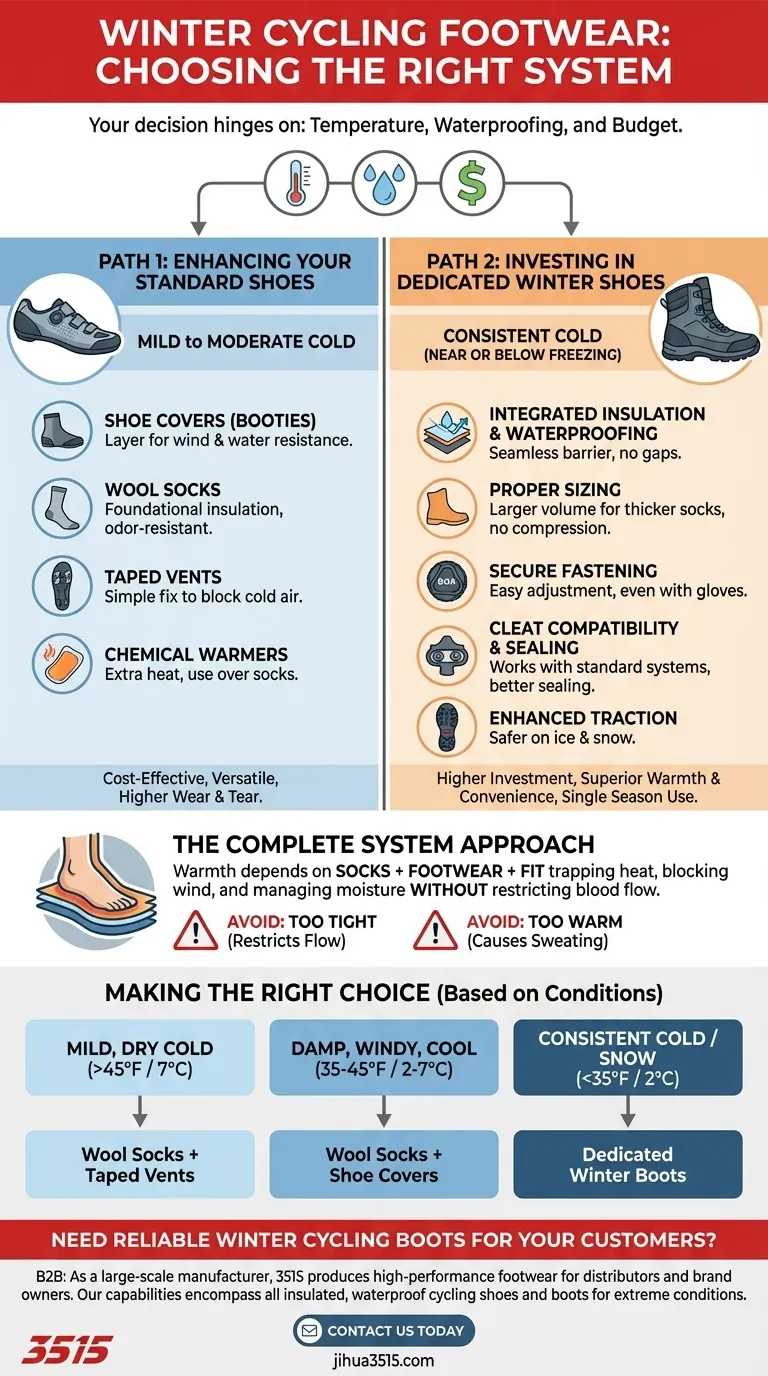
When selecting winter cycling footwear, your decision hinges on three core factors: the temperature range you ride in, the need for waterproofing, and your budget. Your ideal solution will fall on a spectrum from simple shoe covers for milder days to fully insulated, dedicated boots for deep-winter conditions.
The key to warm feet is not a single product but a complete system. Success depends on how your socks, footwear, and their combined fit work together to trap heat, block wind, and manage moisture without restricting blood flow.
The Core Components of a Winter System
A cyclist has two primary paths for winter foot protection: enhancing their existing shoes or investing in a dedicated winter-specific shoe.
Path 1: Enhancing Your Standard Cycling Shoes
This approach is cost-effective and suitable for mild to moderately cold conditions.
- Shoe Covers (Booties): These are the most common solution. They slip over your regular cycling shoes to provide a crucial layer of wind and water resistance, which are the primary thieves of warmth.
- The Right Socks: A quality pair of wool socks is foundational. Wool insulates well even when damp and is naturally odor-resistant.
- Low-Cost Insulation: For a simple boost, cover the ventilation holes in your shoes with duct tape or cling wrap from the inside. This effectively blocks cold air entry at no real cost.
- Chemical Warmers: Single-use toe warmers can be placed on top of your socks (never directly on skin) inside your shoe for an extra source of heat on particularly cold days.
Path 2: Investing in Dedicated Winter Cycling Shoes
For those who ride consistently in temperatures near or below freezing, a dedicated winter shoe or boot is a significant upgrade in performance and convenience.
- Integrated Insulation and Waterproofing: Unlike shoe covers, the protective layers are built-in. This creates a seamless barrier against the elements with no gaps or vulnerabilities.
- Proper Sizing: Winter boots are designed with a larger volume to accommodate thicker socks without compressing them. This space is critical for trapping warm air.
- Secure Fastening: Systems like BOA dials or protected laces allow for a secure fit that can be adjusted easily, even with gloves on, ensuring comfort without being too tight.
- Cleat Compatibility: These shoes are built to work with standard road or mountain bike cleat systems while often offering better sealing around the cleat area to prevent water ingress.
- Enhanced Traction: Many winter models feature more aggressive rubber soles, providing safer traction for those inevitable moments when you have to walk on icy or snowy ground.
Understanding the Trade-offs
Choosing the right system involves balancing cost, convenience, and outright performance.
Dedicated Shoes vs. Shoe Covers
A dedicated winter boot is a single, integrated solution. It is warmer, more waterproof, and far more convenient than fussing with separate covers. However, it represents a significant financial investment for a single season.
Shoe covers are more versatile and vastly more affordable. They allow you to use your preferred three-season shoes deeper into the year, but they can be difficult to put on and are more susceptible to wear and tear.
The Pitfall of "Too Much"
It is possible to have too much insulation or to layer improperly. If your socks are too thick or your shoes are too tight, you will restrict blood flow, which is the fastest way to get cold feet, regardless of your gear.
Likewise, feet that are too warm will sweat. This moisture will eventually cool down, leaving your feet damp and chilled from the inside out. The goal is warmth and breathability, not just bulk.
Making the Right Choice for Your Ride
Your decision should be based directly on the conditions you face most often.
- If your primary focus is riding in mild, dry cold (above 45°F / 7°C): A good pair of wool socks and taping over your shoe's vent holes is often enough.
- If your primary focus is riding in damp, windy, and cool conditions (35-45°F / 2-7°C): Combining wool socks with a quality pair of shoe covers (booties) over your standard shoes is the most effective strategy.
- If your primary focus is riding consistently in the cold or snow (below 35°F / 2°C): Investing in dedicated, insulated, and waterproof winter cycling boots is the most reliable path to comfort and safety.
By correctly matching your footwear system to your climate, you can ensure your feet remain a source of strength, not a distraction.
Summary Table:
| Temperature Range | Recommended Footwear System | Key Components |
|---|---|---|
| Above 45°F / 7°C | Standard Cycling Shoes | Wool socks, taped vents |
| 35-45°F / 2-7°C | Shoes + Covers (Booties) | Wool socks, shoe covers |
| Below 35°F / 2°C | Dedicated Winter Boots | Insulated, waterproof boots |
Need reliable winter cycling boots for your customers? As a large-scale manufacturer, 3515 produces a comprehensive range of high-performance footwear for distributors, brand owners, and bulk clients. Our production capabilities encompass all types of insulated, waterproof cycling shoes and boots designed for extreme conditions. Let us help you equip your customers with the right gear for winter riding. Contact us today to discuss your production needs!
Visual Guide
Related Products
- Premium Insulated Safety Boots and Shoes for Wholesale & Bulk Orders
- Durable Waterproof Rain Boots | Custom Manufacturer for Wholesale & Brands
- Premium Suede Sport Safety Shoes for Wholesale & Bulk Orders
- Lightweight Breathable Sneakers with Wet-Traction Grip for Wholesale & Private Label
- Wholesale Waterproof Tactical Boots Custom Suede & High-Traction Soles
People Also Ask
- What are the recommended insulation ratings for mild winter conditions? A Guide for Active & Stationary Workers
- How does insulation thickness correlate with temperature ranges? A Guide to Choosing the Right Warmth
- What insulation level is needed for severe cold and stationary work? 1200g or Higher is Essential
- What safety advantages do insulated boots offer beyond warmth? Dielectric Protection & Superior Grip
- How does fleece lining contribute to the warmth of insulated boots? Trapping Air for Superior Cold Protection