
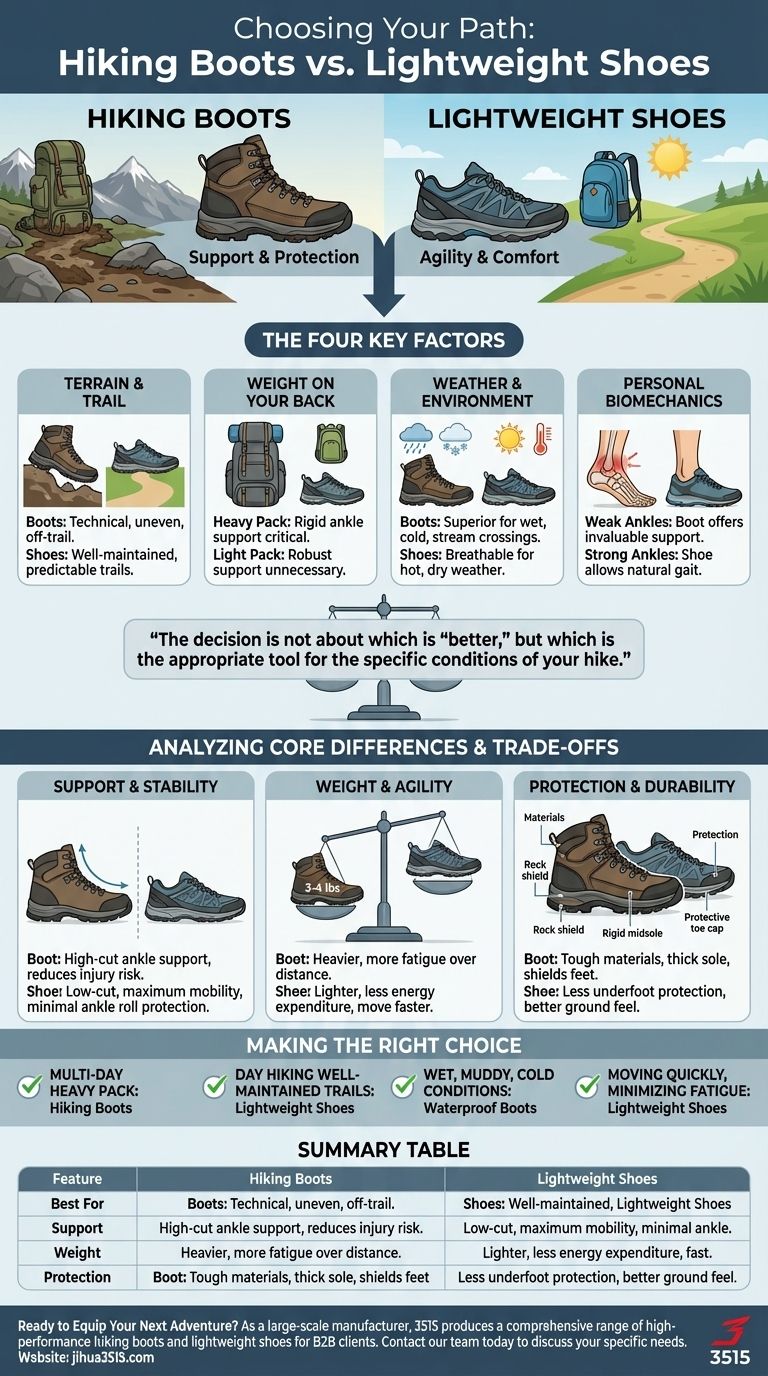
The right choice between hiking boots and lightweight shoes depends on four primary factors: the terrain you will be on, the weight of the pack you will be carrying, the expected weather conditions, and your personal biomechanics. Hiking boots excel in providing support and protection on rough, unpredictable terrain with a heavy pack, while lightweight shoes offer superior agility and comfort on well-maintained trails with a light load.
The decision is not about which footwear is inherently "better," but which is the appropriate tool for the specific conditions of your hike. Boots prioritize protection and stability at the cost of weight, while shoes prioritize comfort and agility at the cost of support.
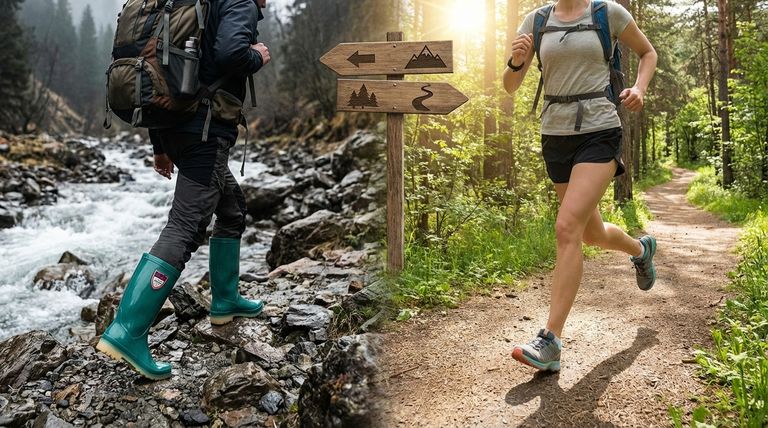
Deconstructing the Choice: The Four Key Factors
Understanding how each variable impacts your footwear needs is the first step to making a confident decision. Your choice should be a deliberate response to the demands of your planned adventure.
Terrain and Trail Conditions
The surface under your feet is a primary determinant. Boots are built for technical, uneven, or off-trail environments where you might encounter sharp rocks, loose scree, or deep mud. Their stiff soles and durable construction protect your feet from impacts.
Lightweight shoes, in contrast, are ideal for well-maintained and predictable trails. Their flexibility allows for a more natural foot-strike and better "ground feel," which can be more comfortable on smoother paths.
The Weight on Your Back
The load you carry directly affects your center of gravity and the stress on your joints. When carrying a heavy pack for multi-day trips, the rigid ankle support of a hiking boot becomes critical. It helps prevent ankle twists and provides the stability needed to manage the extra weight.
For day hikes with a light pack, the robust support of a boot is often unnecessary. Hiking shoes provide sufficient cushioning and traction for light loads without the added weight and stiffness.
Weather and Environment
Consider the climate of your hike. Boots, especially waterproof models, offer superior protection from rain, snow, and stream crossings, keeping your feet dry and warm in cold or wet conditions.
Lightweight shoes are far more breathable, making them a better choice for hot and dry weather. They allow heat and moisture to escape, reducing the risk of blisters and keeping your feet comfortable.
Your Personal Biomechanics
Finally, consider your own body. If you have a history of ankle sprains or feel you have weaker ankles, the high-cut support of a boot is an invaluable safety feature.
However, if you have strong, stable ankles and prioritize a natural gait, the freedom of movement offered by a low-cut hiking shoe may be preferable. Comfort is highly personal, so factors like foot width and arch shape also play a role.
Analyzing the Core Differences
Boots and shoes are constructed differently to serve distinct purposes. Recognizing these design differences clarifies their intended use.
Support and Stability
A boot's defining feature is its high-cut design that wraps around the ankle. This structure provides crucial lateral support, reducing the risk of injury on unstable ground, especially when you're fatigued at the end of a long day.
A shoe is low-cut, leaving the ankle exposed. This allows for maximum mobility and flexibility but offers minimal protection against ankle rolls.
Weight and Agility
Hiking boots are significantly heavier, often weighing 3-4 pounds per pair. This added weight requires more energy to lift with every step, which can contribute to fatigue over a long distance.
Hiking shoes are much lighter, often resembling a rugged sneaker. This lower weight translates directly to less energy expenditure, allowing you to move faster and more efficiently.
Protection and Durability
Boots are built with thicker, tougher materials like leather and have rigid midsoles. This robust construction shields your feet from sharp rocks, roots, and direct impacts.
Shoes offer less underfoot protection. While they have protective toe caps and rock plates, their softer soles mean you will feel more of the terrain underfoot, for better or worse.
Understanding the Trade-offs
Every gear choice involves compromise. Being aware of the inherent trade-offs between boots and shoes is key to avoiding common pitfalls.
The Boot Trade-off: Protection vs. Fatigue
The very features that make a boot protective—its weight, stiffness, and thick materials—are also what make it more tiring to wear. The extra pound on your feet can feel like five pounds on your back over the course of a full day.
The Shoe Trade-off: Agility vs. Risk
The lightness and flexibility that make a hiking shoe feel so comfortable and fast come at the expense of protection. Wearing a shoe on terrain that demands a boot significantly increases your risk of a trip-ending ankle injury or a painful stone bruise.
Making the Right Choice for Your Hike
Match your footwear directly to the demands of your planned hike and your personal needs.
- If your primary focus is multi-day backpacking with a heavy pack: Choose hiking boots for their non-negotiable stability and ankle support.
- If your primary focus is day hiking on well-maintained trails: Choose lightweight hiking shoes for their superior comfort and breathability.
- If your primary focus is hiking in wet, muddy, or cold conditions: Choose waterproof boots to ensure your feet stay dry, warm, and protected.
- If your primary focus is moving quickly and minimizing fatigue on moderate terrain: Choose lightweight shoes to conserve energy and maximize agility.
Ultimately, selecting the right footwear is about empowering yourself to hike with greater comfort, confidence, and safety.
Summary Table:
| Feature | Hiking Boots | Lightweight Shoes |
|---|---|---|
| Best For | Heavy packs, rough terrain, wet/cold weather | Light packs, well-maintained trails, hot/dry weather |
| Support | High ankle support, maximum stability | Low-cut, maximum agility and natural movement |
| Weight | Heavier (3-4 lbs/pair), more fatiguing | Lighter, less energy expenditure |
| Protection | High protection from impacts and elements | Less underfoot protection, better ground feel |
Ready to Equip Your Next Adventure with the Perfect Footwear?
As a large-scale manufacturer, 3515 produces a comprehensive range of high-performance hiking boots and lightweight shoes for distributors, brand owners, and bulk clients. Our expertise ensures durable, comfortable, and purpose-built footwear for any trail condition.
Let us help you provide the right gear for every hiker.
Contact our team today to discuss your specific needs and discover how our manufacturing capabilities can benefit your business.
Visual Guide
Related Products
- Durable Rubber Sole Outdoor Shoes Wholesale & Custom Manufacturing
- Wholesale High-Traction Camo Boots - Custom Manufacturer for Brands
- Wholesale Lightweight Tactical Boots Custom Manufacturer for Desert & Combat Use
- Wholesale Durable Camouflage Canvas Shoes with High-Traction Cleated Rubber Sole
- Wholesale Waterproof Tactical Boots Custom Suede & High-Traction Soles
People Also Ask
- What is the function of the sole in outdoor shoes? Find the Perfect Grip and Support
- What role do outdoor shoes and sneakers play in navigating external terrains? Engineered Stability for Every Surface
- How is AI utilized in the design of outdoor and safety footwear? Harnessing Big Data for Market-Driven Shoe Innovation
- Why is durability important when selecting outdoor shoes? A Guide to Safety & Long-Term Value
- What are the key components of outdoor shoes that affect comfort and sturdiness? A Guide to Durable, High-Performance Footwear



















