
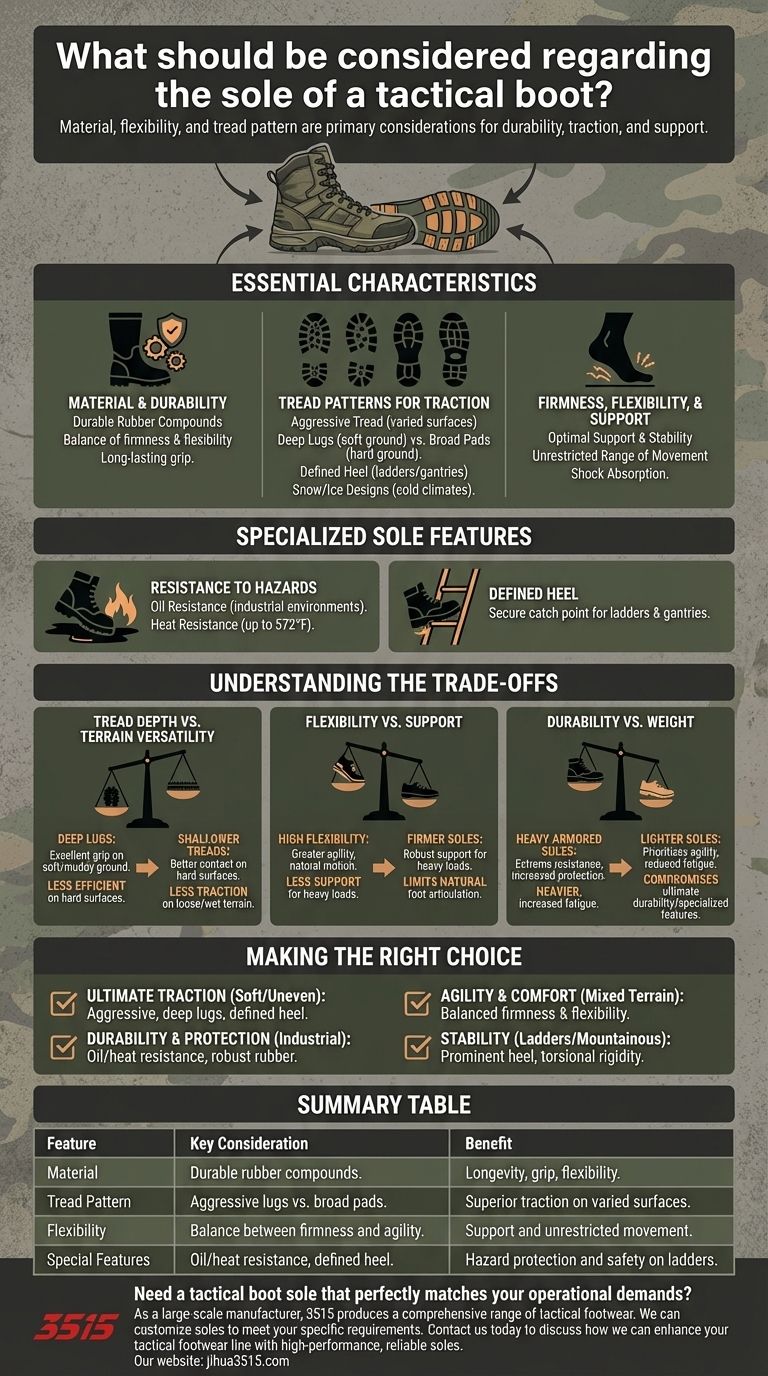
For a tactical boot sole, primary considerations revolve around its material, flexibility, and tread pattern, ensuring optimal durability, traction, and support across diverse, demanding environments. These elements collectively dictate the boot's performance, protecting the wearer and enabling efficient movement whether on rough terrain, slippery surfaces, or industrial settings.
The core of a tactical boot's performance lies in its sole. It must strike a critical balance between robust protection and agile movement, demanding careful consideration of its composition, design, and specialized features to meet the rigorous demands of tactical operations.

Essential Characteristics of a Tactical Boot Sole
The sole of a tactical boot is a complex component designed for high performance under challenging conditions. It integrates several critical features to ensure safety, efficiency, and durability.
Material and Durability
The sole material is fundamental to its performance.
- Durable Rubber is Standard: Tactical boot outsoles are primarily made from durable rubber. This material provides essential grip, flexibility, and longevity.
- Balancing Strength and Flexibility: The material must offer a firm yet flexible structure. This allows the sole to withstand rough terrain while enabling a maximum range of movement.
Tread Patterns for Traction
The design of the sole's surface is crucial for maintaining footing.
- Aggressive Tread for Varied Surfaces: Soles feature aggressive tread patterns to provide superior slip resistance and traction. This is vital on surfaces like mud, gravel, wet rocks, and even oily ground.
- Deep Lugs vs. Broad Pads: Deep lugs are designed for soft ground, offering maximum bite. Conversely, broad pads are better suited for hard, flat terrains.
- Specialized Traction Needs: Some designs are specifically tailored for snow and ice in cold climates, ensuring stability in extreme conditions.
- Defined Heel for Safety: A defined heel is critical for users who frequently encounter ladders or gantries, providing a secure catch point.
Firmness, Flexibility, and Support
The sole must support the foot while allowing natural movement.
- Support and Stability: The sole unit must offer adequate support and stability, particularly for extended wear and long walks.
- Optimal Range of Movement: Despite being firm, the sole must retain enough flexibility to allow for a full and unrestricted range of foot movement.
- Shock Absorption: While not explicitly detailed, implicit in tactical boot design is the need for some level of shock absorption to reduce fatigue during high-impact activities.
Specialized Sole Features
Beyond basic traction and durability, some environments demand specific sole properties.
Resistance to Hazards
Certain tactical scenarios require advanced protective features.
- Oil Resistance: Many tactical boot soles are designed to be oil-resistant. This is particularly important for industrial environments where oil and grease can pose slip hazards.
- Heat Resistance: For industries exposing boots to high temperatures, heat resistance is crucial. Soles can offer resistance up to 572ºF, common in fields like road resurfacing.
Understanding the Trade-offs
Choosing the right tactical boot sole involves balancing various performance characteristics, as optimizing one aspect may impact another.
Tread Depth vs. Terrain Versatility
Different tread designs excel on specific surfaces but may be less effective on others.
- Deeper treads offer excellent grip on soft, muddy, or uneven ground. However, they can feel clunky or less efficient on hard, flat surfaces like concrete.
- Shallower, more uniform treads provide better contact and stability on hard surfaces but will slip on loose or wet terrain.
Flexibility vs. Support
The degree of sole flexibility directly impacts foot support and agility.
- Highly flexible soles allow for greater agility and a more natural foot motion, which is beneficial for varied movements and comfort.
- Firmer soles provide more robust support, crucial for carrying heavy loads or navigating extremely rough, unstable terrain, but can limit natural foot articulation.
Durability vs. Weight
More durable materials often come with added mass.
- Heavily armored or specialized soles with extreme resistance (e.g., heat, puncture) tend to be heavier. This increases protection and lifespan but can contribute to wearer fatigue over long periods.
- Lighter soles prioritize agility and reduce fatigue, often by compromising on ultimate durability or specialized protective features.
Making the Right Choice for Your Goal
Selecting the ideal tactical boot sole depends entirely on the primary demands of your mission or environment.
- If your primary focus is ultimate traction on soft, uneven ground: Prioritize boots with aggressive, deep lug patterns and a defined heel.
- If your primary focus is durability and protection in industrial or hazardous environments: Choose soles with oil resistance, heat resistance, and robust rubber compounds.
- If your primary focus is agility and comfort for varied movements on mixed terrain: Seek a balance between firmness and flexibility, ensuring adequate support without restricting natural foot articulation.
- If your primary focus is stability on ladders, gantries, or mountainous terrain: A prominent, well-defined heel and excellent torsional rigidity in the sole are essential.
Ultimately, the best tactical boot sole is the one that comprehensively addresses the specific challenges of your operational environment while providing reliable support and protection.
Summary Table:
| Feature | Key Consideration | Benefit |
|---|---|---|
| Material | Durable rubber compounds | Longevity, grip, and flexibility |
| Tread Pattern | Aggressive lugs vs. broad pads | Superior traction on varied surfaces |
| Flexibility | Balance between firmness and agility | Support and unrestricted movement |
| Special Features | Oil/heat resistance, defined heel | Hazard protection and safety on ladders |
Need a tactical boot sole that perfectly matches your operational demands?
As a large-scale manufacturer, 3515 produces a comprehensive range of tactical footwear for distributors, brand owners, and bulk clients. Our production capabilities encompass all types of boots, and we can customize soles to meet your specific requirements for durability, traction, and specialized resistance.
Contact us today to discuss how we can enhance your tactical footwear line with high-performance, reliable soles.
Visual Guide
Related Products
- Wholesale Waterproof Tactical Boots Custom Suede & High-Traction Soles
- High-Traction Suede Tactical Boots Wholesale & Custom Manufacturing
- Durable Leather Tactical Boots Wholesale & Custom Manufacturing for Brands
- Durable Leather High-Ankle Tactical Boots for Wholesale & Custom Manufacturing
- Durable Mid-Cut Tactical Boots for Wholesale & Private Label
People Also Ask
- What waterproof technology is used in tactical boots? Unlock All-Weather Performance & Protection
- What are the advantages and disadvantages of waterproof tactical boots? A Guide to the Key Trade-Offs
- What is the significance of waterproof functionality in tactical boots? Essential for Health & Performance
- What is the role of professional 3D medical imaging software in optimizing tactical boot design and performance?
- What features enhance breathability and comfort in tactical boots? A Guide to Superior Footwear Performance

















