
While certain brands are consistently favored by foot doctors, the true recommendation is not a specific logo but a set of crucial features that support proper foot mechanics. Podiatrists often point to brands like New Balance, Brooks, ASICS, Saucony, and Hoka because they reliably build shoes with excellent stability, cushioning, and a supportive fit designed for a variety of foot types.
The most important takeaway is to shift your focus from brand names to the specific construction of the shoe. A podiatrist's recommendation is ultimately about finding a shoe with the right features for your unique foot shape, arch type, and activity level.

Why Podiatrists Prioritize Features Over Brands
A shoe is a tool designed to support your body's foundation. A doctor's recommendation is based on how well that tool performs its job, regardless of the brand stamped on the side. The key is understanding what makes a shoe effective.
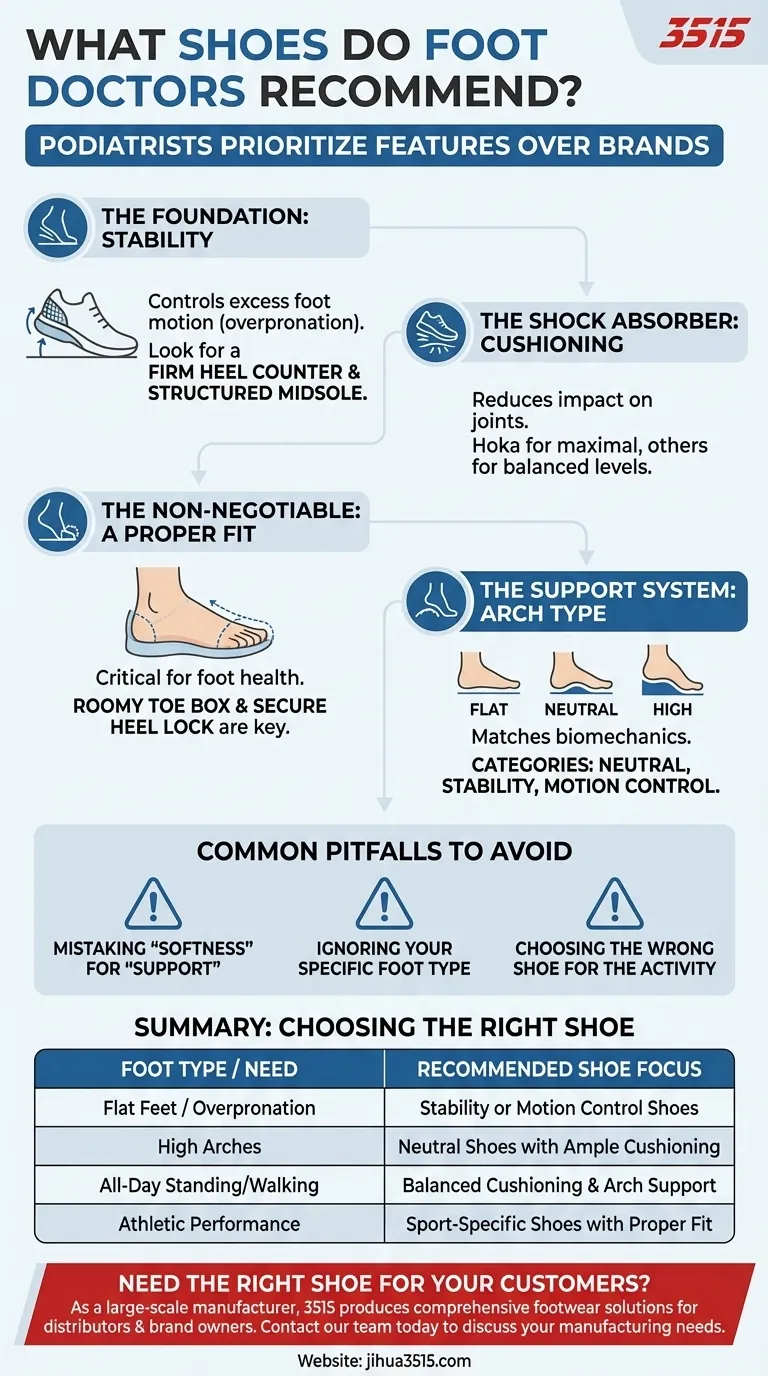
The Foundation: Stability
Stability features help control excess foot motion, particularly overpronation (where the foot rolls too far inward).
A stable shoe has a firm heel counter—the part that wraps around your heel—to prevent side-to-side wobble. It also features a well-structured midsole that resists easy twisting.
The Shock Absorber: Cushioning
Cushioning is about shock absorption, reducing the impact that travels from your feet up through your joints with every step.
Brands like Hoka are known for maximal cushioning, while others like Saucony or Brooks offer a wide range of cushioning levels to suit different preferences and needs.
The Non-Negotiable: A Proper Fit
No feature matters if the shoe doesn't fit correctly. A proper fit is the most critical factor for foot health and comfort.
Look for a roomy toe box that allows your toes to splay naturally without being cramped. Your heel should feel secure and "locked in" without slipping.
The Support System: Arch Type
Your arch is your foot's natural shock absorber. The right shoe supports your specific arch type.
Shoes are often categorized as neutral, stability, or motion control to match different biomechanics, from high arches (supination) to flat feet (overpronation).
Common Pitfalls to Avoid
Choosing the right shoe involves navigating some common misconceptions. Being aware of these trade-offs is crucial for making an informed decision that benefits your foot health.
Mistaking 'Softness' for 'Support'
An extremely soft, plush shoe can feel comfortable initially but may lack the necessary stability to guide your foot properly.
For many people, especially those who overpronate or spend long hours on their feet, a shoe that is supportively firm is better than one that is excessively soft.
Ignoring Your Specific Foot Type
A shoe that receives five-star reviews may be entirely wrong for you. A motion-control shoe designed for flat feet will feel awkward and potentially harmful for someone with high, rigid arches.
It is essential to understand your own foot mechanics—or get an assessment at a specialty running store—before selecting a shoe.
Choosing the Wrong Shoe for the Activity
Running shoes are designed for forward motion. Court shoes are built for lateral stability. Wearing the wrong type of shoe for your activity compromises its support features and can increase the risk of injury.
How to Choose the Right Shoe for You
Use these principles to guide your selection, focusing on your primary goal.
- If your primary focus is managing flat feet or overpronation: Look for shoes marketed for "stability" or "motion control," which feature firmer midsoles and strong heel counters.
- If your primary focus is accommodating high arches: Prioritize "neutral" shoes with significant cushioning to help absorb impact where your natural arch cannot.
- If your primary focus is all-day comfort for standing or walking: Seek a balanced shoe that offers both moderate cushioning and durable arch support, rather than one at an extreme end of the spectrum.
- If your primary focus is athletic performance: Choose a shoe designed specifically for your sport that fits correctly and matches your foot's biomechanics.
Ultimately, investing the time to understand your needs is the best step you can take for your long-term foot health.
Summary Table:
| Foot Type / Need | Recommended Shoe Focus |
|---|---|
| Flat Feet / Overpronation | Stability or Motion Control Shoes |
| High Arches | Neutral Shoes with Ample Cushioning |
| All-Day Standing/Walking | Balanced Cushioning & Arch Support |
| Athletic Performance | Sport-Specific Shoes with Proper Fit |
Need the right shoe for your customers? As a large-scale manufacturer, 3515 produces a comprehensive range of footwear for distributors, brand owners, and bulk clients. Our production capabilities encompass all types of shoes and boots, from supportive walking shoes to high-performance athletic footwear. We can help you source or develop the perfect product line that meets the specific needs of your target market. Contact our team today to discuss your manufacturing needs.
Visual Guide
Related Products
- Wholesale Durable & Breathable Training Shoes for Custom Brands
- Premium Lightweight Safety Shoes for Wholesale & Bulk Orders
- Custom OEM Training Shoes Wholesale Manufacturer Durable & Breathable
- Wholesale Breathable Training Shoes Custom Athletic Footwear Manufacturer
- Wholesale Durable Camouflage Canvas Shoes with High-Traction Cleated Rubber Sole
People Also Ask
- Why is structural stability in footwear required during dual-task walking tests? Ensure Sensor Precision & Data Integrity
- Why is the integration of advanced cushioning in training shoes necessary for athletes? Boost Recovery and Performance
- Why is the use of flat-soled or professional training shoes essential for WBV? Maximize Vibration Energy Transfer
- Why is it necessary for participants to wear professional training shoes? Ensuring Data Accuracy & Patient Safety
- How does the Ground Reaction Force (GRF) constancy hypothesis influence professional training shoes and sneakers?











