
At their core, racing boots are a highly specialized safety system engineered to protect a rider's feet, ankles, and shins from the unique forces of a high-speed motorcycle crash. They provide critical protection against impact, abrasion, and the dangerous twisting motions that can cause severe injury, utilizing features like reinforced armor and low-friction sliders.
The fundamental purpose of a racing boot is not just to cover your foot, but to manage the violent physics of a motorcycle accident. They are designed to let your foot slide rather than grip the pavement and to prevent your ankle from bending or twisting in ways it was never meant to.

The Core Pillars of Racing Boot Protection
A motorcycle crash involves a combination of impact, abrasion, and torsional forces. A true racing boot is built to address all three threats with a system of integrated components.
Torsional and Flexion Control
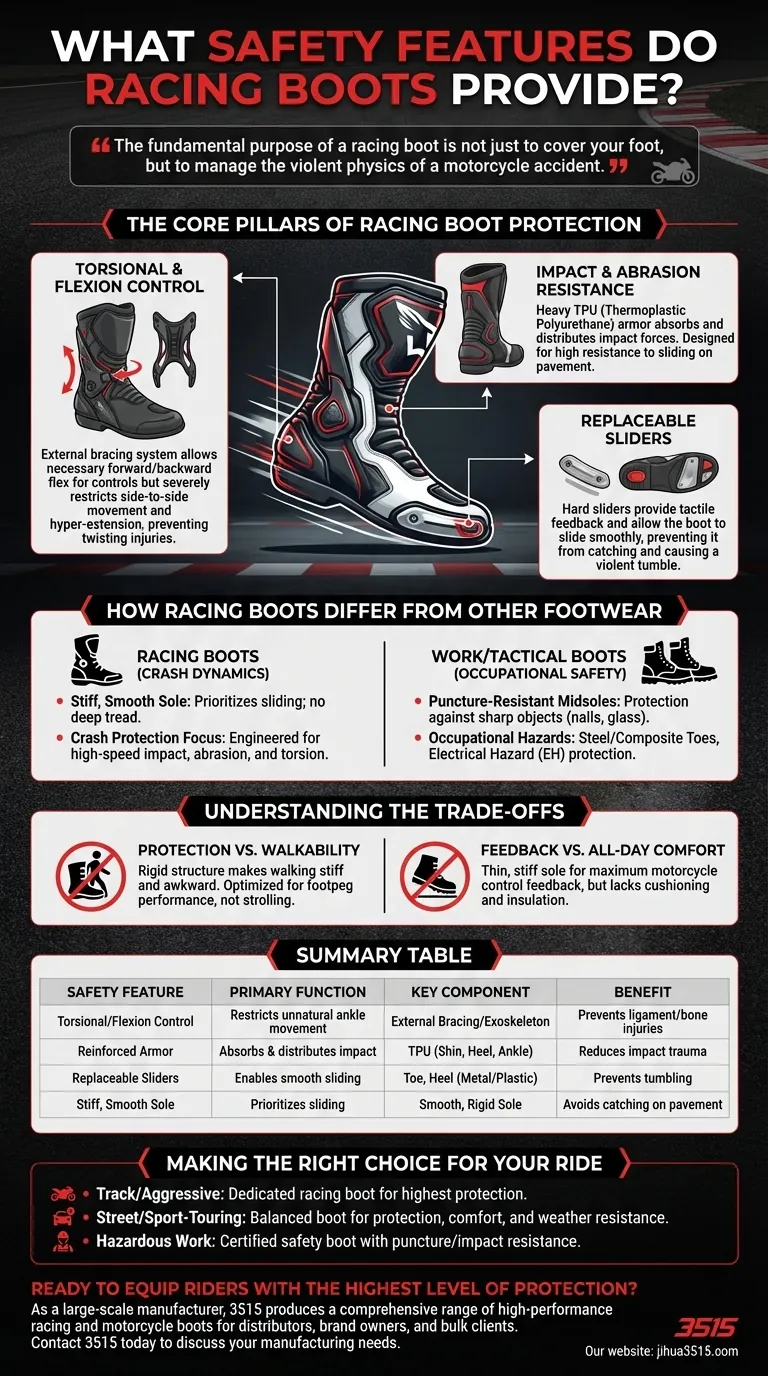
The most critical feature of a high-end racing boot is its ability to control unnatural movement. Many feature an external bracing system or "exoskeleton."
This structure allows for the necessary forward and backward flex for shifting and braking but severely restricts side-to-side movement and hyper-extension, protecting ligaments and bones from devastating twisting injuries.
Impact and Abrasion Resistance
During a fall, your feet and lower legs are highly vulnerable to both the initial impact and the subsequent slide.
Racing boots feature heavy reinforcement, often with TPU (Thermoplastic Polyurethane) armor over the shin, heel, and ankle. This armor is designed to absorb and distribute the force of an impact.
Replaceable Sliders
Hard plastic or metal sliders on the toe, heel, and sometimes the calf are a defining feature. Their purpose is twofold.
First, they provide tactile feedback, letting a rider know when their boot is touching the pavement during extreme lean angles. More importantly, they allow the boot to slide smoothly across the asphalt, preventing it from catching or digging in, which could send a rider tumbling violently.
How Racing Boots Differ from Other Protective Footwear
Understanding what a racing boot is not clarifies its specific purpose. Unlike work or tactical boots, which are designed for a different set of hazards, racing boots are singularly focused on crash dynamics.
Sliding vs. Puncture Resistance
A key difference is the sole's design philosophy. Tactical and work boots often feature puncture-resistant midsoles to protect against nails, glass, and other sharp objects on the ground.
Racing boots, however, prioritize a stiff, smooth sole that facilitates sliding. A high-grip, puncture-resistant sole would be a liability in a crash, as it could catch on the pavement and cause injury.
Crash Protection vs. Occupational Safety
Specialist work boots are designed for industrial hazards. They may offer features like steel or composite toes to protect from heavy falling objects or Electrical Hazard (EH) protection against accidental shocks.
These features are absent in racing boots. The design assumes the primary threat is a high-energy crash, not a workshop accident. A steel toe, for example, could potentially bend and trap the toes in a motorcycle accident.
Understanding the Trade-offs
The specialized nature of racing boots means they come with significant compromises in other areas. This is a deliberate engineering choice that prioritizes safety above all else.
Protection vs. Walkability
The same rigid structure that prevents ankle torsion makes racing boots notoriously stiff and awkward for walking. They are designed for optimal performance on the bike's footpegs, not for strolling around.
Feedback vs. All-Day Comfort
A racing boot's sole is typically thin and very stiff. This design provides the rider with maximum feel and feedback from the motorcycle's controls. The trade-off is a near total lack of cushioning or insulation, making them unsuitable for long-distance comfort or cold weather.
Single-Purpose Design
Racing boots are not general-purpose footwear. They are typically not waterproof, offer poor insulation, and provide no protection against the common hazards found in a workshop or construction site. They are a precise tool for a specific job.
Making the Right Choice for Your Ride
Choosing the correct footwear depends entirely on its intended use. A tool that is perfect for one job can be dangerously inadequate for another.
- If your primary focus is track days or aggressive performance riding: A dedicated racing boot with an external anti-torsion brace offers the highest level of protection.
- If your primary focus is street riding or sport-touring: A less extreme sport or touring boot provides a better balance of crash protection, walking comfort, and weather resistance.
- If your primary focus is working in a hazardous environment: A certified safety boot with features like puncture resistance and impact-rated toes is the only appropriate choice.
Ultimately, selecting the right boot is about honestly assessing your environment and choosing the equipment specifically engineered to protect you from its most likely dangers.
Summary Table:
| Safety Feature | Primary Function |
|---|---|
| Torsional/Flexion Control | Restricts unnatural ankle movement to prevent ligament/bone injuries. |
| Reinforced Armor (Shin, Heel, Ankle) | Absorbs and distributes impact forces during a crash. |
| Replaceable Sliders (Toe, Heel) | Enables smooth sliding on asphalt to prevent tumbling. |
| Stiff, Smooth Sole | Prioritizes sliding over grip to avoid catching on pavement. |
Ready to equip riders with the highest level of protection?
As a large-scale manufacturer, 3515 produces a comprehensive range of high-performance racing and motorcycle boots for distributors, brand owners, and bulk clients. Our production capabilities encompass all types of specialized footwear, engineered with the critical safety features detailed above.
Contact 3515 today to discuss your manufacturing needs and provide your customers with boots built for safety and performance.
Visual Guide
Related Products
- High-Traction Suede Tactical Boots Wholesale & Custom Manufacturing
- Wholesale Tactical Boots High-Traction & Reflective for Bulk & Brand Orders
- Durable Leather Tactical Boots Wholesale & Custom Manufacturing for Brands
- Wholesale Lightweight Tactical Boots Custom Manufacturer for Desert & Combat Use
- Durable Military Combat Boots with Water Drainage for Wholesale & OEM
People Also Ask
- Why is sequential analysis utilized to evaluate tactical boots? Master Dynamic Boot Development and Ergonomic Performance
- How does the material of tactical boots affect their performance? Choose the Right Material for Your Mission
- How do tactical boots differ from regular boots? Performance, Durability & Design Explained
- How do military uniforms and tactical boots impact the prediction of thermal risk? Essential Safety Insights
- What are the benefits of integrating FES and sEMG into tactical boots? Safety, Reliability & Field-Ready Performance



















