
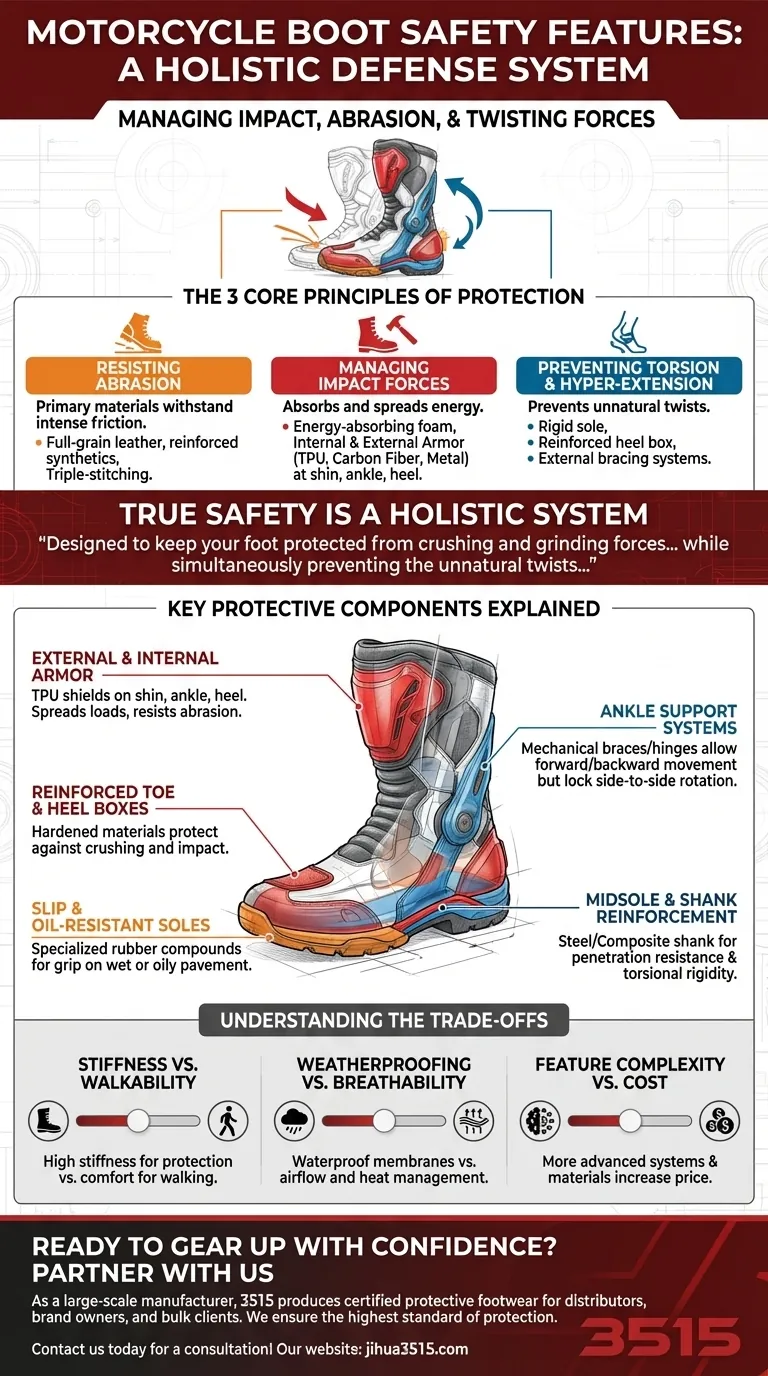
To be considered protective, a motorcycle boot incorporates a system of features designed to manage impact, abrasion, and twisting forces. Key components include hardened armor made from plastic or composite materials, energy-absorbing padding, reinforced soles, and highly abrasion-resistant primary materials like leather with reinforced stitching.
True motorcycle boot safety is not about a single feature, but a holistic system. It's designed to keep your foot protected from crushing and grinding forces in a crash while simultaneously preventing the unnatural twists that cause severe ankle and leg injuries.
The Core Principles of Motorcycle Boot Safety
Understanding why certain features exist is critical to evaluating a boot's effectiveness. The design of any proper riding boot is based on three fundamental principles of protection needed during a motorcycle accident.
Resisting Abrasion
In a slide, your gear is the only thing between you and the road surface. A boot's primary material must be able to withstand intense friction without tearing through.
Materials like full-grain leather, often coated with polyurethane, and advanced synthetic textiles are chosen for this purpose. Construction methods like triple-stitching ensure the seams hold together under this stress.
Managing Impact Forces
A crash involves sudden, violent impacts with the ground or other objects. A boot must be able to absorb and spread this energy to prevent fractures.
This is achieved with energy-absorbing foam and padding placed in high-risk areas. Furthermore, external or internal armor—often made of hard plastic, carbon fiber, or metal—at the ankle, heel, and shin acts as a rigid shield.
Preventing Torsion and Hyper-Extension
One of the most common and severe riding injuries involves the foot being twisted or bent in a way it was not meant to.
Protective boots are built with torsional stiffness to prevent this. A rigid sole, a reinforced heel box, and often an external bracing system work together to keep the ankle from rotating or bending past its natural range of motion.
Key Protective Components Explained
While all boots combine these principles, their execution varies. Looking for these specific components will tell you how well a boot can protect you.
External and Internal Armor
This is the most visible safety feature. Hardened plates, often made of thermoplastic polyurethane (TPU), are placed over the shin, the back of the heel, and both sides of the ankle. These shields spread impact loads and resist abrasion.
Reinforced Toe and Heel Boxes
Unlike a steel-toe work boot designed for falling objects, a motorcycle boot's toe box is reinforced to protect against crushing and impact forces common in a crash. The heel is similarly structured to create a protective "cup" around the back of your foot.
Ankle Support Systems
More advanced boots feature external mechanical braces or hinges. These systems are specifically designed to allow for normal forward and backward ankle movement for shifting and braking but lock out dangerous side-to-side rotation.
Slip and Oil-Resistant Soles
Maintaining grip is a crucial safety function. A boot's sole must be made from a compound that resists degradation from fuel and oil while providing excellent traction on pavement, especially in wet conditions.
Midsole and Shank Reinforcement
A thin piece of steel or composite material, known as a shank, is often embedded in the midsole. This provides penetration resistance from sharp objects on the road and contributes significantly to the boot's overall rigidity, preventing the sole from flexing unnaturally around a footpeg in an impact.
Understanding the Trade-offs
No single boot is perfect for every situation. Choosing the right one means understanding the inherent compromises between maximum protection and practical usability.
Stiffness vs. Walkability
A boot with high torsional rigidity and extensive armor will offer incredible on-bike protection. However, that same stiffness makes it clumsy and uncomfortable to walk in for any significant distance.
Weatherproofing vs. Breathability
Features like waterproof membranes are excellent for touring or commuting in varied climates. The trade-off is a significant reduction in airflow, which can lead to excessive heat and discomfort in warm, dry weather.
Feature Complexity vs. Cost
As boots incorporate more advanced safety systems, exotic materials like carbon fiber, and complex construction, the price increases accordingly. It's important to match the level of protection to your specific type of riding.
Choosing the Right Boot for Your Ride
Your choice should be directly informed by how and where you ride. Different environments present different risks.
- If your primary focus is track racing or aggressive street riding: Prioritize boots with maximum torsional stiffness, replaceable toe sliders, and extensive external armor.
- If your primary focus is touring or daily commuting: Balance robust ankle and impact protection with features like weather resistance and reasonable off-bike comfort.
- If your primary focus is adventure or off-road riding: Seek a taller boot with heavy-duty shin protection, rugged lugged soles for grip, and a secure buckle closure system.
Ultimately, investing in a boot with certified protective features is a foundational element of safe riding.
Summary Table:
| Safety Feature | Purpose | Common Materials |
|---|---|---|
| External/Internal Armor | Manages impact forces, spreads energy | TPU, Carbon Fiber, Plastic |
| Reinforced Toe/Heel Boxes | Protects against crushing and impact | Hardened Leather, Composite Materials |
| Ankle Support Systems | Prevents torsion and hyper-extension | Hinges, Braces, Rigid Construction |
| Abrasion-Resistant Materials | Withstands road friction in a slide | Full-Grain Leather, Reinforced Synthetics |
| Slip/Oil-Resistant Soles | Maintains grip on pavement, especially when wet | Specialized Rubber Compounds |
| Midsole Shank | Provides penetration resistance and torsional rigidity | Steel, Composite Materials |
Ready to Gear Up with Confidence?
As a large-scale manufacturer, 3515 produces a comprehensive range of certified protective footwear for distributors, brand owners, and bulk clients. Our production capabilities encompass all types of safety-focused motorcycle boots, ensuring your customers get the highest standard of impact, abrasion, and torsion protection.
Partner with us to supply boots that riders trust. Let's discuss your specific needs and how we can support your business with reliable, high-quality manufacturing.
Contact us today for a consultation!
Visual Guide
Related Products
- Wholesale Tactical Boots High-Traction & Reflective for Bulk & Brand Orders
- High Performance Fire-Retardant Waterproof Safety Boots
- Durable Goodyear Welt Leather Work Boots for Wholesale & Private Label
- Wholesale High-Traction Camo Boots - Custom Manufacturer for Brands
- Heavy-Duty Waterproof Nubuck Safety Boots Safety Shoes for Bulk Supply
People Also Ask
- How do tactical boots protect against injuries? Discover the Integrated Safety System
- What are the recommended work boot features for military and law enforcement? Enhance Operator Performance & Safety
- Are tactical boots suitable for hiking? Discover the Ultimate Footwear for Rugged Trails
- What is the necessity of high-performance tactical boots in exoskeletons? Enhancing Load Efficiency and Safety
- What are the consequences of wearing ill-fitting tactical boots? Avoid Injury and Boost Performance



















