
At its core, footwear is a specialized tool designed to manage the constant interaction between your body and the ground. Its primary roles are to provide protection from environmental hazards, support the complex biomechanics of your feet and legs, and enhance performance for specific tasks, from standing at a workstation to running a marathon.
The most critical mistake is viewing footwear as a passive accessory. In reality, it is an active piece of equipment that directly influences your comfort, safety, and long-term joint health, making activity-specific choices non-negotiable.
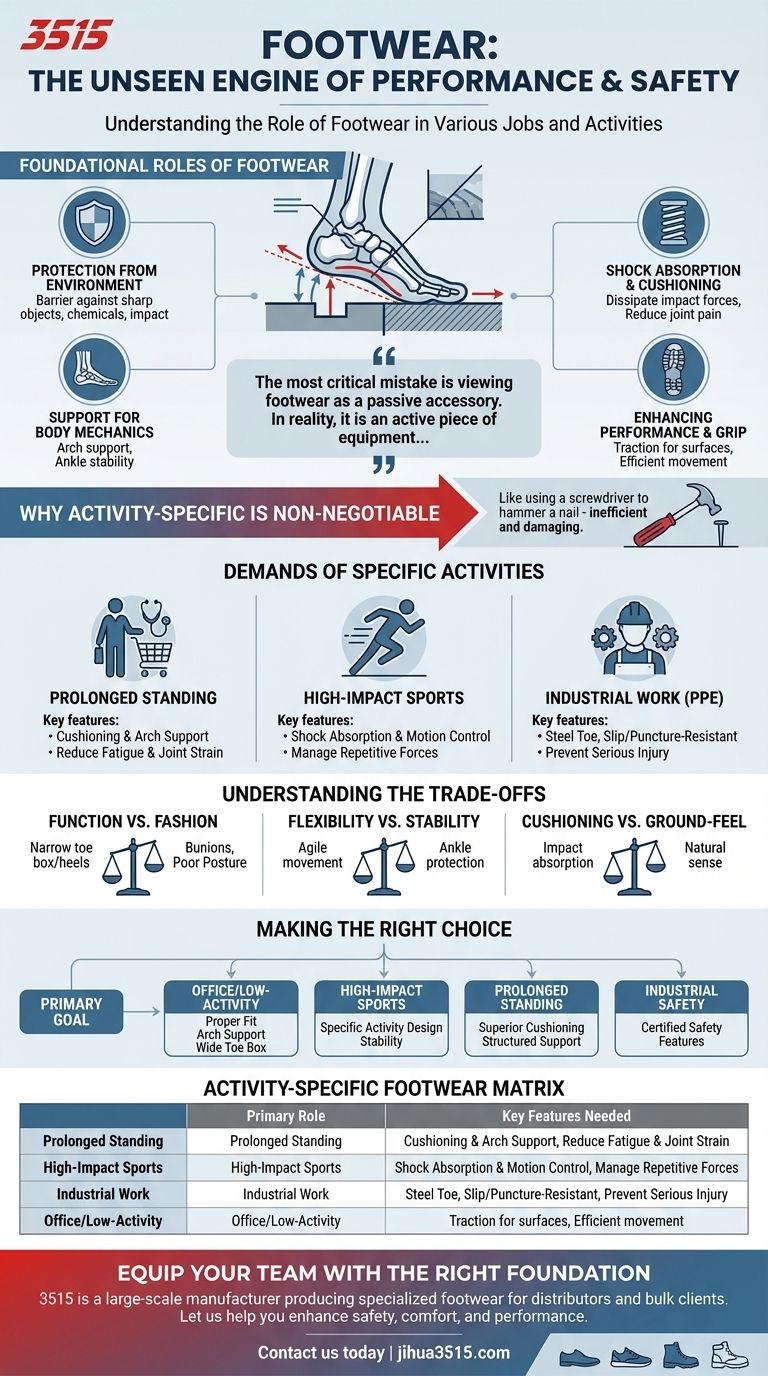
The Foundational Roles of Footwear
To understand why the right shoe is so important, you must first understand the fundamental problems it is designed to solve. Footwear acts as a critical interface that protects and supports your body's foundation.
Protection from the Environment
The most basic function of a shoe is to create a barrier. This shields your feet from sharp objects, abrasive surfaces, extreme temperatures, and moisture. In specialized jobs, this extends to protection from chemical spills, electrical shock, or heavy impacts.
Support for Body Mechanics
Your feet contain a complex structure of bones, ligaments, and tendons. Proper footwear provides arch support to prevent the collapse of the foot's natural shock-absorbing mechanism. It also offers stability around the heel and ankle, which helps maintain proper alignment up through the knees, hips, and back.
Shock Absorption and Cushioning
Every step you take, especially on hard surfaces, sends impact forces traveling up your body. A key role of footwear is to dissipate these forces through cushioning. Without it, this repeated impact can lead to stress injuries, joint pain, and fatigue.
Enhancing Performance and Grip
Different activities require different types of traction. The outsole of a shoe is engineered to provide the right amount of grip for a specific surface, whether it's a trail, a basketball court, or a wet factory floor. This prevents slips and allows for more efficient and powerful movement.
Why Activity-Specific Footwear is Non-Negotiable
Wearing the wrong type of shoe for a task is like using a screwdriver to hammer a nail. While it might work in the short term, it's inefficient and likely to cause damage. Different activities place vastly different demands on your feet.
The Demands of Prolonged Standing
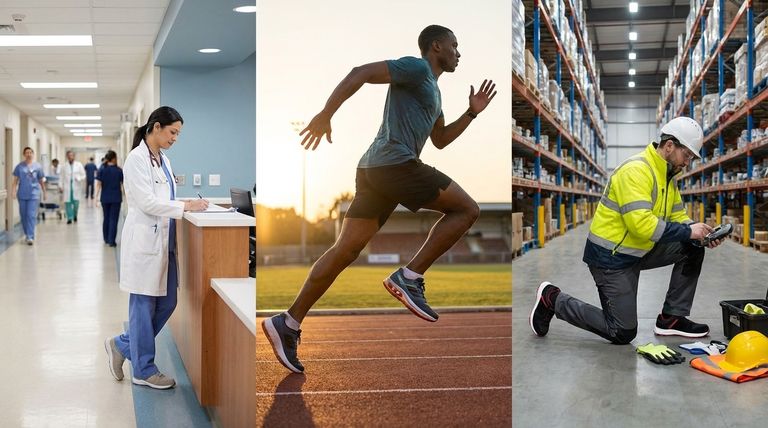
For workers in retail, healthcare, or food service, the primary challenge is static load and fatigue. The right shoe provides significant cushioning and arch support to distribute pressure evenly and reduce the strain on the feet, legs, and lower back over a long day.
The Forces of High-Impact Activities
Distance runners and dancers subject their bodies to immense, repetitive impact forces. Their footwear must be engineered for maximum shock absorption, flexibility in the right places, and features that control specific foot motions (like pronation) to prevent overuse injuries.
The Need for Safety in Industrial Work
For construction or factory workers, footwear is a critical piece of personal protective equipment (PPE). Features like steel toes, puncture-resistant plates, and slip-resistant soles are not optional—they are essential for preventing serious, life-altering injuries.
Understanding the Trade-offs
Choosing the right footwear often involves balancing competing needs. There is no single "perfect" shoe for all situations, which is why understanding the trade-offs is key.
Function vs. Fashion
This is the most common compromise. Many fashionable shoes feature narrow toe boxes, high heels, or completely flat, unsupportive soles. While visually appealing, they can lead to conditions like bunions, plantar fasciitis, and poor posture by forcing your foot into an unnatural position.
Flexibility vs. Stability
A highly stable and rigid shoe, like a hiking boot, is excellent for protecting your ankle on uneven terrain. However, that same rigidity would hinder performance in a sport that requires quick, agile movements, where a more flexible shoe is needed.
Cushioning vs. Ground-Feel
Maximalist shoes with thick cushioning are superb at absorbing impact, but they can reduce your natural sense of the ground beneath you. Conversely, minimalist shoes provide excellent ground-feel but offer little protection from impact forces, requiring a very different running or walking form.
Making the Right Choice for Your Needs
Selecting footwear should be a deliberate process guided by your primary activity. To simplify the decision, consider your main goal.
- If your primary focus is an office or low-activity job: Prioritize a proper fit with adequate arch support and a wide enough toe box to prevent long-term foot strain.
- If your primary focus is high-impact sports or athletics: Select footwear designed specifically for that activity to manage impact forces and provide necessary stability.
- If your primary focus is a job involving prolonged standing or walking: Choose shoes with superior cushioning and structured support to reduce fatigue and prevent joint pain.
- If your primary focus is safety in an industrial environment: Never compromise on certified safety features like steel toes and slip-resistant soles.
Ultimately, viewing your footwear as essential equipment is the first step toward better performance, comfort, and long-term health.
Summary Table:
| Activity/Job | Primary Footwear Role | Key Features Needed |
|---|---|---|
| Prolonged Standing (e.g., Retail, Healthcare) | Reduce fatigue & joint strain | Maximum cushioning, arch support |
| High-Impact Sports (e.g., Running, Dancing) | Manage repetitive impact forces | Superior shock absorption, motion control |
| Industrial Work (e.g., Construction, Factory) | Prevent serious injury (PPE) | Steel toe, slip/puncture-resistant sole |
| Office/Low-Activity Jobs | Prevent long-term foot strain | Proper fit, adequate arch support, wide toe box |
Equip Your Team with the Right Foundation
As a large-scale manufacturer, 3515 produces a comprehensive range of specialized footwear for distributors, brand owners, and bulk clients. Whether you need durable safety boots for industrial workers, comfortable supportive shoes for healthcare professionals, or high-performance athletic footwear, our production capabilities encompass all types of shoes and boots.
Let us help you enhance safety, comfort, and performance.
Contact us today to discuss your specific needs and sourcing requirements.
Visual Guide
Related Products
- Wholesale Durable Camouflage Canvas Shoes with High-Traction Cleated Rubber Sole
- Lightweight Breathable Training Shoes for Wholesale & Custom OEM Manufacturing
- Wholesale Breathable Training Shoes Custom Athletic Footwear Manufacturer
- Durable Leather High-Ankle Tactical Boots for Wholesale & Custom Manufacturing
- Durable Waterproof Rain Boots | Custom Manufacturer for Wholesale & Brands
People Also Ask
- Why is the selection of high-strength fabric materials necessary in the production of canvas shoes and training shoes?
- What are the properties of canvas as a shoe material? A Guide to Lightweight Comfort & Style
- Can canvas shoes be worn in rainy conditions? The Truth About Water Resistance
- What are some examples of vulcanized shoes? Discover the Flexibility and Board Feel of Classic Sneakers
- What are the characteristics of canvas as a shoe material? A Guide to Lightweight, Breathable Footwear


















