
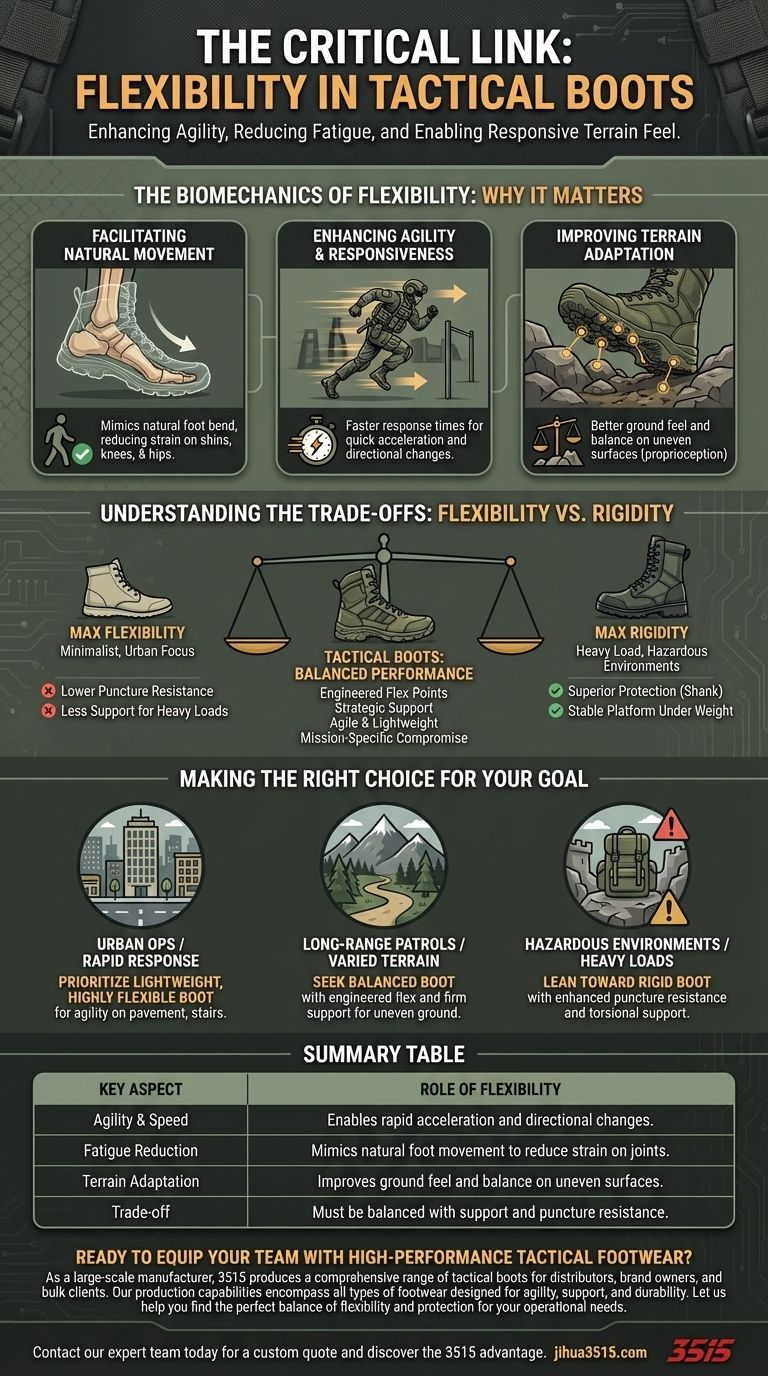
In tactical boots, flexibility is the critical link between the wearer and their environment. It allows the boot to mimic the natural movement of the foot, enhancing agility, reducing fatigue, and enabling a rapid, responsive feel for the terrain underfoot. This isn't about making a boot flimsy; it's about engineering it to bend and move precisely where your foot needs it to.
The core function of flexibility in tactical footwear is to provide maximum agility and comfort without compromising essential support. The ideal boot isn't the most flexible one, but the one that offers the right kind of flexibility for a specific mission or environment.

The Biomechanics of Flexibility: Why It Matters
A tactical boot's performance is directly tied to how well it works with your body's natural mechanics. Stiffness creates resistance, while engineered flexibility creates synergy.
Facilitating Natural Movement
Your foot is designed to bend at the ball, a movement essential for walking, running, and climbing. A flexible tactical boot accommodates this, bending at the toe line to prevent the unnatural "slapping" motion of an overly rigid sole.
This natural articulation reduces strain on your shins, knees, and hips, significantly lowering fatigue during long treks or extended periods on your feet.
Enhancing Agility and Responsiveness
In a tactical situation, the ability to accelerate, stop, and change direction instantly is paramount. A flexible boot is a faster boot.
It allows for a quicker response time because the boot moves with you, not against you. This is crucial when navigating obstacles, climbing, or maintaining a stable firing stance on uneven ground.
Improving Terrain Adaptation
A moderately flexible sole allows your foot to better conform to uneven surfaces like rocks, rubble, or inclines.
This improved ground feel enhances your proprioception—your sense of body position—leading to better balance and a more secure footing. A completely rigid sole, by contrast, can teeter on irregular points of contact.
Understanding the Trade-offs: Flexibility vs. Rigidity
Choosing a tactical boot is an exercise in managing compromises. The ideal level of flexibility is entirely dependent on the mission's demands, and you must balance it against the need for protection and support.
The Support Spectrum
Think of footwear on a spectrum. On one end, you have minimalist running shoes with maximum flexibility. On the other, you have heavy-duty combat or mountaineering boots with extreme rigidity for protection and load-bearing.
Tactical boots sit in the middle of this spectrum. They are designed to be more agile and lightweight than traditional combat boots, which often means sacrificing some degree of raw protection.
Durability and Puncture Resistance
Greater flexibility often comes from using thinner or more pliable sole materials. This can make the boot more vulnerable to punctures from sharp objects like nails or jagged rocks.
A stiffer boot, often incorporating a non-metallic or steel shank, provides superior protection from underfoot threats but at the cost of weight and flexibility.
Support Under Heavy Loads
If you are carrying a heavy pack or equipment, a more rigid boot provides a more stable platform. A shank and a stiffer midsole prevent the boot from bowing under the weight, which reduces arch strain and foot fatigue over long distances.
A highly flexible boot may not offer enough support for heavy-load scenarios, potentially leading to foot injuries.
Making the Right Choice for Your Goal
To select the right boot, you must first define your primary operational environment. The balance between flexibility and support shifts based on your needs.
- If your primary focus is urban operations or rapid response: Prioritize a lightweight, highly flexible boot that excels in agility for running on pavement, climbing stairs, and moving quickly on predictable surfaces.
- If your primary focus is long-range patrols over varied terrain: Seek a balanced boot with engineered flex points in the forefoot but a firm, supportive sole and ankle to handle uneven ground and moderate loads.
- If your primary focus is operating in hazardous environments or carrying heavy loads: Lean toward a more rigid boot with enhanced puncture resistance and torsional support, accepting a decrease in flexibility as a necessary trade-off for protection.
Ultimately, understanding this balance empowers you to choose footwear that functions as a high-performance tool, not a cumbersome liability.
Summary Table:
| Key Aspect | Role of Flexibility |
|---|---|
| Agility & Speed | Enables rapid acceleration and directional changes. |
| Fatigue Reduction | Mimics natural foot movement to reduce strain on joints. |
| Terrain Adaptation | Improves ground feel and balance on uneven surfaces. |
| Trade-off | Must be balanced with support and puncture resistance. |
Ready to equip your team with high-performance tactical footwear?
As a large-scale manufacturer, 3515 produces a comprehensive range of tactical boots for distributors, brand owners, and bulk clients. Our production capabilities encompass all types of footwear designed for agility, support, and durability. Let us help you find the perfect balance of flexibility and protection for your operational needs.
Contact our expert team today for a custom quote and discover the 3515 advantage.
Visual Guide
Related Products
- Durable Leather Tactical Boots Wholesale & Custom Manufacturing for Brands
- High-Traction Suede Tactical Boots Wholesale & Custom Manufacturing
- Durable Leather High-Ankle Tactical Boots for Wholesale & Custom Manufacturing
- Durable Mid-Cut Tactical Boots for Wholesale & Private Label
- Wholesale Waterproof Tactical Boots Custom Suede & High-Traction Soles
People Also Ask
- What specialized protections do tactical boots offer? Maximize Endurance with High-Performance Footwear
- What features should law enforcement officers look for in tactical boots? Essential Guide for Safety & Performance
- Importance of Professional Tactical Boots in Loess Gully Regions: Ensure Safety and Precision for Field Monitoring
- What is rucking, and why are tactical boots suitable for it? Discover the Ultimate Footwear for Heavy Loads
- What makes the traction of tactical boots superior? Unlock the Science of Unbeatable Grip















