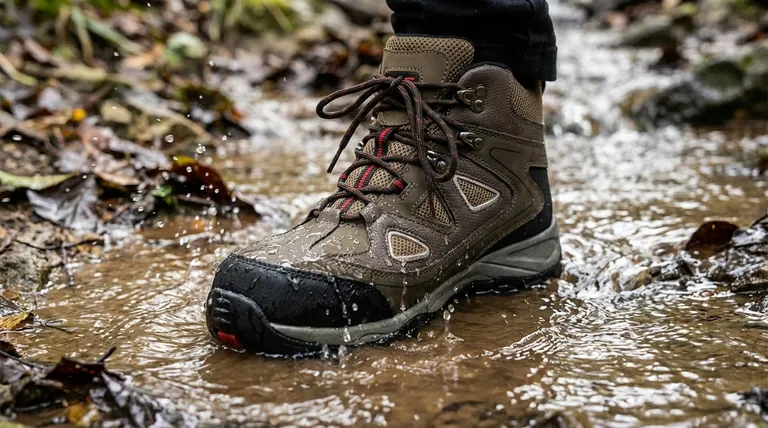
At its core, a waterproof membrane in a boot is a specialized internal layer, often made from materials like Gore-Tex, that serves a dual purpose. It acts as an impenetrable barrier to prevent external water from reaching your foot, while simultaneously being porous enough to allow moisture vapor from sweat to escape. This technology is the primary reason your feet can remain dry even when the boot is submerged or exposed to heavy rain.
The crucial insight is to view the waterproof membrane not as a feature of the boot's exterior, but as an internal lining that acts as the last line of defense for your foot's health and comfort. It protects your foot from water, but does not protect the boot's outer material itself.
How a Membrane Delivers "Waterproof Breathability"
A waterproof membrane is a marvel of material science, engineered to handle moisture from both the outside and the inside. Its effectiveness comes from its unique physical structure.
The Internal Barrier System
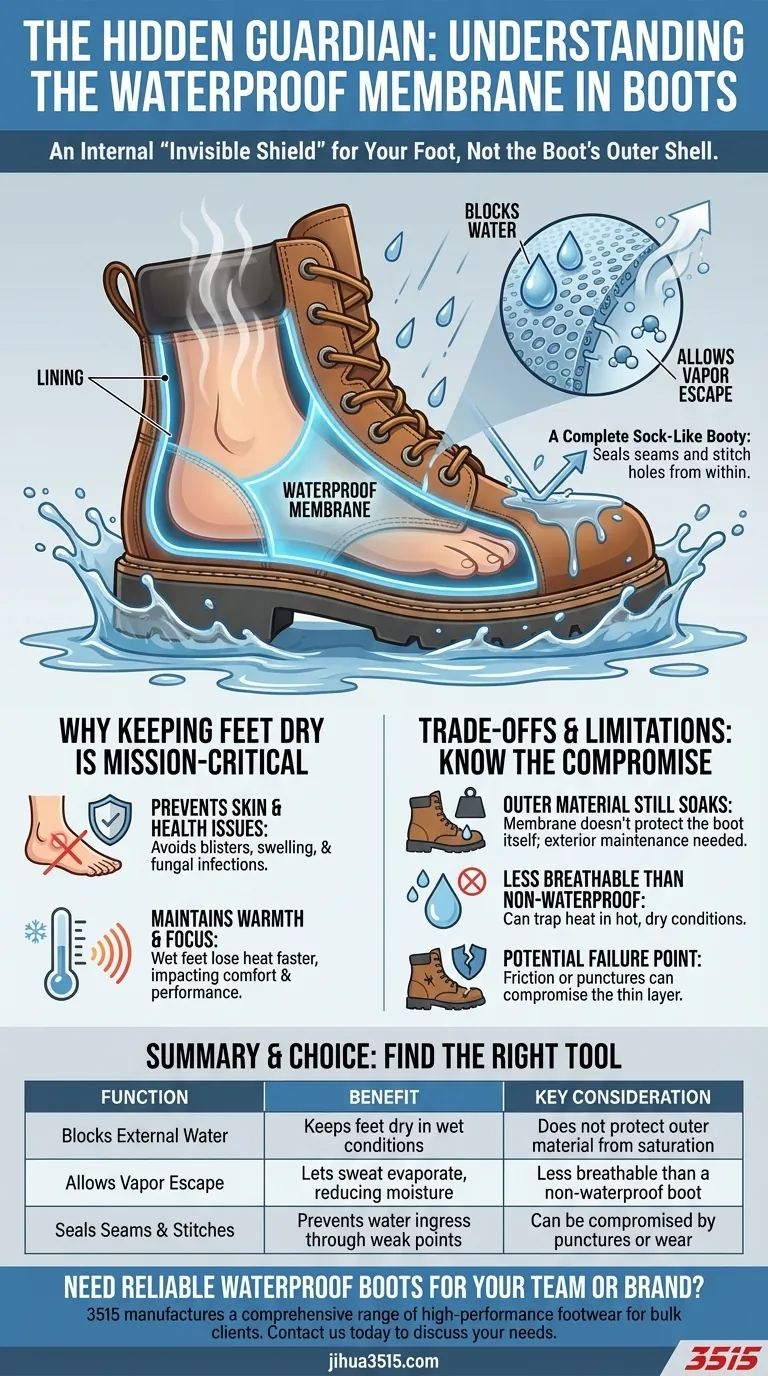
The membrane is a complete sock-like booty or liner that sits between the boot's outer material (like leather or nylon) and the inner lining that touches your foot. It is essentially a self-contained, waterproof layer hidden within the boot's construction.
Sealing the Weak Points
A boot's primary points of failure against water are its seams and stitch holes. The continuous sheet of the waterproof membrane covers these vulnerable areas from the inside, ensuring that water cannot penetrate even as the boot flexes and bends with your foot.
The Science of Breathability
The material of the membrane contains billions of microscopic pores per square inch. These pores are thousands of times smaller than a liquid water droplet, which is why rain and puddle water are physically blocked. However, they are large enough for a single molecule of water vapor (sweat) to pass through, allowing internal moisture to escape.
Why Keeping Feet Dry is Mission-Critical
The function of a waterproof membrane goes far beyond simple comfort. In professional and recreational settings, dry feet are fundamental to health, safety, and performance.
Preventing Skin and Health Issues
Prolonged exposure to moisture creates an environment ripe for painful blisters, swelling, and fungal infections like athlete's foot. A waterproof lining is a critical defense against these conditions, especially for those working in consistently wet environments.
Maintaining Warmth and Focus
Wet feet lose heat dramatically faster than dry feet, which can lead to discomfort and, in cold conditions, more serious issues. By keeping feet dry, the membrane helps your body regulate temperature, allowing you to remain comfortable and focused on your task.
Understanding the Trade-offs and Limitations
While highly effective, a waterproof membrane is not a universal solution. Understanding its limitations is key to selecting the right footwear and maintaining it properly.
Membrane vs. Outer Material
The membrane protects your foot, not the boot's exterior. If the outer leather or fabric becomes saturated with water, the boot will feel heavy and cold, and the material itself can degrade over time. This is why external waterproofing treatments and regular maintenance are still necessary.
The Breathability Compromise
Although membranes are designed to be "breathable," they will always be less breathable than a boot with no membrane at all. In very hot and dry climates, a membrane can trap some heat and moisture, making a highly breathable, non-waterproof boot a more comfortable option.
A Point of Potential Failure
The membrane is a thin layer. Over time, friction from foot movement can wear it down, or a sharp object penetrating the boot can puncture it. Once the membrane is compromised, its waterproofing capability is lost in that area.
Making the Right Choice for Your Goal
Selecting a boot with or without a waterproof membrane depends entirely on your intended use and environment.
- If your primary focus is maximum protection in wet or unpredictable weather: A boot with an integrated waterproof membrane is non-negotiable.
- If your primary focus is maximum breathability for hot, dry conditions: A non-membraned boot will offer superior comfort by allowing for better airflow.
- If your primary focus is the long-term durability of your boots: Remember that a membrane does not replace the need for regular cleaning and conditioning of the outer materials.
Ultimately, understanding the specific role of the waterproof membrane allows you to choose the precise tool your feet need to perform safely and effectively in any condition.
Summary Table:
| Function | Benefit | Key Consideration |
|---|---|---|
| Blocks External Water | Keeps feet dry in rain, snow, and wet conditions | Does not protect the boot's outer material from saturation |
| Allows Vapor Escape | Lets sweat evaporate, reducing moisture buildup | Less breathable than a non-waterproof boot |
| Seals Seams & Stitches | Prevents water ingress through construction weak points | Can be compromised by punctures or wear over time |
Need reliable waterproof boots for your team or brand?
As a large-scale manufacturer, 3515 produces a comprehensive range of high-performance footwear for distributors, brand owners, and bulk clients. Our production capabilities encompass all types of waterproof and non-waterproof shoes and boots, ensuring your customers get the right tool for the job.
Contact us today to discuss your specific needs and benefit from our manufacturing expertise.
Visual Guide
Related Products
- High Performance Fire-Retardant Waterproof Safety Boots
- Premium Wholesale Waterproof Safety Boots High Performance Protection for Industrial Markets
- Premium Flame-Retardant Waterproof Safety Boots and Shoes
- Premium High-Cut Waterproof Safety Boots Manufacturing & Wholesale Solutions
- Premium Waterproof High-Cut Industrial Safety Boots for Wholesale and Bulk Orders
People Also Ask
- Why are waterproof safety boots recommended for certain work environments? Essential Protection for Wet & Hazardous Jobs
- What roles do 3D vision systems and industrial robots play in the manufacturing of fire safety boots? Smart Automation
- What is a drawback of waterproof boots? The Hidden Cost of Trapped Sweat and Heat
- What materials make waterproof boots durable? The Ultimate Guide to Long-Lasting Footwear
- What are the primary benefits of incorporating waterproof technology into professional and outdoor boots? Boost Value