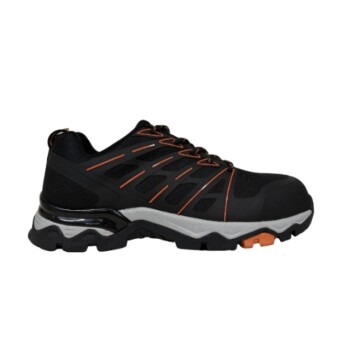
Professional safety footwear serves as the biomechanical foundation for the entire body. By providing structural support and advanced shock absorption, these shoes stabilize the lower limbs, which prevents the "kinetic chain" of fatigue from traveling upward. This stabilization allows workers to maintain a neutral spine and correct posture, directly reducing the risk of systemic musculoskeletal disorders.
Safety shoes are not merely protective barriers; they are precision tools that stabilize your biomechanics. By mitigating lower limb exhaustion, they prevent the compensatory movements that lead to long-term postural damage and occupational injury.
The Biomechanical Impact on Posture
Professional safety shoes act as a stabilizer for the body's center of gravity, which is essential for maintaining a healthy musculoskeletal alignment.
Stabilizing Lower Limb Biomechanics
Quality safety footwear provides the structural integrity needed to align the feet, ankles, and knees.
When the base of the body is stable, it prevents the ankles from rolling and the arches from collapsing during long shifts.
Preventing Compensatory Movements
When legs become fatigued, the body naturally attempts to shift its weight, leading to "compensatory movements" like slouching or bending.
By keeping the lower limbs energized, safety shoes allow workers to maintain correct working postures, preventing abnormal strain on the back and even the wrists.
Impact on Center of Gravity
Professional soles are engineered to influence stride rhythm and center of gravity control.
This mechanical stability is so significant that it is used in industrial monitoring to ensure consistent gait analysis and worker balance.
Strategies for Fatigue Prevention
Fatigue in industrial environments is often the result of repetitive impact and the physical weight of the equipment itself.
Advanced Shock Absorption
Cushioned footbeds and shock-absorbing materials dissipate the energy generated by walking on hard industrial surfaces.
This reduction in impact protects the joints and knees, preventing the dull muscle aches that typically accumulate over an 8-hour shift.
The Role of Arch Support
Proper arch support redistributes pressure across the entire foot rather than concentrating it on the heel or ball.
This redistribution relieves strain during extended periods of standing, walking, or running, which helps maintain overall energy levels.
Lightweight Material Technology
Modern safety shoes often utilize foam composite technology to reduce the weight of each step.
Reducing the weight of a shoe by even 100 grams can significantly decrease the physical workload on the legs, leading to higher focus and fewer exhaustion-related mistakes.
Understanding the Trade-offs
While professional safety shoes offer significant benefits, the "one-size-fits-all" approach can lead to unintended consequences.
Weight vs. Protection Level
Higher protection ratings, such as S3 or S5, often require heavier materials like steel toes or puncture-resistant midsoles.
A worker in a low-risk environment wearing over-engineered, heavy boots may experience unnecessary fatigue compared to wearing a lighter S1-rated shoe.
Rigidity and Natural Movement
Extremely rigid soles provide excellent stability on uneven terrain like mines, but they can restrict the natural flex of the foot on flat factory floors.
This lack of flexibility can lead to foot arch discomfort if the shoe's rigidity does not match the specific demands of the work surface.
Applying Footwear Standards to Your Environment
Selecting the right footwear requires balancing the specific hazards of your industry with the ergonomic needs of your body.
- If your primary focus is heavy construction or mining: Prioritize S3 or S5 rated boots with high-performance shock absorption to handle uneven terrain and heavy impact.
- If your primary focus is long-duration standing in labs or food service: Seek out S1 or S2 rated footwear with foam composite technology and anti-slip soles to minimize leg fatigue.
- If your primary focus is preventing long-term joint pain: Choose boots specifically featuring form-fitting cushioned footbeds and reinforced arch support.
- If your primary focus is high-heat or welding environments: Ensure your S1 footwear includes an HRO (Heat Resistant Outsole) classification to maintain sole integrity and stability.
By treating professional safety footwear as an ergonomic necessity rather than a compliance requirement, you protect both your immediate safety and your long-term physical health.
Summary Table:
| Feature | Biomechanical Benefit | Ergonomic Outcome |
|---|---|---|
| Arch Support | Redistributes foot pressure | Reduces strain during long standing periods |
| Shock Absorption | Dissipates impact energy | Protects joints and prevents muscle aches |
| Foam Composites | Reduces overall shoe weight | Lowers physical workload and leg exhaustion |
| Structural Soles | Stabilizes center of gravity | Maintains neutral spine and prevents slouching |
| S-Rating (S1-S5) | Matches protection to risk | Balances safety needs with physical comfort |
Elevate Your Workforce Safety and Comfort with 3515
As a premier large-scale manufacturer serving global distributors and brand owners, 3515 delivers footwear solutions that go beyond basic compliance. Our flagship Safety Shoes series is engineered to optimize biomechanics, ensuring your team maintains perfect posture while minimizing fatigue in demanding industrial environments.
Whether you need robust tactical boots, lightweight sneakers, or specialized dress and formal shoes for bulk requirements, 3515 offers unparalleled production capabilities. Partner with us to provide your customers with footwear that combines protection with advanced ergonomic technology.
Ready to upgrade your inventory? Contact us today to discuss your bulk requirements!
References
- Nengzhou Chen, Ning Jia. Prevalence status and associated factors of wrist postural injury in the Chinese occupational population. DOI: 10.3389/fpubh.2022.1047814
This article is also based on technical information from 3515 Knowledge Base .
Related Products
- Premium Safety Shoes with Rotating Buckle Safety Sneakers
- Premium Suede Sport Safety Shoes for Wholesale & Bulk Orders
- Premium KPU Injection Athletic Style Safety Shoes
- Wholesale Anti-Smash & Puncture-Proof Safety Shoes Custom Manufacturing for Brands
- Premium Wheat Nubuck Safety Shoes for Bulk Distribution
People Also Ask
- What role do specialized safety shoes play in preventing falls? Engineering Stability in Industrial Environments
- What are the technical advantages of integrating sensors into safety shoes? Achieve Superior Motion Capture Precision
- Why should ergonomics and comfort be prioritized when selecting safety shoes? Boost Compliance & Worker Health
- What are the primary functions of professional safety shoes? Maximize Safety in Water Supply Confined Spaces
- How do gait analysis algorithms ensure accuracy in footwear? Master Step Length Precision for Boots & Sneakers