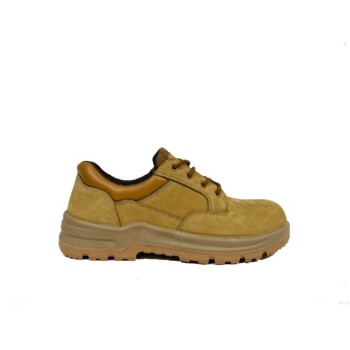
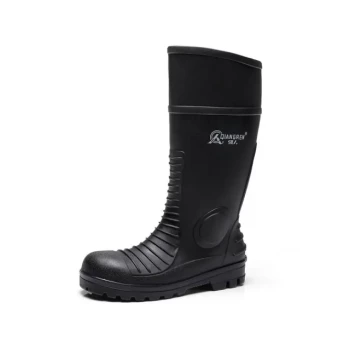
Industrial safety shoes and protective gaiters serve a dual purpose: they safeguard the worker’s physical well-being while functioning as a critical hardware interface for data collection. Specifically, the gaiters provide a stable mounting platform for Inertial Measurement Units (IMUs) on the right ankle, ensuring the precise capture of lower limb movements during bricklaying tasks.
While safety shoes provide the baseline physical protection required for the job site, the integrated protective gaiters transform the setup into a data acquisition tool, serving as the stable foundation necessary to extract accurate gait and posture features.
The Role of the Protective Gaiter
Stable Sensor Mounting
The primary technical function of the protective gaiter in this context is to act as a mounting base.
Rather than attaching sensors directly to the skin or loose clothing, the gaiter secures the sensors specifically to the right ankle. This ensures the hardware remains fixed relative to the limb bone structure.
Ensuring Data Fidelity
High-precision Inertial Measurement Units (IMUs) are installed directly onto these gaiters.
Because the gaiter minimizes the relative motion between the sensor and the leg, it allows for the accurate capture of movement data. This stability is essential for analyzing complex actions like walking and brick handling without "noise" from slipping sensors.
The Role of Industrial Safety Shoes
Necessary Physical Protection
The safety shoe retains its traditional role: protecting the worker from crushing injuries, punctures, and slips.
This is the non-negotiable layer of the system. It ensures that the monitoring experiment does not compromise the occupational safety standards required on a construction site.
Hardware Support Foundation
The shoes work in tandem with the gaiters to provide comprehensive hardware support.
Together, they create a wearable system that allows researchers to extract precise posture features. The shoe provides the grounded base, while the gaiter bridges the gap between the safety gear and the data collection technology.
Understanding the Trade-offs
Sensor Placement vs. Mobility
Mounting sensors on the ankle via gaiters provides excellent data on foot placement, but it adds bulk to the lower limb.
Engineers must ensure the gaiter does not restrict the natural range of motion. If the mounting is too bulky, it could alter the bricklayer's natural gait, leading to skewed data.
System Integration
Integrating gaiters with standard industrial shoes requires a seamless fit.
If the gaiter is not perfectly compatible with the shoe design, it may shift during vigorous activity. This introduces artifacts into the IMU data, rendering the high-precision sensors less effective.
Making the Right Choice for Your Goal
When implementing limb movement monitoring in industrial environments, consider the following priorities:
- If your primary focus is Data Accuracy: Prioritize the rigidity and fit of the protective gaiter to ensure the IMU on the right ankle experiences zero slippage relative to the limb.
- If your primary focus is Worker Compliance: Ensure the gaiter and sensor integration adds negligible weight to the safety shoe to prevent increased fatigue during brick handling.
The success of this monitoring approach relies on the synergy between rigid sensor mounting and uncompromising physical protection.
Summary Table:
| Component | Primary Function | Research & Monitoring Role |
|---|---|---|
| Industrial Safety Shoes | Crushing, puncture, and slip protection | Provides the grounded hardware support foundation |
| Protective Gaiters | Lower limb shielding | Stable mounting base for high-precision IMU sensors |
| IMU Sensors | N/A | Captures gait, posture, and movement data features |
| Synergistic System | Occupational safety | Ensures data fidelity and reduces motion noise |
Optimize Your Workplace Safety and Data Collection with 3515
As a large-scale manufacturer serving distributors and brand owners, 3515 offers comprehensive production capabilities for all footwear types, anchored by our flagship Safety Shoes series. Whether you need high-performance work and tactical boots for construction or specialized integration for wearable monitoring technology, our extensive portfolio covers outdoor shoes, training shoes, sneakers, and Dress & Formal shoes to meet diverse bulk requirements.
Partner with us to leverage our manufacturing expertise and provide your customers with the ultimate balance of physical protection and technological compatibility.
Ready to elevate your product line? Contact us today to discuss your wholesale and manufacturing needs!
References
- Sungkook Hong, Hyunsoo Kim. Productivity Measurement through IMU-Based Detailed Activity Recognition Using Machine Learning: A Case Study of Masonry Work. DOI: 10.3390/s23177635
This article is also based on technical information from 3515 Knowledge Base .
Related Products
- Wholesale Mesh Steel Toe Safety Shoes with Dial Closure Factory Production
- Wholesale Anti-Smash & Puncture-Proof Safety Shoes Custom Manufacturing for Brands
- Premium Wheat Nubuck Safety Shoes for Bulk Distribution
- Durable Steel Toe Safety Boots Wholesale & Custom Manufacturing
- Premium Waterproof High-Cut Industrial Safety Boots for Wholesale and Bulk Orders
People Also Ask
- What type of safety shoe is recommended for workers exposed to heavy machinery? Steel Toe Boots for Ultimate Protection
- Why is it mandatory to wear safety shoes with steel toe protection during metal loading? Prevent Crushing Injuries
- What are the main materials used in steel toe safety shoes? A Guide to Protective Footwear Construction
- Why are steel toes popular in safety footwear? The Ultimate Guide to Heavy-Duty Protection
- What are the recommended uses for steel toe safety shoes? Essential Protection for High-Risk Industries