
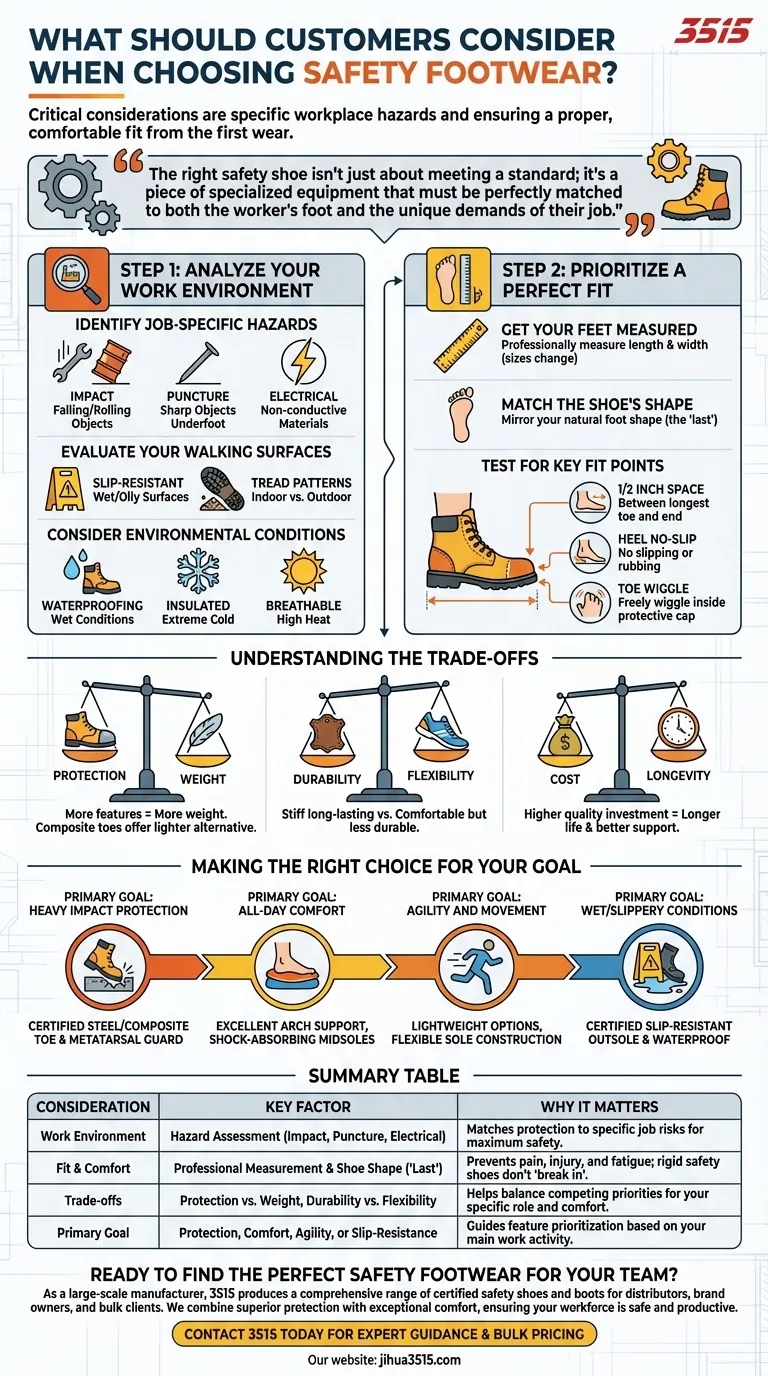
When choosing safety footwear, the most critical considerations are the specific hazards of your work environment and ensuring a proper, comfortable fit from the very first wear. A safety shoe's protective features must directly counter the risks you face, such as impact, punctures, or electrical hazards, while a correct fit prevents discomfort and long-term issues.
The right safety shoe isn't just about meeting a standard; it's a piece of specialized equipment that must be perfectly matched to both the worker's foot and the unique demands of their job.
Step 1: Analyze Your Work Environment
Before you even look at a shoe, you must understand the specific risks you need protection from. This is a non-negotiable first step that dictates every other choice. Employers are often required to conduct a formal hazard assessment to guide this process.
Identify Job-Specific Hazards
Your daily tasks expose you to a unique combination of risks. The footwear you choose must be rated to protect against them.
Key hazards include impact from falling or rolling objects, puncture from sharp objects underfoot like nails, and electrical hazards that require non-conductive materials.
Evaluate Your Walking Surfaces
Consider the ground you cover. Are you on hard, flat concrete all day, or do you navigate uneven terrain?
Look for soles designed for your environment. A slip-resistant sole is essential for wet or oily surfaces, while different tread patterns are better suited for indoor floors versus outdoor, rugged ground.
Consider Environmental Conditions
Your surroundings also play a major role. Do you work in wet conditions, extreme cold, or high heat?
Features like waterproofing are critical for wet environments, while insulated boots are necessary for cold weather. Breathable materials can improve comfort in hot conditions.
Step 2: Prioritize a Perfect Fit
Unlike casual shoes, safety footwear has a rigid structure, particularly around the protective toe cap. It will not "break in" or stretch over time. An improper fit from day one will lead to pain, affect your gait, and can even cause injury.
Get Your Feet Measured
Don't assume you know your size. Have both of your feet professionally measured for length and width, as sizes can change over time.
Match the Shoe's Shape to Your Foot
Pay attention to the overall shape of the shoe (often called the "last"). Some are narrow, while others have a wider toe box. The shoe's shape should mirror the natural shape of your foot.
Test for Key Fit Points
When trying on footwear, ensure there is about half an inch of space between your longest toe and the end of the shoe. Your heel should not slip or rub when you walk, and you should be able to wiggle your toes freely inside the protective cap.
Understanding the Trade-offs
Choosing safety footwear often involves balancing competing priorities. Understanding these trade-offs helps you select the most effective option for your specific needs.
Protection vs. Weight
More protective features, like steel shanks or metatarsal guards, inevitably add weight. For workers who are constantly moving, a heavy boot can lead to fatigue.
Composite-toe shoes offer a lighter alternative to steel toes while still meeting impact standards, making them a good compromise for many roles.
Durability vs. Flexibility
Highly durable materials, such as thick leather, provide excellent longevity and protection but can be stiff.
More flexible, modern materials might offer greater comfort and a shorter break-in period but may not withstand the same level of abrasion and wear over the long term.
Cost vs. Longevity
Investing in a higher-quality, more expensive boot often pays off. Better materials and construction mean the shoe will last longer and provide better support, reducing long-term replacement costs and preventing discomfort.
Making the Right Choice for Your Goal
Your primary goal will determine which features you prioritize.
- If your primary focus is protection against heavy impact: You need footwear with a certified steel or composite safety toe and potentially a metatarsal guard for added protection.
- If your primary focus is all-day comfort while standing: Prioritize excellent arch support, shock-absorbing midsoles, and a precise fit to prevent fatigue and foot pain.
- If your primary focus is agility and movement: Look for lighter-weight options, such as those with composite safety toes and flexible sole construction, to reduce fatigue.
- If your primary focus is working in wet or slippery conditions: A certified slip-resistant outsole and waterproof construction are the most important features to look for.
Ultimately, selecting the correct safety footwear is a critical investment in your personal well-being and productivity at work.
Summary Table:
| Consideration | Key Factor | Why It Matters |
|---|---|---|
| Work Environment | Hazard Assessment (Impact, Puncture, Electrical) | Matches protection to specific job risks for maximum safety. |
| Fit & Comfort | Professional Measurement & Shoe Shape ('Last') | Prevents pain, injury, and fatigue; rigid safety shoes don't 'break in'. |
| Trade-offs | Protection vs. Weight, Durability vs. Flexibility | Helps balance competing priorities for your specific role and comfort. |
| Primary Goal | Protection, Comfort, Agility, or Slip-Resistance | Guides feature prioritization based on your main work activity. |
Ready to find the perfect safety footwear for your team?
As a large-scale manufacturer, 3515 produces a comprehensive range of certified safety shoes and boots for distributors, brand owners, and bulk clients. We combine superior protection with exceptional comfort, ensuring your workforce is safe and productive.
Contact 3515 today for expert guidance and bulk pricing tailored to your specific hazard and comfort requirements.
Visual Guide
Related Products
- Safety Footwear Wholesale Manufacturer for Custom OEM/ODM Production
- Premium Suede Sport Safety Shoes for Wholesale & Bulk Orders
- Premium Safety Shoes with Rotating Buckle Safety Sneakers
- Premium Lightweight Safety Shoes for Wholesale & Bulk Orders
- Puncture-Resistant Velcro Safety Boots for Wholesale & Custom Manufacturing
People Also Ask
- What are the key OSHA regulations for safety footwear? Ensure Compliance & Protect Your Workforce
- Why is high-load mechanical testing equipment necessary for safety footwear? Ensure Life-Saving Compression Resistance
- What does a red rectangle with a white C letter on safety footwear mean? Essential Guide to Conductive Footwear
- What is the difference between oil resistance and slip resistance in footwear? Protect Your Boots and Your Safety
- What are the basic requirements of the ASTM F2413-05 standard? Mandatory Impact & Compression Protection


















