
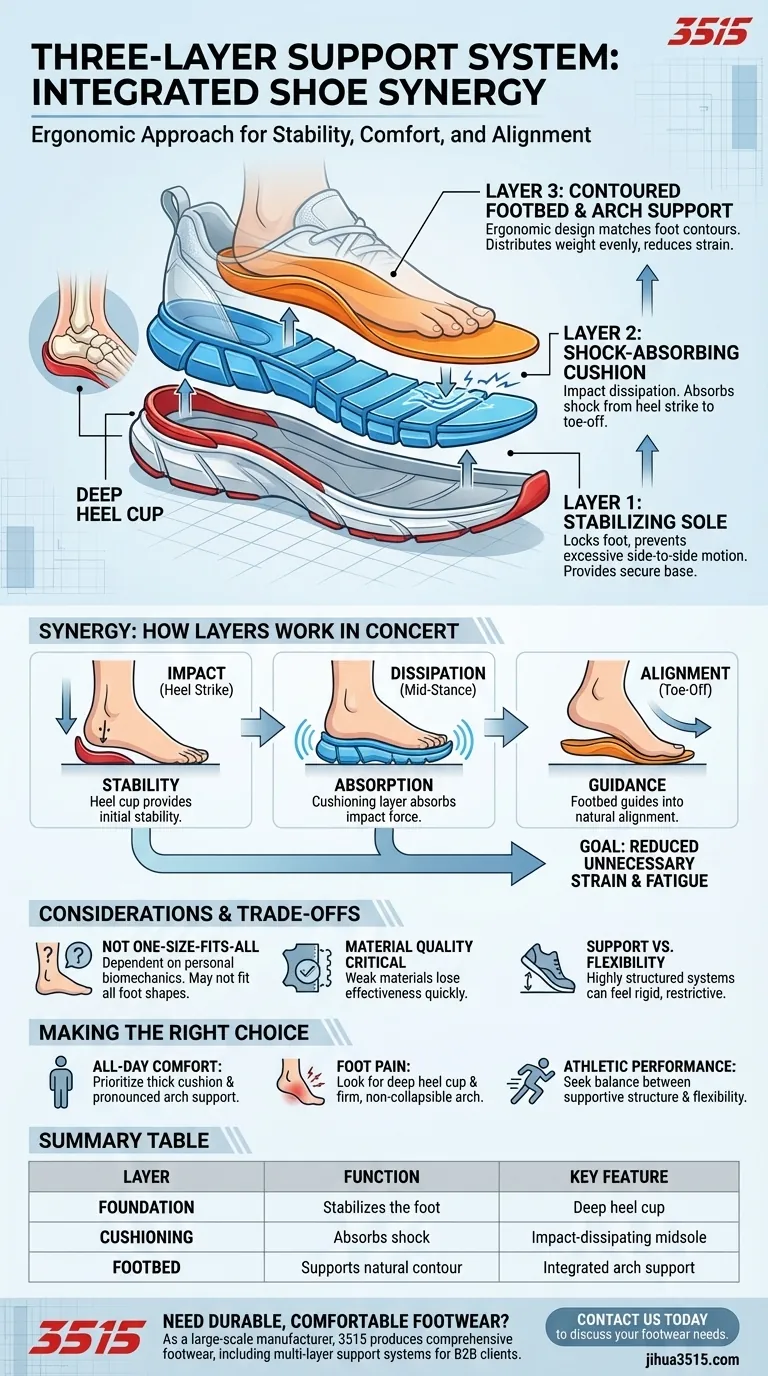
The defining characteristic of a three-layer support system in footwear is not a single feature, but its integrated, ergonomic approach. It combines distinct components—a stabilizing sole, a shock-absorbing cushion, and a contoured footbed—that work in concert to support the natural shape and mechanics of the human foot.
The core principle is synergy. Rather than relying on one element for comfort, this system creates a comprehensive environment where the foundation, cushioning, and foot-to-shoe interface are engineered to function as a single, supportive unit.
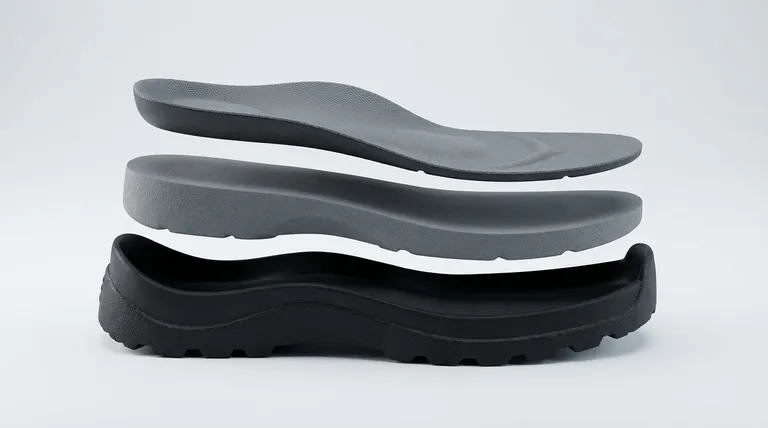
Deconstructing the Three-Layer System
To understand its uniqueness, we must analyze how each component contributes to the overall goal of comfort and stability. While marketing terms may vary, the system is consistently built on these three functional layers.
Layer 1: The Foundation (Heel-Cupping Sole)
The outermost layer, the sole, acts as the shoe's foundation. A key feature here is the deep heel cup.
This design cradles the heel's natural fat pad, locking the foot in place. This foundational stability prevents excessive side-to-side motion (pronation or supination) and provides a secure base for every step.
Layer 2: The Shock Absorber (Cushioning)
Sandwiched between the sole and the footbed is the cushioning layer, often referred to as the midsole. Its primary job is impact dissipation.
When you walk or run, this layer compresses to absorb the shock that would otherwise travel up through your ankles, knees, and hips. The quality and type of material used here directly impact both comfort and joint protection.
Layer 3: The Contoured Interface (Footbed & Arch Support)
The top layer is the footbed or insole, which makes direct contact with your foot. Its ergonomic design is defined by its curved shape and integrated arch support.
This layer is engineered to match the natural contours of the foot. By supporting the arch, it helps distribute your body weight evenly across the entire foot, preventing pressure points and reducing strain on the plantar fascia.
How These Layers Work in Concert
The system's true value comes from the seamless interaction between these layers. No single component is responsible for all the work; they function as a cohesive mechanical unit.
From Impact to Alignment
As your heel strikes the ground, the heel cup provides initial stability. Immediately after, the cushioning layer absorbs the impact force.
Finally, as your weight rolls forward, the contoured footbed and arch support guide your foot into its natural alignment, ensuring an efficient and low-strain stride.
The Goal: Reducing Unnecessary Strain
By working together, these layers create an environment that supports the foot's natural structure. This reduces the micro-corrections and muscular strain your feet would otherwise endure on hard, flat surfaces.
Understanding the Trade-offs
While effective, this system is not a universal solution. Understanding its limitations is key to making an informed choice.
Not a One-Size-Fits-All Solution
The "ideal" foot contour used in the design may not perfectly match every individual's foot, especially for those with very high or very low arches. The effectiveness is dependent on how well the shoe's shape matches your personal biomechanics.
Material Quality is Critical
The system is only as good as its weakest material. A low-density foam cushion will quickly compress and lose its shock-absorbing properties, while a poorly molded footbed can create pressure points instead of relieving them.
Support vs. Flexibility
A highly structured and supportive system can sometimes feel rigid. For activities that require significant foot flexibility, a shoe with an overly aggressive three-layer system might feel restrictive.
Making the Right Choice for Your Goal
Use your primary need to determine what to look for in a support system.
- If your primary focus is all-day standing comfort: Prioritize a system with a thick cushioning layer and pronounced arch support to combat fatigue and distribute pressure.
- If your primary focus is addressing foot pain: Look for a deep heel cup and firm, non-collapsible arch support to provide maximum stability and proper alignment.
- If your primary focus is athletic performance: Seek a balance between supportive structure and material flexibility to ensure the shoe aids movement without restricting it.
Ultimately, choosing the right footwear means finding a support system that complements the natural mechanics of your feet.
Summary Table:
| Layer | Function | Key Feature |
|---|---|---|
| Foundation | Stabilizes the foot | Deep heel cup |
| Cushioning | Absorbs shock | Impact-dissipating midsole |
| Footbed | Supports natural contour | Integrated arch support |
Need durable, comfortable footwear built on proven support systems?
As a large-scale manufacturer, 3515 produces a comprehensive range of footwear for distributors, brand owners, and bulk clients. Our production capabilities encompass all types of shoes and boots, including those featuring advanced multi-layer support systems for maximum comfort and durability.
Contact us today to discuss your footwear needs and discover how we can bring quality and comfort to your customers.
Visual Guide
Related Products
- Wholesale Training Shoes with Dial Lacing System Custom OEM Manufacturing
- Wholesale Comfort Leather Business Shoes with Dial Lacing System
- Advanced KPU Athletic Safety Shoe with Steel Toe Cap Anti-Slip Rotary Lacing System
- Wholesale Modern Business Shoes with Dial Closure System for Bulk Orders
- Wholesale Breathable & Cushioned Training Shoes Custom Factory Production
People Also Ask
- Why is it necessary for participants to wear professional training shoes? Ensuring Data Accuracy & Patient Safety
- Why is the integration of advanced cushioning in training shoes necessary for athletes? Boost Recovery and Performance
- Why is the use of flat-soled or professional training shoes essential for WBV? Maximize Vibration Energy Transfer
- Why is structural stability in footwear required during dual-task walking tests? Ensure Sensor Precision & Data Integrity
- Why are professional-grade training shoes essential for physical therapy? Ensure Patient Safety and Gait Stability














