
At their core, tactical shoes are distinguished from regular footwear by five key design principles: uncompromising durability, advanced protection, superior traction, engineered support, and all-environment versatility. Unlike shoes designed for casual comfort or a single sport, tactical footwear is built as a complete system to ensure stability and safety in demanding, often unpredictable conditions.
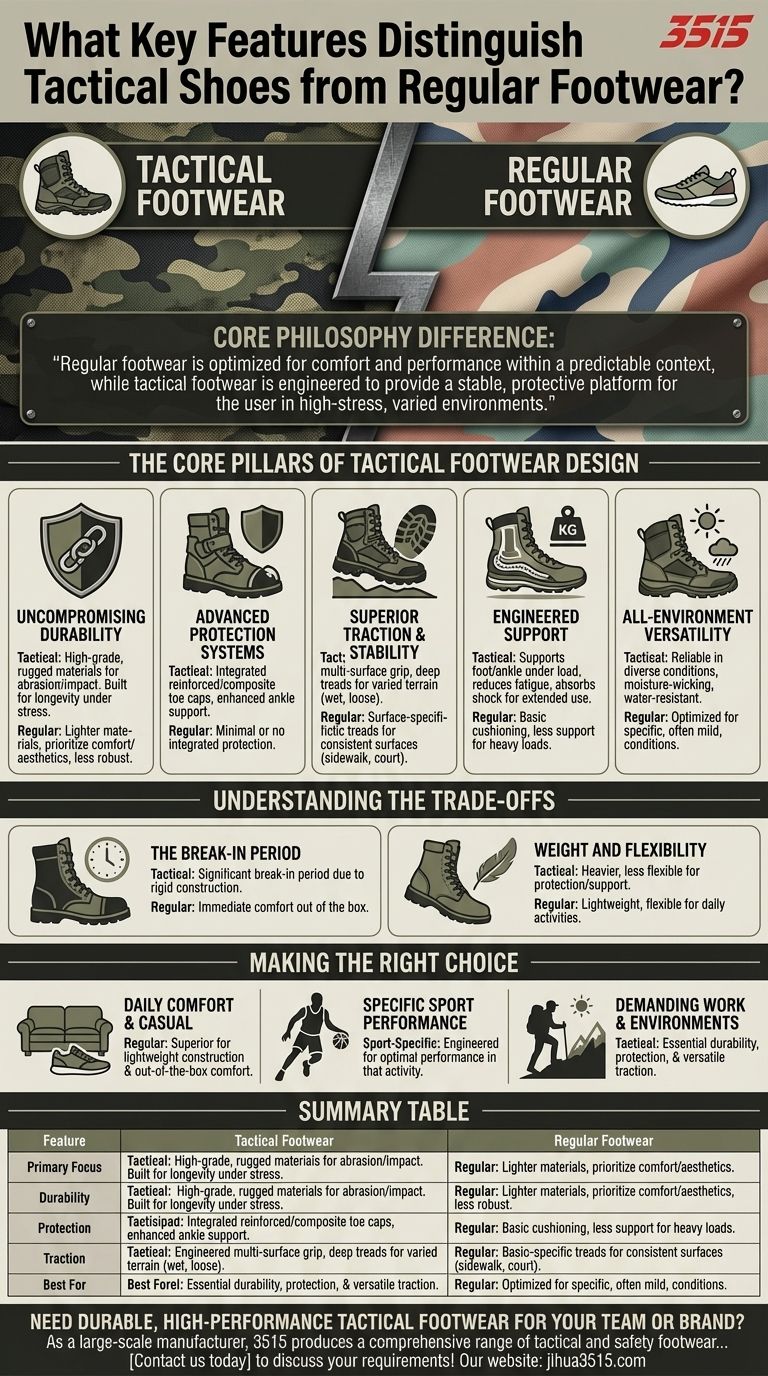
The fundamental difference is not merely the materials used, but the core design philosophy. Regular footwear is optimized for comfort and performance within a predictable context, while tactical footwear is engineered to provide a stable, protective platform for the user in high-stress, varied environments.
The Core Pillars of Tactical Footwear Design
To understand the distinction, it's best to analyze the specific engineering goals that define a tactical shoe. These are features rarely found, or needed, in standard footwear.
Uncompromising Durability
Tactical shoes are built with high-grade, rugged materials designed to withstand abrasion, impact, and exposure to harsh elements. This focus on longevity ensures they do not fail under physical stress.
Regular footwear, by contrast, often prioritizes lighter materials for comfort or aesthetics, which may not hold up to rigorous use.
Advanced Protection Systems
A key differentiator is the inclusion of integrated protective features. This often includes reinforced or composite toe caps to shield against impact and compression.
Many models also feature enhanced ankle support to prevent sprains and slip-resistant outsoles to guard against environmental hazards.
Superior Traction and Stability
The outsole of a tactical shoe is specifically engineered for maximum grip across a wide variety of surfaces, from wet pavement to loose gravel and uneven terrain.
The tread patterns are typically deeper and more aggressive than those on regular shoes, which are often designed for a single, consistent surface like a sidewalk or basketball court.
Engineered Support for High-Stress Activity
Tactical footwear is designed to support the foot and ankle under load, whether from carrying gear or moving quickly over unstable ground.
They incorporate advanced cushioning systems and structural elements to reduce fatigue and absorb shock, maintaining comfort during extended periods of use.
All-Environment Versatility
These shoes are built to perform reliably in diverse conditions. Features like moisture-wicking liners and water-resistant materials are common, allowing the user to operate effectively in wet, dry, hot, or cold environments.
Understanding the Trade-offs
Choosing tactical footwear involves acknowledging its specific design intent. The features that make it exceptional in some scenarios create disadvantages in others.
The Break-In Period
Because of their rigid construction and durable materials, most tactical boots require a significant break-in period to become comfortable.
Regular shoes, especially sneakers and casual footwear, are typically designed for immediate comfort right out of the box.
Weight and Flexibility
The added protection, support, and durable materials inevitably increase the weight of tactical footwear. They are heavier and often less flexible than a standard running shoe or casual loafer.
This can make them feel cumbersome for light, everyday activities where protection is not a primary concern.
Making the Right Choice for Your Activity
Your intended use is the only factor that matters when deciding between these two categories of footwear.
- If your primary focus is daily comfort and casual wear: Regular footwear is the superior choice for its lightweight construction and out-of-the-box comfort.
- If your primary focus is a specific sport like running or basketball: A sport-specific shoe is engineered for optimal performance in that activity and will outperform a general-purpose tactical boot.
- If your primary focus is demanding work, hiking, or use in unpredictable environments: Tactical footwear provides the essential durability, protection, and versatile traction you need to operate safely.
Ultimately, choosing the right footwear means matching the tool to the task at hand.
Summary Table:
| Feature | Tactical Footwear | Regular Footwear |
|---|---|---|
| Primary Focus | Protection & Stability in Demanding Conditions | Comfort & Aesthetics |
| Durability | High-grade, abrasion-resistant materials | Lighter, less durable materials |
| Protection | Reinforced toe caps, ankle support, slip-resistance | Minimal to no integrated protection |
| Traction | Aggressive, multi-surface outsoles | Surface-specific or casual treads |
| Best For | Law enforcement, security, hiking, demanding work | Casual wear, specific sports, daily comfort |
Need durable, high-performance tactical footwear for your team or brand?
As a large-scale manufacturer, 3515 produces a comprehensive range of tactical and safety footwear for distributors, brand owners, and bulk clients. Our production capabilities ensure superior quality, durability, and protection—exactly what your customers need.
Contact us today to discuss your tactical footwear requirements and explore our catalog!
Visual Guide
Related Products
- Durable Leather Tactical Boots Wholesale & Custom Manufacturing for Brands
- Durable Leather High-Ankle Tactical Boots for Wholesale & Custom Manufacturing
- Durable High-Ankle Tactical Boots Wholesale Manufacturer for Custom & Bulk Orders
- Wholesale Waterproof Tactical Boots Custom Suede & High-Traction Soles
- Wholesale Lightweight Tactical Boots with Dial Closure OEM & Bulk Orders
People Also Ask
- What specialized protections do tactical boots offer? Maximize Endurance with High-Performance Footwear
- What features should law enforcement officers look for in tactical boots? Essential Guide for Safety & Performance
- Importance of Professional Tactical Boots in Loess Gully Regions: Ensure Safety and Precision for Field Monitoring
- What is rucking, and why are tactical boots suitable for it? Discover the Ultimate Footwear for Heavy Loads
- What makes the traction of tactical boots superior? Unlock the Science of Unbeatable Grip



















