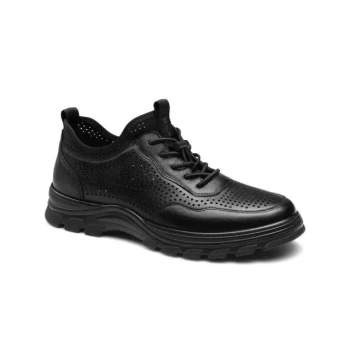
High-quality athletic footwear acts as a critical structural component, not just an accessory, in gait data collection. For exoskeleton systems, these shoes provide the necessary physical stability to house plantar pressure sensors (such as Force Sensing Resistors), ensuring that data gathered reflects accurate human biomechanics rather than equipment artifacts.
In the context of exoskeleton development, the shoe serves as the primary "physical carrier" for your sensor array. Its structural integrity is essential for preventing sensor migration and filtering out mechanical noise, which is a prerequisite for capturing reliable data in dynamic, natural environments.
The Role of the Shoe as a Sensor Interface
Securing the Sensor Array
The most immediate function of a high-quality training shoe is to act as a stable physical carrier. In gait analysis, precise sensor placement is paramount.
Lower-quality footwear often lacks the internal structure to hold sensors in place during dynamic movement. A high-quality athletic shoe offers a superior fit that locks Force Sensing Resistors (FSRs) in position, preventing displacement that would render the data spatially inaccurate.
Minimizing Mechanical Noise
Soft or unstructured soles can warp significantly under load. This shoe deformation creates pressure spikes that sensors interpret as foot pressure, effectively corrupting the signal.
High-quality shoes provide a stable, structured sole that resists this deformation. By reducing this "pressure noise," the shoe ensures that the signal generated corresponds to actual plantar pressure, not the twisting of the rubber sole.
Enabling Real-World Data Validity
Moving Beyond the Lab
Exoskeleton algorithms must be robust enough to handle the variability of the real world. The stability provided by high-quality footwear allows researchers to confidently collect data in natural and outdoor environments.
Reflecting True Biomechanics
When the sensor interface is unstable, the resulting data is a mix of human motion and equipment failure. By eliminating slippage and deformation artifacts, high-quality shoes ensure the data accurately reflects human walking characteristics.
This fidelity is critical for developing control strategies that can accurately detect gait phases without being triggered by false positive signals.
Understanding the Trade-offs
The Risk of Over-Constriction
While a "superior fit" is necessary for sensor fixation, there is a fine line between stability and restriction. If a shoe is too tight or rigid in an attempt to secure the sensors, it may alter the user's natural gait pattern or cause discomfort, which ironically corrupts the "natural" data you are trying to collect.
Hardware Dependency
Relying heavily on specific shoe structures to filter noise means your data is somewhat coupled to that specific footwear profile. You must ensure that the exoskeleton's control parameters are not calibrated strictly to the dampening characteristics of one specific shoe model, potentially limiting versatility.
Optimization for Data Reliability
To ensure your gait data collection yields usable inputs for exoskeleton control, approach footwear selection as a hardware specification.
- If your primary focus is Signal Clarity: Prioritize shoes with rigid, structured soles to minimize pressure noise caused by material deformation.
- If your primary focus is Spatial Accuracy: Select footwear with a superior, tight-tolerance fit to ensure Force Sensing Resistors remain fixed over long-duration trials.
Treating the shoe as a precision mounting interface is the first step toward achieving the data fidelity required for advanced exoskeleton control.
Summary Table:
| Feature | Impact on Gait Data Collection | Benefit for Exoskeleton Systems |
|---|---|---|
| Structural Integrity | Prevents sensor migration & displacement | Ensures spatial accuracy of pressure data |
| Sole Rigidity | Minimizes mechanical noise & deformation | Filters out artifacts for cleaner signal input |
| Superior Fit | Locks FSR sensors in precise positions | Enables reliable data in dynamic environments |
| Material Quality | Reduces pressure spikes from sole warping | Reflects true human biomechanical characteristics |
Elevate Your Technical Footwear Solutions with 3515
As a large-scale manufacturer serving global distributors and brand owners, 3515 provides the engineering excellence required for specialized applications like exoskeleton integration. Our comprehensive production capabilities allow us to anchor performance in our flagship Safety Shoes series while delivering precision-built training shoes, tactical boots, and sneakers that serve as reliable hardware interfaces.
Whether you need bulk manufacturing for high-stability athletic footwear or professional-grade work boots, 3515 offers the structural integrity and quality control your brand demands. Partner with us to bring superior footwear technology to your customers.
Contact 3515 Today for Bulk Orders & Manufacturing Inquiries
References
- Hongmin Wang, Yingying Song. Gait Phase Recognition of Hip Exoskeleton System Based on CNN and HHO-SVM Model. DOI: 10.3390/electronics14010107
This article is also based on technical information from 3515 Knowledge Base .
Related Products
- Lightweight Breathable Training Shoes for Wholesale & Custom OEM Manufacturing
- Custom OEM Training Shoes Wholesale Manufacturer Durable & Breathable
- Wholesale Breathable & Cushioned Training Shoes Custom Factory Production
- Wholesale Durable & Breathable Training Shoes for Custom Brands
- Wholesale Breathable Training Shoes Custom Athletic Footwear Manufacturer
People Also Ask
- Why are lightweight training shoes often preferred over professional hiking boots in urban walking? Maximize City Comfort
- What is the primary role of specialized training or orthopedic shoes? Enhance Safety in Elderly Balance Training
- Why are professional-grade training shoes essential for physical therapy? Ensure Patient Safety and Gait Stability
- Why are the slip-resistance and stability performance of training shoes critical in gait analysis? Ensure Data Accuracy
- Why is the use of flat-soled or professional training shoes essential for WBV? Maximize Vibration Energy Transfer