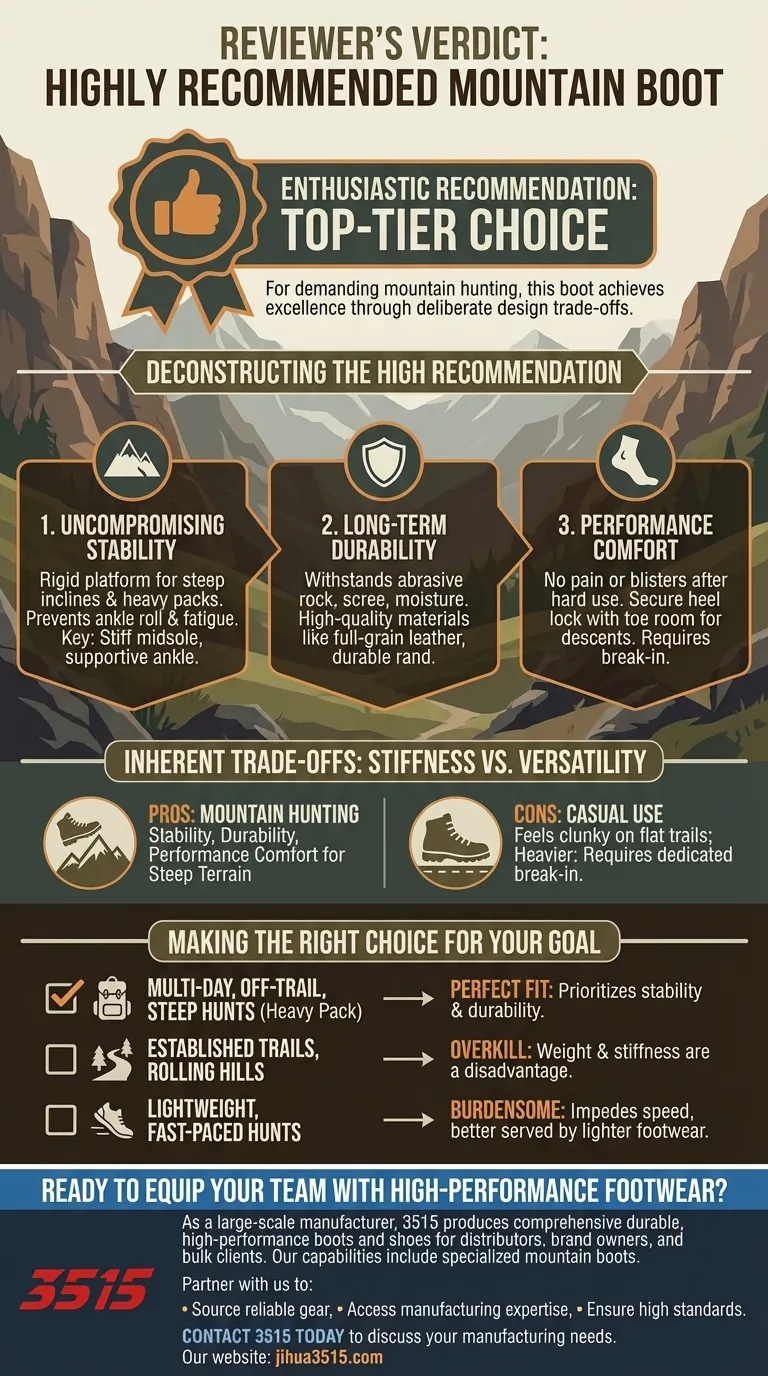
The reviewer's verdict is exceptionally clear. These boots receive an enthusiastic and high recommendation, positioned as a top-tier choice for anyone in the market for new mountain hunting footwear. The assessment suggests they excel in their intended, demanding environment.
A strong recommendation for a specialized piece of gear like a mountain boot is never about it being universally "good." It signifies that the boot achieves excellence in a specific, high-stakes role, often by making deliberate design trade-offs.
Deconstructing a "High Recommendation"
A glowing review for this category of boot implies it successfully solves the core challenges of mountain terrain. These are not all-purpose hikers; they are specialized tools. Such a recommendation is typically based on performance in three critical areas.
The Foundation: Uncompromising Stability
A top-tier mountain boot must provide a rigid, confidence-inspiring platform. This is crucial for traversing side-hills, navigating talus fields, and carrying heavy packs.
The reviewer's enthusiasm suggests the boot's construction, likely featuring a stiff midsole and a supportive ankle structure, prevents ankle roll and reduces foot fatigue over long, uneven miles.
The Mandate: Long-Term Durability
Mountain environments are relentlessly abrasive. A boot that earns a high recommendation has proven it can withstand significant abuse from rock, scree, and moisture without critical failure.
This implies the use of high-quality materials, such as a full-grain leather upper or robust synthetics, coupled with a durable rand that protects the boot's seams and high-wear areas.
The Critical Factor: Performance Comfort
In this context, comfort is not about a soft, sneaker-like feel. It's about the absence of pain and problems after hours of hard use, meaning no hot spots, blisters, or heel slip.
A strong endorsement indicates the boot's design effectively locks the heel in place while allowing enough room in the toe box, a crucial combination for preventing foot damage on long descents.
Understanding the Inherent Trade-offs
No piece of high-performance gear comes without compromises. A boot designed to excel in the mountains will, by necessity, have drawbacks in other applications.
Stiffness vs. General Versatility
The same rigidity that makes a mountain boot stable on a steep incline makes it feel clunky and awkward on flat, easy trails or pavement. These are not ideal for casual day hikes or everyday wear.
Weight vs. Protection
Durability and support require substantial materials, which add weight. While modern designs have improved, a true mountain boot will almost always be heavier than a standard hiking boot, demanding more energy from the user with every step.
The Break-in Period
To achieve a locked-in fit, these boots are often very stiff out of the box. Earning a high recommendation suggests the boot can be broken in for excellent long-term comfort, but it almost certainly requires a dedicated break-in period before a serious hunt.
Making the Right Choice for Your Goal
This recommendation is a powerful signal, but only if your needs align with the boot's purpose. Use the following to determine if this type of boot is your solution.
- If your primary focus is multi-day hunts in steep, off-trail, or rocky terrain with a heavy pack: This boot is likely designed precisely for your mission, prioritizing stability and durability above all else.
- If your primary focus is hunting on established trails, rolling hills, or mixed farmland: This boot is likely overkill, and its weight and stiffness could be a significant disadvantage compared to a more flexible hiking boot.
- If your primary focus is lightweight, fast-paced hunts in moderate terrain: You would be better served by a lighter, more agile trail-focused boot or shoe, as this boot's design would impede speed and feel unnecessarily burdensome.
Ultimately, understanding the specific problem a piece of gear is designed to solve is the key to making an informed decision.
Summary Table:
| Key Recommendation Factor | What It Means for Your Hunt |
|---|---|
| Uncompromising Stability | Provides a rigid platform for traversing steep, uneven terrain with a heavy pack. |
| Long-Term Durability | Built with high-quality materials to withstand abrasive rock, scree, and moisture. |
| Performance Comfort | Locks the heel and prevents blisters during long descents, despite a break-in period. |
| Inherent Trade-offs | Stiffness and weight make it less ideal for casual hiking or flat terrain. |
Ready to Equip Your Team with High-Performance Footwear?
As a large-scale manufacturer, 3515 produces a comprehensive range of durable, high-performance boots and shoes for distributors, brand owners, and bulk clients. Our production capabilities encompass all types of footwear, including specialized mountain boots designed for stability and long-term wear.
Partner with us to:
- Source reliable, high-quality footwear built for demanding environments.
- Access extensive manufacturing expertise and customizable options.
- Ensure your customers are equipped with gear that meets the highest standards.
Contact 3515 today to discuss your manufacturing needs and elevate your product line.
Visual Guide
Related Products
- Wholesale Lightweight Tactical Boots Custom Manufacturer for Desert & Combat Use
- Wholesale High-Traction Camo Boots - Custom Manufacturer for Brands
- Durable Spiked Camouflage Boots Wholesale & Factory Production
- Durable Rubber Sole Outdoor Shoes Wholesale & Custom Manufacturing
- High-Traction Suede Tactical Boots Wholesale & Custom Manufacturing
People Also Ask
- What are the common types of combat boots? Find the Right Boot for Your Mission
- What specialized protections do tactical boots offer? Maximize Endurance with High-Performance Footwear
- How is the compatibility of polymer materials demonstrated in smart footwear? Enhancing Tactical & Training Performance
- What are the different types of tactical boots available? Find the Right Boot for Your Mission
- What are the main construction similarities between tactical boots and tactical sneakers? Built for Performance & Durability