
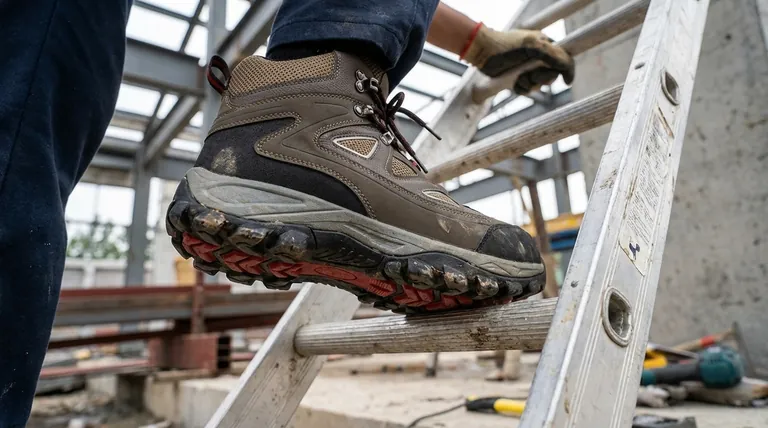
At its core, the midsection with an insert for ladder support transforms a flexible boot sole into a rigid, stable platform specifically for climbing. This feature provides crucial stability for the middle of your foot and reinforces the sole against the unique wear and tear caused by standing on narrow ladder rungs.
The fundamental purpose of ladder support is to prevent the boot from dangerously flexing around a ladder rung, which reduces foot fatigue, increases stability, and protects the sole from accelerated damage.
The Core Problem: Why Standard Soles Fail on Ladders
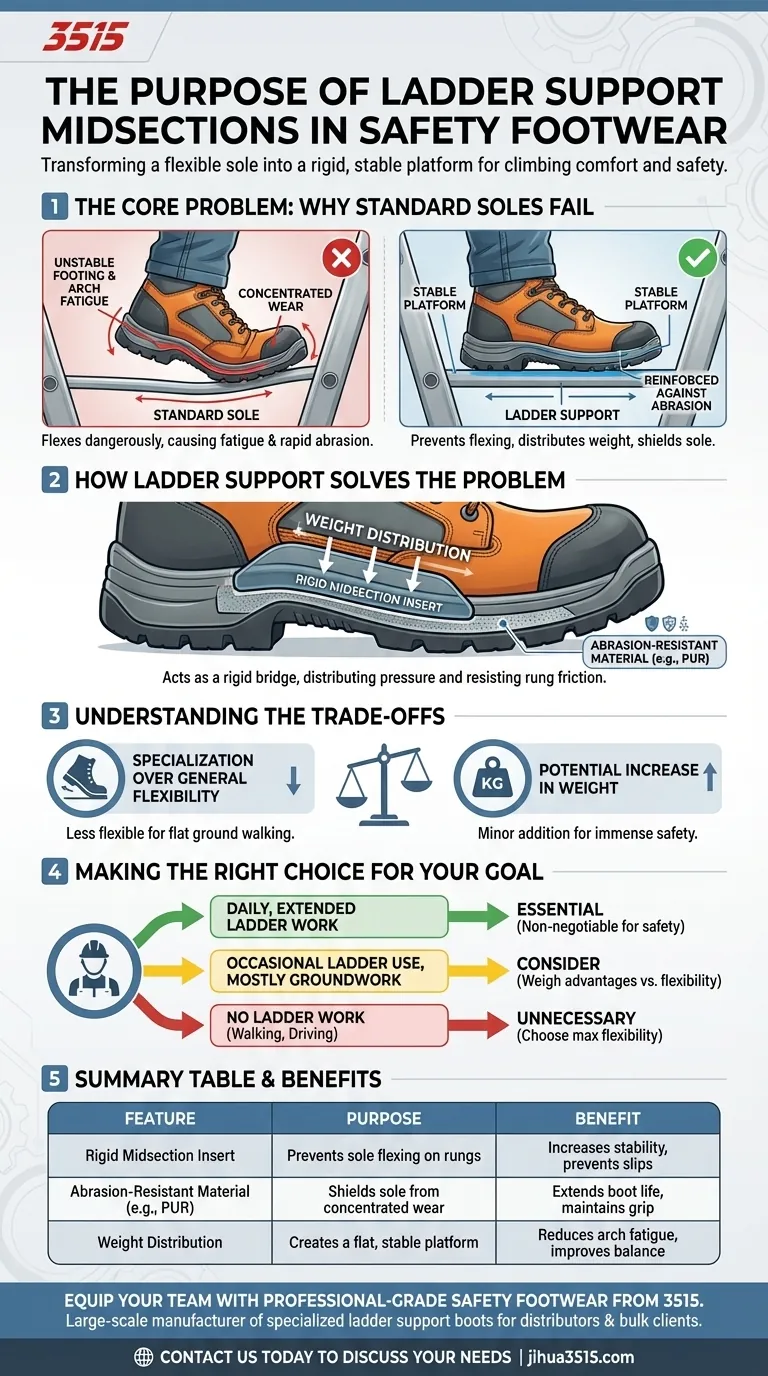
Standing on a ladder rung concentrates your entire body weight onto a very small surface area directly under the arch of your foot. Standard footwear is not designed to handle this specific, high-pressure load.
Unstable Footing and Arch Fatigue
Without a reinforced midsection, the sole of the boot can bend and wrap around the ladder rung. This flexing creates an unstable platform, increasing the risk of a slip or loss of balance.
It also forces the muscles in your arch to work constantly to maintain stability, leading to significant pain and fatigue over time.
Concentrated Wear and Tear
The focused pressure and friction from a metal or fiberglass ladder rung can rapidly abrade a standard boot sole. This concentrated wear can quickly compromise the sole's integrity and wear away its non-slip tread pattern precisely where you need it most.
How Ladder Support Solves the Problem
A dedicated ladder support insert is engineered to counteract these specific forces. It adds critical rigidity and durability to the middle of the boot sole.
Creating a Rigid Bridge for Stability
The support insert acts as a rigid bridge spanning the arch of your foot. This prevents the sole from sagging or flexing when all your weight is on a rung.
This rigidity distributes your weight more evenly and creates a stable, flat surface, mimicking the feeling of standing on a solid floor and dramatically improving your balance.
Reinforcing Against Abrasion
This feature is typically made from a highly durable material, such as a polyurethane (PUR) component. This material is engineered to be exceptionally abrasion-resistant.
It shields the core sole material from being ground down by the ladder rung, preserving the boot's structural integrity and ensuring the non-slip properties remain effective for much longer.
Understanding the Trade-offs
While essential for frequent ladder work, this specialized feature does involve certain design compromises.
Specialization Over General Flexibility
A boot with a rigid ladder support midsection will inherently be less flexible through the arch than one without it. While this is a benefit on a ladder, it can make the boot feel slightly stiffer when walking on flat ground or crouching for long periods.
A Potential Increase in Weight
The addition of a dense, durable insert can add a small amount of weight to the footwear compared to a standard sole design. However, for professionals, this minor increase is a worthwhile trade-off for the immense safety benefit.
Making the Right Choice for Your Goal
Selecting footwear with this feature depends entirely on your daily tasks and the environments you work in.
- If your primary focus is daily, extended work on ladders: A boot with a dedicated ladder support insert is non-negotiable for your safety and comfort.
- If your primary focus is occasional ladder use but mostly groundwork: You may still benefit from this feature, but you should weigh its advantages against the need for maximum walking flexibility.
- If your primary focus is walking, driving, or operating machinery with no ladder work: This feature is unnecessary and you would be better served by footwear designed for maximum flexibility and comfort on flat surfaces.
Ultimately, choosing footwear with ladder support is a critical investment in your stability and safety when working at height.
Summary Table:
| Feature | Purpose | Benefit |
|---|---|---|
| Rigid Midsection Insert | Prevents sole from flexing on ladder rungs | Increases stability and prevents slips |
| Abrasion-Resistant Material (e.g., PUR) | Shields the sole from concentrated wear | Extends boot life and maintains grip |
| Weight Distribution | Creates a flat, stable platform on narrow rungs | Reduces arch fatigue and improves balance |
Ensure your team's safety and comfort on the job with professional-grade safety footwear from 3515.
As a large-scale manufacturer, 3515 produces a comprehensive range of footwear, including boots with specialized ladder support features, for distributors, brand owners, and bulk clients. Our production capabilities encompass all types of safety shoes and boots designed for durability and protection.
Ready to equip your workforce with reliable safety footwear? Contact us today to discuss your specific needs and learn how 3515 can be your trusted manufacturing partner.
Visual Guide
Related Products
- Premium Safety Shoes with Rotating Buckle Safety Sneakers
- Premium Wholesale Tactical Style Safety Shoes Boots with Quick Lacing
- Wholesale Mesh Steel Toe Safety Shoes with Dial Closure Factory Production
- Advanced KPU Athletic Safety Shoe with Steel Toe Cap Anti-Slip Rotary Lacing System
- Heavy-Duty Waterproof Nubuck Safety Boots Safety Shoes for Bulk Supply
People Also Ask
- How do complex outsole tread designs in safety shoes work with coated floors? Master Slip Resistance Engineering
- How Specialized Footwear Impacts Side-Cutting Performance and Injury Risk Assessment
- How do gait analysis algorithms ensure accuracy in footwear? Master Step Length Precision for Boots & Sneakers
- What role do specialized safety shoes play in preventing falls? Engineering Stability in Industrial Environments
- What are the technical advantages of integrating sensors into safety shoes? Achieve Superior Motion Capture Precision

















