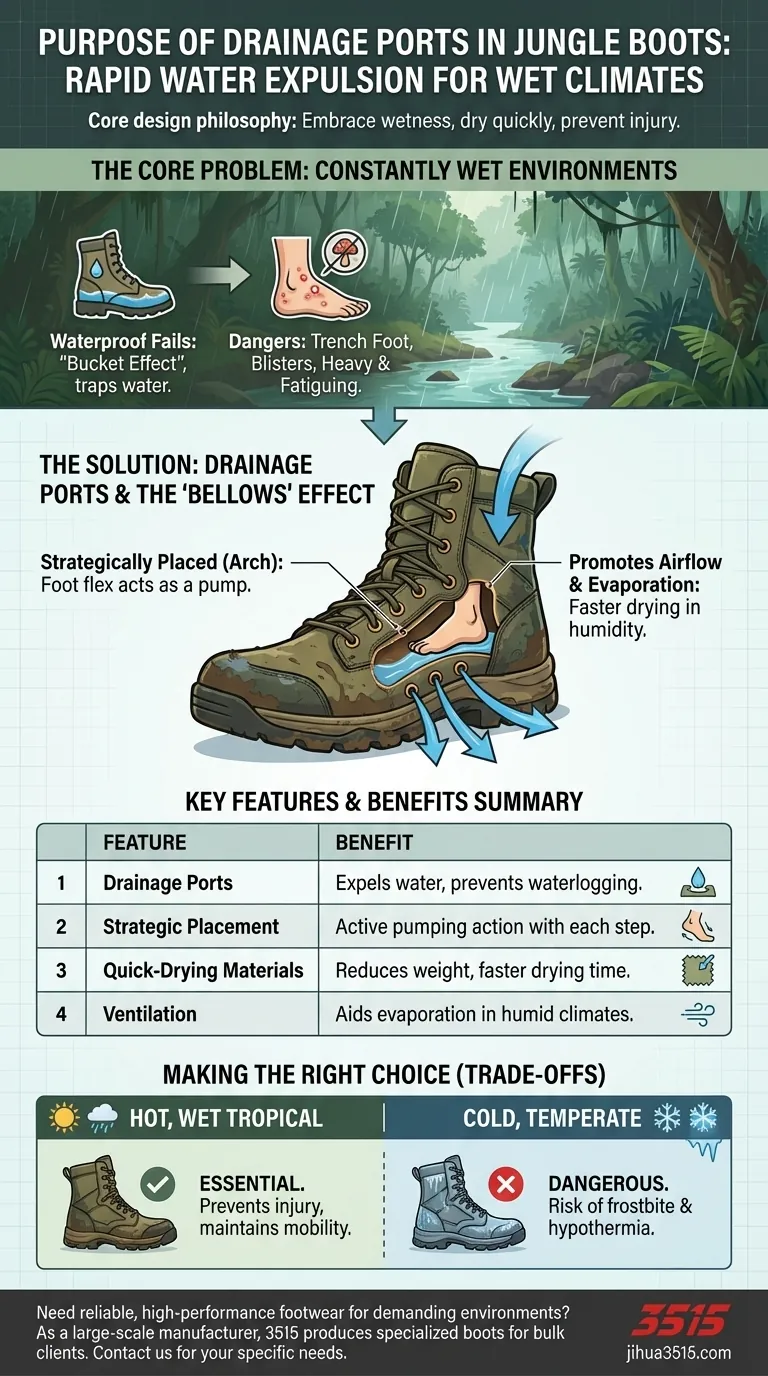
The primary purpose of drainage ports in jungle boots is to allow water that enters the boot to be expelled quickly. These small, often screened or brass-ringed holes are typically located on the inner arch of the boot, enabling water to drain out with each step you take in wet conditions.
The core design philosophy of a jungle boot is not to keep water out, but to accept that it will get in and to dry as quickly as possible. Drainage ports are the most critical feature for achieving this rapid drying.
The Core Problem: A Constantly Wet Environment
To understand the function of drainage ports, you must first understand the environment for which jungle boots were designed. It's a fundamentally different challenge than hiking in a temperate forest.
Why Waterproofing Fails in the Jungle
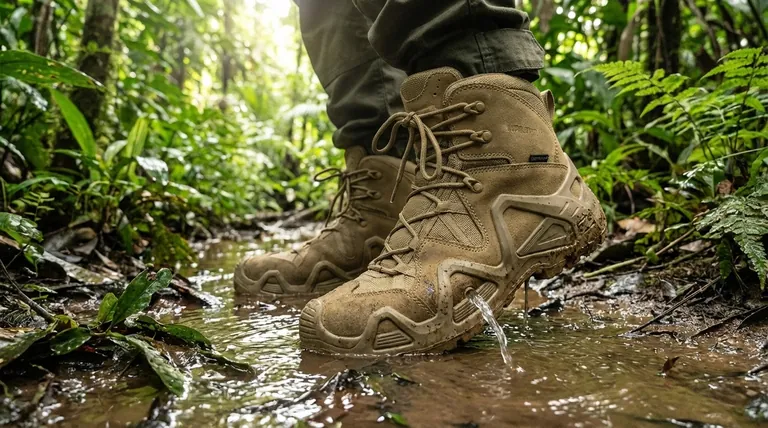
In environments with frequent river crossings, deep mud, and constant, heavy rain, keeping your feet dry is impossible. Water will inevitably pour over the top of any boot.
A traditional waterproof boot, like one with a Gore-Tex liner, becomes a liability in these conditions. Once water gets inside, the waterproof membrane traps it, creating a "bucket effect" that keeps your feet submerged and accelerates skin breakdown.
The Dangers of Waterlogged Feet
When feet remain saturated with water for extended periods, it leads to serious health issues. This includes painful blisters, fungal infections, and debilitating conditions like trench foot.
Furthermore, a boot full of water is significantly heavier, leading to faster fatigue and reduced mobility when it matters most.
How Drainage Ports Create a Solution
The designers of the original jungle boots understood that embracing the wetness was the only viable strategy. The entire boot is built around the principle of rapid drying, not water resistance.
The "Bellows" Effect
Drainage ports are strategically placed on the arch of the boot. As you walk, the natural flexing of your foot acts like a pump or a bellows, actively pushing water out through the ports with each step.
Promoting Airflow and Evaporation
These ports also serve a secondary function of promoting ventilation. This passive airflow is crucial in humid climates, helping the boot's materials and your socks dry much faster once you are on solid ground.
A System, Not a Single Feature
Drainage ports work in conjunction with the boot's other materials, which are typically quick-drying synthetics like nylon and specially treated leather. This complete system is designed to go from fully submerged to damp and functional in the shortest time possible.
Understanding the Trade-offs
This design is highly specialized and comes with compromises that make it unsuitable for other environments.
Water Enters as Easily as It Exits
The most obvious trade-off is that drainage ports are a two-way street. When you step into water, it will enter the boot through the ports just as easily as it exits. This is an intentional design choice, not a flaw.
Not Designed for Cold Weather
Jungle boots are explicitly designed for hot, wet climates. Using a boot with drainage ports in a cold or freezing environment would be dangerous, as the constant ingress of cold water would dramatically increase the risk of frostbite and hypothermia.
Making the Right Choice for Your Environment
Choosing between a boot with drainage ports and a waterproof boot depends entirely on the conditions you expect to face.
- If your primary focus is operating in hot, wet, tropical environments: A boot with drainage ports is essential for preventing foot injuries and maintaining mobility.
- If your primary focus is operating in temperate or cold climates: A waterproof boot is the correct choice to protect your feet from external moisture and maintain critical insulation.
Ultimately, selecting the right footwear requires understanding that no single design can solve every environmental challenge.
Summary Table:
| Feature | Purpose | Benefit |
|---|---|---|
| Drainage Ports | Expel water that enters the boot | Prevents waterlogging and trench foot |
| Strategic Placement (Arch) | Acts as a pump with each step | Actively pushes water out |
| Quick-Drying Materials | Work with ports for rapid drying | Reduces boot weight and fatigue |
| Ventilation | Promotes airflow in humid climates | Aids in faster evaporation |
Need reliable, high-performance footwear for demanding environments?
As a large-scale manufacturer, 3515 produces a comprehensive range of footwear for distributors, brand owners, and bulk clients. Our production capabilities encompass all types of specialized boots, including models designed for rapid drainage and quick drying. We can help you equip your team or customers with the right gear for the mission.
Contact us today to discuss your specific needs and get a quote!
Visual Guide
Related Products
- Durable Military Combat Boots with Water Drainage for Wholesale & OEM
- Durable Waterproof Rain Boots | Custom Manufacturer for Wholesale & Brands
- Factory Direct Wholesale Rain Boots Durable Waterproof & Fully Customizable
- Wholesale Waterproof Tactical Boots Custom Suede & High-Traction Soles
- Durable Spiked Camouflage Boots Wholesale & Factory Production
People Also Ask
- Why must gait validation for military applications be conducted in combat boots? Ensure Data Accuracy for Soldiers
- What are the common types of combat boots? Find the Right Boot for Your Mission
- What factors should be considered when choosing military boots for hiking? Durability vs. Weight for Your Terrain
- What are the key considerations when choosing military boots? Prioritize Compliance, Environment & Fit
- How should the midfoot and heel fit in military boots? Achieve a Snug, Secure Fit for Blister Prevention